
Revision summary
Articles 25 to 28, 15, 16, 27 and 30 frame Indian secularism as liberty plus non-discrimination plus minority schools. Article 25(2) lets the State reform secular aspects of religion. S.R. Bommai made secularism a basic feature of the Constitution. France can learn accommodation, minority education and reform for equality, not hostility to visible faith. India’s communal violence is a caution, not a model to export.
Model answer
Copper italics in this answer — like this — are the key facts. Each one is unpacked in the Facts & figures rail.
Introduction
French laïcité grew from a republican fight to keep the Catholic Church out of the public school and the State. Indian secularism grew from a multi-religious society that needed both freedom of faith and a State able to reform and to protect. France can learn from that positive, equal-distance model without copying India’s communal failures.
Body
Indian constitutional secularism
- Articles 25 to 28 guarantee freedom of conscience and religion, including the right to manage religious affairs, subject to public order, morality, health, and other fundamental rights.
- Article 15 and Article 16 bar religion-based discrimination by the State in public life and public employment; Article 27 bars a tax solely to promote a particular religion.
- Article 30 protects minority educational institutions, which is an accommodation France’s strict school-neutrality model often refuses.
- The State may regulate economic, financial, and secular activity associated with religion (Article 25(2)), which allowed Hindu-law reform and later debates on a Uniform Civil Code under Article 44.
- S.R. Bommai v. Union of India (1994) held that secularism is part of the basic structure; religion cannot be the official basis of State power.
- Indian practice is often called principled distance: the State can help a pilgrimage, run a waqf or a temple board, and still claim not to establish a church.
What France can learn
- France can learn that public peace in a diverse society may need visible religious liberty in schools and streets, not only a ban on signs, as in the 2004 and 2010 French laws on conspicuous symbols and face covering.
- It can learn minority-institution space of the Article 30 type, so religious and linguistic groups educate without being treated as enemies of the Republic.
- It can learn that a secular State may still reform religious personal law in the name of equality, as India did in Hindu law, instead of leaving inequality untouched in the name of non-interference.
- It can learn Bommai’s rule that parties and governments must not make religion the test of citizenship, which is a lesson against both communal majoritarianism and against treating one immigrant faith as a security class.
- It can learn festival accommodation and optional religious instruction in the Indian public culture, which reduces the feeling that the Republic is at war with believers.
What France need not copy
- India has communal riots, politicised personal-law fights, and uneven reform of non-Hindu codes; those are warnings, not exports.
- Kesavananda protects secularism as basic structure; the lesson is constitutional lock-in of equal citizenship, not a licence for vote-bank bargains.
- The way forward for a French reader is principled distance plus gender equality, not either hostile laïcité or uncritical Indian practice.
Flow diagram
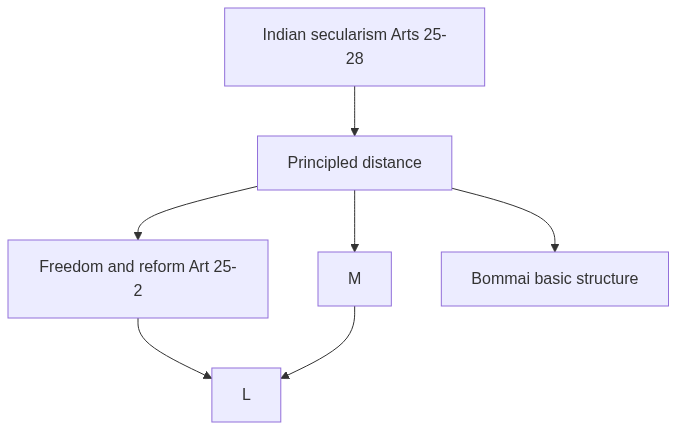
Conclusion
The Indian Constitution treats secularism as equal religious liberty, non-discrimination, and a State that may both reform and accommodate. France can learn that model of principled distance and minority education, while keeping its own republican equality and avoiding India’s communal wounds.
Quick related
Students also ask
-
Whether National Commission for Scheduled Castes (NCSC) can enforce the implementation of constitutional reservation for the Scheduled Castes in the religious minority institutions? Examine.
Next question on this syllabus topic (2018 · Q2). View answer →
-
Is Indian secularism the same as a US wall of separation?
No. India allows principled engagement, reform of religious law, and some public religious presence, while barring an established theocratic State.
-
Did Bommai define secularism only as equal festivals?
No. It treated secularism as a constitutional limit: religion cannot be the official basis of government, and misuse can attract Article 356 review.
Same topic · past papers
UPSC has asked this before
These previous-year questions sit on the same topic. Open one to practise the earlier ask.
More from this topic
Q17 · UPSC Mains 2026 · GS II · 15 marks · Solution
Can the constitutional mandate of rights-based welfare be effectively realised in the context of non-integrated governance and minimal public investment? Examine.
Indian Constitution
Rights-based welfare has a strong constitutional and statutory base, but silos across ministries and levels, low social-sector spending and rationed funds weaken delivery. DBT, mission-mode schemes, ration portability and district convergence help only when funding and local capacity grow with them.
Q1 · UPSC Mains 2026 · GS II · 10 marks · Solution
Right to privacy relating to self-identity is very dear to every human being and well protected under Article 21 of the Constitution. In this context, examine the effect of the amendment in 2026 to the Transgender Persons (Protection of Rights) Act, 2019.
Indian Constitution
• Gender identity is part of dignity, autonomy and privacy under Article 21, as held in NALSA and Puttaswamy. • The 2019 Act already weakened self-identification through the District Magistrate certificate route. • An amendment that adds medical or board scrutiny turns a right into a permission. • Collecting medical history creates data risks and fails the proportionality test when gentler options exist. • Intersex variation and gender identity are different and should not sit under one test. • Remedies are weak without strong penalties, reservation and working institutions. • A fair design keeps self-declaration, confidential records, time limits and community participation.
Q3 · UPSC Mains 2025 · GS II · 10 marks · Solution
Compare and contrast the President's power to pardon in India and in the USA. Are there any limits to it in both the countries? What are 'preemptive pardons'?
Indian Constitution
Article 72 (and 161) are exercised on aid and advice; Maru Ram, Kehar Singh, Epuru Sudhakar and Shatrughan Chauhan frame Indian limits and delay. The US Article II pardon is personal, federal-only, and barred in impeachment. Judicial review is stronger in India; political cost is the main US brake. A preemptive pardon forgives before conviction, as in Ford–Nixon. India has no working doctrine of preemptive pardon for the untried.