
Revision summary
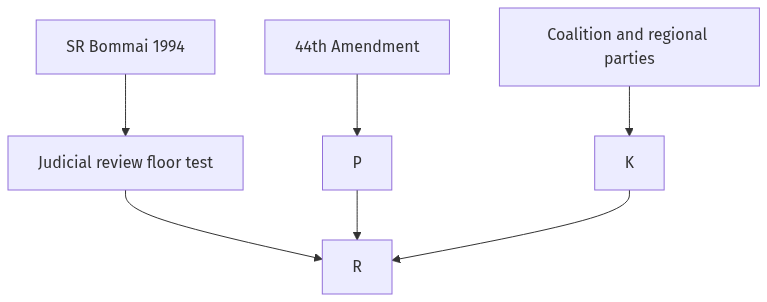
Article 356 use declined after the mid-1990s for legal and political reasons together. S.R. Bommai (1994) made the proclamation justiciable and centred the floor test. The 44th Amendment had already limited duration and required parliamentary approval. Sarkaria and Punchhi recommended last-resort use; courts enforced that idea. Coalition Union governments and regional parties raised the political price of dismissal. The Article remains; casual partisan use became harder.
Model answer
Copper italics in this answer — like this — are the key facts. Each one is unpacked in the Facts & figures rail.
Introduction
Article 356 allows the President to assume a State’s government when the constitutional machinery has failed. After the mid-1990s its use fell because the Supreme Court in S.R. Bommai (1994) legalised limits, and because coalition and later competitive federal politics raised the political cost of dismissal.
Body
The legal factors
- S.R. Bommai v. Union of India (1994) held that a Presidential proclamation under Article 356 is justiciable; the Union must have relevant material, and the Court can strike down a mala fide or irrelevant proclamation.
- Bommai made the floor test the primary proof of majority; the Governor’s report cannot replace a vote in the Assembly when the House can meet.
- Secularism was held to be a basic feature, so a State government that undermines it can still invite Article 356, but ordinary political instability cannot.
- The Constitution (Forty-fourth Amendment) Act, 1978, had already required the proclamation to be laid before Parliament, limited the first period, and barred dissolution of the Assembly until Parliament approves; Bommai enforced the spirit of those curbs.
- Later cases — Rameshwar Prasad (Bihar, 2006) and the Arunachal and Uttarakhand episodes — showed that courts will restore a government when the Governor or the Union rushes dissolution or floor arithmetic.
- Sarkaria Commission (1988) and later the Punchhi Commission on Centre–State relations had recommended rare, last-resort use; Bommai turned that advice into judicial rule.
The political factors
- Hung verdicts and coalition Union governments from 1989 through the 1990s made every State party a potential partner; dismissing a State government risked losing parliamentary support in New Delhi.
- The rise of strong regional parties meant that Article 356 was read as an attack on a whole linguistic or regional electorate, not only on a Chief Minister.
- Television, a louder Rajya Sabha, and Inter-State Council politics after the 1990s made a midnight dismissal nationally expensive.
- Even majority Union governments after 2014 still face judicial review, Election Commission schedules, and the need for State allies on GST and other federal files, so the old single-party habit of routine President’s Rule is harder to revive.
- Hung Assemblies now more often produce floor tests, Governor’s invitations, and Speaker fights rather than an immediate Article 356, which is a political substitute, not always a cleaner one.
Residual use
- Article 356 still appears in genuine breakdown, hung Houses after large defections, or law-and-order collapse.
- The reduction is therefore frequency and casual use, not repeal of the Article.
Flow diagram
Conclusion
Legal limits after Bommai — justiciability, relevant material, and the floor test — made casual Article 356 legally dangerous. Coalition federalism and strong regional parties made it politically expensive. Together they explain the fall in frequency since the mid-1990s.
Quick related
Students also ask
-
Discuss the role of the Vice -Presidents of India as the chairman of the Rajyasabha.
Next question on this syllabus topic (2022 · Q4). View answer →
-
Did Bommai abolish Article 356?
No. It subjected the proclamation to judicial review and to the floor test. The Union can still use the Article on relevant material.
-
Why did coalitions matter?
A Union that needs regional parties in the Lok Sabha cannot dismiss those parties’ State governments without losing its own majority politics.
Same topic · past papers
UPSC has asked this before
These previous-year questions sit on the same topic. Open one to practise the earlier ask.
More from this topic
Q17 · UPSC Mains 2026 · GS II · 15 marks · Solution
Can the constitutional mandate of rights-based welfare be effectively realised in the context of non-integrated governance and minimal public investment? Examine.
Indian Constitution
• India’s constitutional welfare mandate struggles due to fragmented administrative silos and low public spending. • Siloed departmental functioning causes duplication, exclusion errors, and severe frontline administrative overload. • Suboptimal public investment in health and education forces heavy reliance on profit-driven private providers. • Fiscal federalism pressures leave financially weaker states unable to co-finance central welfare mandates properly. • Overcoming these bottlenecks requires a whole-of-government approach using unified digital platforms for convergence. • Progressively increasing public expenditure on core social infrastructure is vital to meet statutory entitlements. • Strengthening social audits and grievance redressal ensures legal rights translate into tangible grassroots outcomes.
Q1 · UPSC Mains 2026 · GS II · 10 marks · Solution
Right to privacy relating to self-identity is very dear to every human being and well protected under Article 21 of the Constitution. In this context, examine the effect of the amendment in 2026 to the Transgender Persons (Protection of Rights) Act, 2019.
Indian Constitution
• Article 21 protects personal autonomy, bodily integrity, and the right to self-identity as core components of human dignity. • The Supreme Court's *K.S. Puttaswamy* judgment firmly established privacy as a fundamental right encompassing personal choices. • The 2026 amendment to the Transgender Persons Act, 2019, aims to align statutory laws with evolving constitutional jurisprudence. • Key reforms include decentralising identity certification to eliminate bureaucratic delays and arbitrary state interference. • The amendment also strengthens punitive and remedial mechanisms against social and institutional discrimination. • Persistent challenges remain, notably bridging the gap between legal recognition and deep-rooted societal stigma. • True realization of these rights requires continuous administrative sensitization and inclusive access to education, healthcare, and jobs.
Q3 · UPSC Mains 2025 · GS II · 10 marks · Solution
Compare and contrast the President's power to pardon in India and in the USA. Are there any limits to it in both the countries? What are 'preemptive pardons'?
Indian Constitution
Article 72 (and 161) are exercised on aid and advice; Maru Ram, Kehar Singh, Epuru Sudhakar and Shatrughan Chauhan frame Indian limits and delay. The US Article II pardon is personal, federal-only, and barred in impeachment. Judicial review is stronger in India; political cost is the main US brake. A preemptive pardon forgives before conviction, as in Ford–Nixon. India has no working doctrine of preemptive pardon for the untried.