
Revision summary
Hindu custom treated marriage as a samskara; modern statutes treat it as a civil bond that can end in divorce. Registration, later marriage, and some love and inter-caste unions weaken a purely sacred monopoly. Most unions remain ritualised and endogamous, and divorce is still socially costly. The fair view is loss of exclusive value, not disappearance. Rights inside marriage matter more than declaring the sacrament dead.
Model answer
Copper italics in this answer — like this — are the key facts. Each one is unpacked in the Facts & figures rail.
Introduction
In much of Hindu and allied custom, marriage was taught as a samskara, a sacrament, not only a contract. Modern India has added statute, divorce, choice, and delayed marriage, so the sacrament is under pressure, but it has not vanished from ritual or family life.
Body
Signs that the sacrament is losing exclusive value
- The Hindu Marriage Act, 1955, and the Special Marriage Act, 1954, treat marriage as a civil status that can be registered, and they allow divorce on listed grounds.
- Live-in recognition in Supreme Court rulings, later marriage age in NFHS data, and a small but rising share of love and inter-caste unions show that consent and law now compete with kanyadaan as the only meaning.
- Urban work, women’s education, and the Special Marriage Act route weaken the idea that marriage is only a sacred, indissoluble, family-arranged duty.
- Matrimonial sites, court marriage, and public debate on marital rape and domestic violence shift talk from purity to rights.
Signs that the sacrament still holds
- A large majority of marriages are still arranged within caste and religion, with saptapadi, nikah, or church rites as the public core.
- Divorce rates remain far lower than in many industrial societies, and social stigma around separation is still strong, especially for women.
- Endogamy, dowry displays, and family honour continue to police who may marry, which is a sacramental-community logic, not a pure contract logic.
- Personal laws still differ by religion, so the state has not replaced the sacred with one civil code in daily practice.
A balanced view
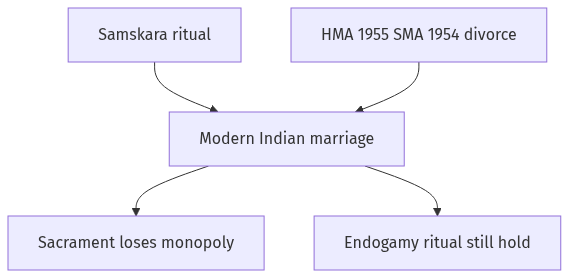
- Marriage in modern India is becoming a mixed institution: statute and choice at one end, ritual and caste at the other.
- The sacrament is losing monopoly, not all value, which is why the paper’s idea of “loosing” is partly true and partly overstated.
Way forward
- Register every marriage, enforce the Prohibition of Child Marriage Act, 2006, and the Protection of Women from Domestic Violence Act, 2005, without mocking ritual that couples still want.
- Expand the Special Marriage Act as a real option so sacrament and contract can coexist without coercion.
Flow diagram
Conclusion
Sacramental marriage is losing exclusive authority because law, divorce, and choice now share the field. It still organises most Indian weddings through ritual and endogamy, so the task is equal rights inside marriage, not a forced funeral of ritual.
Quick related
Students also ask
-
Child cuddling is now being replaced by mobile phones. Discuss its impact on the socialization of children.
Next question on this syllabus topic (2023 · Q10). View answer →
-
Has Indian marriage become only a contract?
Law allows contract features such as registration and divorce. Social practice still uses sacred rites and caste gates.
-
Does a low divorce rate prove the sacrament is intact?
It proves exit is hard. Stigma and economics can trap people even when the sacred meaning is already thin.
Same topic · past papers
UPSC has asked this before
These previous-year questions sit on the same topic. Open one to practise the earlier ask.
-
2026 · Q10 · GS I · 10 marks
Do you think digital technology promotes social empowerment? Explain with examples. -
2025 · Q10 · GS I · 10 marks
Do you think that globalization results in only an aggressive consumer culture? Justify your answer. -
2023 · Q11 · GS I · 15 marks
What are the main features of Vedic society and religion? Do you think some of the features are still prevailing in Indian society?
More from this topic
Q19 · UPSC Mains 2026 · GS I · 15 marks · Solution
Critically examine the challenges of demographic transition in contemporary India.
Indian Society and Diversity
India's demographic transition presents a complex picture of falling fertility rates and a rising working-age population, yet regional divergences undermine uniform gains. While southern and western states face rapid population ageing, northern and central states grapple with youth bulges that risk becoming liabilities without robust human capital investments. Critical bottlenecks include persistent gender imbalances, under-employment, and inadequate skilling infrastructure. Harnessing the demographic dividend requires targeted policy interventions in health, education, and employment generation rather than relying on population numbers alone. Ultimately, sustainable growth depends on transforming quantity into quality through inclusive regional development.
Q9 · UPSC Mains 2026 · GS I · 10 marks · Solution
How do you understand disability? Substantiate the need for inclusive policy framework in India in this regard.
Indian Society and Diversity
• Shifts understanding of disability from an individual medical deficit to a social construct caused by environmental and attitudinal barriers. • Adopts a rights-based paradigm that views persons with disabilities as active citizens entitled to dignity and equality rather than charity. • Fulfils constitutional mandates, notably Article 41, which directs the State to secure rights to work, education, and public assistance. • Addresses the demographic reality of over 2.68 crore disabled individuals in India as per Census 2011 through targeted resource allocation. • Overcomes multisectoral physical, educational, and employment barriers by enforcing the Rights of Persons with Disabilities Act, 2016. • Promotes universal design principles to ensure substantive equality, eliminate social exclusion, and drive inclusive national growth.
Q20 · UPSC Mains 2025 · GS I · 15 marks · Solution
Does tribal development in India centre around two axes, those of displacement and of rehabilitation? Give your opinion.
Indian Society and Diversity
Dams, mines and some conservation projects have made displacement a central tribal experience. Rehabilitation has often been a plot or cash that did not restore forest-based life. Those two axes therefore dominate the political meaning of tribal development. They are not sufficient: education, health, forest rights and PESA voice are development without a bulldozer. Opinion: treat displacement as a last resort with just rehab, and do not reduce all Adivasi policy to oustee management. Secure habitat plus citizenship is the fuller centre.