
Revision summary
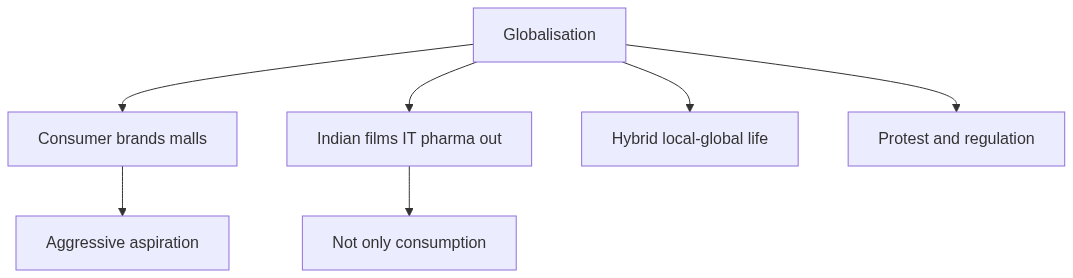
Global media and retail have spread a loud culture of brands, malls and credit. That culture can be aggressive in targeting desire and crowding out other measures of a good life. The same global pipes carry Indian production, hybrid customs, rights talk and political backlash. The poor often meet globalisation as cheap goods and weak jobs, not as lifestyle consumption. So consumer culture is a major result, not the only result. A fair answer justifies the “not only” claim with producer India and hybrid life.
Model answer
Copper italics in this answer — like this — are the key facts. Each one is unpacked in the Facts & figures rail.
Introduction
Globalisation moves goods, images, and money across borders faster than any earlier century. One loud result is the mall, the phone brand, and the wish to live like an advertisement. That consumer culture can be aggressive. The question is whether that is all globalisation does. It is not.
Body
Aggressive consumer culture
- Media reach: Satellite television and then smartphones put the same brand in metro and small town.
- Retail and EMI: FDI, e-commerce, and credit turn aspiration into a monthly payment.
- Mall culture: Shopping spaces become public leisure and identity stages.
- Sale calendars: Festivals are remade as shopping seasons.
- Fast food wave: Global menus are part of the same consumption push.
- Craft pressure: Global looks can pull youth away from local skill and thrift.
- Child targeting: Advertising treats identity and desire as market segments.
- Hollow risk: Thrift, public space, and non-brand measures of a good life can shrink.
Why “only” is wrong
- Producer India: Film, IT, pharma, and yoga travel outward, not only brands inward.
- Hybrid life: Jeans with a caste wedding and English with a regional app are ordinary facts.
- Rights talk: The same networks carry women’s work and Dalit assertion.
- Village phone use: A handset may carry MSP news or a bhajan, not only shopping apps.
- Political backlash: Farmers’ movements and data-localisation law are products of the same age.
- Swadeshi politics: Resistance to the global market would not look like this without that shock.
- Inequality face: Capital can leave; a contract worker cannot.
- Who consumes loudly: Lifestyle consumer culture is loudest among those who can pay.
- Poor meet globalisation: Many meet cheap goods and insecure jobs, not lifestyle blogs.
- Exam verdict: Globalisation strongly feeds aggressive consumption, especially in cities, but that is a major face, not the only face.
Flow diagram
Conclusion
Globalisation does push a loud consumer culture of brands and EMI lives. It also moves work, protest, hybrid identity, and Indian cultural exports. Aggressive consumption is a major face. It is not the only face.
Quick related
Students also ask
-
Mahatma Jotirao Phule's writings and efforts of social reforms touched issues of almost all subaltern classes. Discuss.
Next question on this syllabus topic (2025 · Q11). View answer →
-
Is refusing brands a refusal of globalisation?
Not wholly. A person can use a global tool, such as a phone, and still reject a full consumer identity.
-
Did pre-global India lack consumption?
No. It lacked this speed, this advertising density, and this link to world credit and supply chains.
Same topic · past papers
UPSC has asked this before
These previous-year questions sit on the same topic. Open one to practise the earlier ask.
-
2024 · Q3 · GS I · 10 marks
What were the events that led to the Quit India Movement? Point out its results.
More from this topic
Q11 · UPSC Mains 2026 · GS I · 15 marks · Solution
Vijayanagara architecture exemplifies the amalgamation of past traditions with contemporary practices. Elucidate with examples.
Indian Heritage and Culture
• The Vijayanagara architectural style (14th–17th centuries) brilliantly synthesized classical Dravidian traditions with contemporary Deccan innovations. • It preserved grand spatial layouts, towering gopurams, and enclosed prakaras inspired by earlier Chola and Pandya idioms. • Sacred centers maintained canonical sanctum alignments while expanding peripheral structures to encourage greater public participation. • Secular buildings, such as the Lotus Mahal and Elephant Stables, integrated Islamic arched vaults and domes. • Builders utilized locally available hard granite, shifting ornamentation techniques toward bold, deep-relief stone carving. • Innovative structural typologies included multi-shafted composite pillars featuring rearing yalis, horse riders, and hanging brackets. • The Vittalaswami Temple at Hampi showcased pioneering acoustic engineering through famous resonant musical pillars.
Q1 · UPSC Mains 2026 · GS I · 10 marks · Solution
Analyze the importance of Ashokan inscriptions for reconstructing Mauryan history.
Indian Heritage and Culture
Ashokan inscriptions serve as the bedrock for reconstructing Mauryan history by offering authentic, contemporaneous evidence directly from the emperor. Written primarily in Brahmi, Kharosthi, Aramaic, and Greek scripts, they illuminate Ashoka's administrative reach, socio-religious policies, and the moral framework of Dhamma. Distributed across the Indian subcontinent and beyond, these edicts document spatial boundaries, diplomatic ties with Hellenistic kingdoms, and the socio-economic milieu. They bridge the gap between literary accounts and archaeological finds, providing an invaluable indigenous chronology.
Q15 · UPSC Mains 2025 · GS I · 15 marks · Solution
How can Artificial Intelligence (AI) and drones be effectively used along with GIS and RS techniques in locational and areal planning?
Indian Heritage and Culture
Remote sensing supplies pictures of land and water; GIS stores them with administrative boundaries. Drones add cheap, repeatable local maps for disasters, utilities and village layouts. Artificial intelligence classifies pixels and can forecast flood, heat or sprawl on that GIS base. Indian platforms such as Bhuvan and Gati Shakti already try to combine these tools. Planning still needs ground checks and a public purpose, or the map only watches the poor. The four tools are a chain: locate, refresh, read, then choose the public use.