
Revision summary
Early Vedic society was pastoral and kin-based; later Vedic society was agrarian and more ranked by varna. Religion moved from nature hymns and rita to priestly yajna and then Upanishadic enquiry. Gotra, samskara, fire rites, cow reverence, and dharma talk still mark much Hindu social life. Article 17, urban work, and bhakti mean birth-rank is no longer the whole of society. The fair answer is yes, some features prevail, with clear constitutional limits.
Model answer
Copper italics in this answer — like this — are the key facts. Each one is unpacked in the Facts & figures rail.
Introduction
Vedic society and religion, from the Rig Veda to the later Brahmanas and Upanishads, were built around cattle and then plough, varna rank, and sacrifice. Several of those features still organise Indian life, but the Constitution, cities, and bhakti have also changed them.
Body
Vedic society
- Early Vedic life was pastoral and kin-based, with jana, vis, and assemblies such as sabha and samiti around a rajan whose gifts were cattle and horses.
- Later Vedic society, in the Ganga–Yamuna belt, became more agrarian, used iron, and ranked people more firmly as Brahmana, Kshatriya, Vaishya, and Shudra.
- The household grew more patriarchal; gotra, later ashrama ideas, and a narrower public role for women appear more clearly in later texts.
- Bali and other dues, land grants to priests, and large royal rites such as rajasuya and ashvamedha tied surplus to king and priest.
Vedic religion
- Early hymns praise nature deities such as Indra, Agni, Varuna, and Soma, and they treat rita as the order of the world.
- Sacrifice (yajna) with fire, priestly recitation, and gifts was the main public religion of the later Vedic age.
- The Upanishads shifted some enquiry toward atman and brahman, which later fed Vedanta, while karma and samsara became wider teaching.
- Sacred speech, the cow as wealth, and ancestor rites sat beside this public cult.
Features still prevailing
- Varna-jati rank, gotra exogamy, and marriage as a samskara still structure a large share of Indian kinship, even after Article 17 and the Hindu Marriage Act, 1955.
- Fire ritual, Sanskrit liturgy, shraddha, and the authority of the Brahmana at life-cycle rites remain ordinary in many Hindu homes.
- Cow reverence, vegetarian ideals in some castes, and the language of dharma still enter politics and diet.
- Guru-shishya respect, pilgrimage, and festival calendars keep a Vedic and later Puranic mix alive in public culture.
What has not simply continued
- Urban work, the Constitution, reservations, and women’s legal rights break the later Vedic idea that birth must fix occupation and speech forever.
- Bhakti, Islam, Sikhism, and reform movements already changed Vedic sacrifice long before 1950.
- Therefore the living features are kinship, ritual, and dharma talk, not the full Vedic political economy of yajna-kings.
Way forward
- Teach Vedic history as change from pastoral hymn to agrarian rank, so living custom is not mistaken for an unchanged golden age.
- Use Article 15 and 17 against untouchability while leaving personal faith in rites that do not deny equality.
Flow diagram
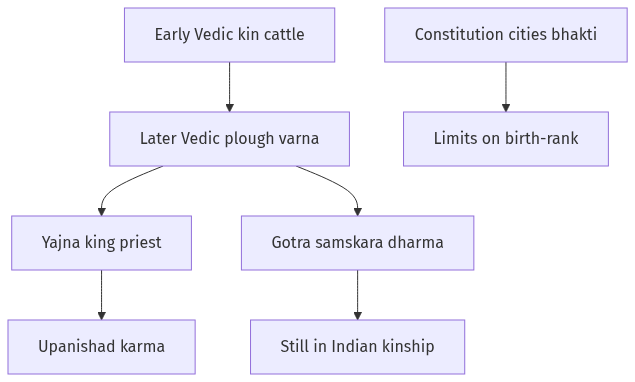
Conclusion
Vedic society and religion were kin, varna, yajna, and later Upanishadic thought on a monsoon agrarian map. Many kinship and ritual features still prevail, but law and social movements have broken the claim that birth must rule work and dignity.
Quick related
Students also ask
-
How will you explain the medieval Indian temple sculptures represent the social life of those days?
Next question on this syllabus topic (2022 · Q1). View answer →
-
Is Indian society still Vedic?
Parts of kinship and ritual are. The economy, the vote, and equal citizenship are not Vedic institutions.
-
Did the Upanishads end sacrifice?
They added a path of knowledge. Household and royal ritual continued beside them.
Same topic · past papers
UPSC has asked this before
These previous-year questions sit on the same topic. Open one to practise the earlier ask.
-
2022 · Q18 · GS I · 15 marks
Analyze the salience of 'sect' in Indian society vis-a-vis caste, region and religion.
More from this topic
Q11 · UPSC Mains 2026 · GS I · 15 marks · Solution
Vijayanagara architecture exemplifies the amalgamation of past traditions with contemporary practices. Elucidate with examples.
Indian Heritage and Culture
• The Vijayanagara architectural style (14th–17th centuries) brilliantly synthesized classical Dravidian traditions with contemporary Deccan innovations. • It preserved grand spatial layouts, towering gopurams, and enclosed prakaras inspired by earlier Chola and Pandya idioms. • Sacred centers maintained canonical sanctum alignments while expanding peripheral structures to encourage greater public participation. • Secular buildings, such as the Lotus Mahal and Elephant Stables, integrated Islamic arched vaults and domes. • Builders utilized locally available hard granite, shifting ornamentation techniques toward bold, deep-relief stone carving. • Innovative structural typologies included multi-shafted composite pillars featuring rearing yalis, horse riders, and hanging brackets. • The Vittalaswami Temple at Hampi showcased pioneering acoustic engineering through famous resonant musical pillars.
Q1 · UPSC Mains 2026 · GS I · 10 marks · Solution
Analyze the importance of Ashokan inscriptions for reconstructing Mauryan history.
Indian Heritage and Culture
Ashokan inscriptions serve as the bedrock for reconstructing Mauryan history by offering authentic, contemporaneous evidence directly from the emperor. Written primarily in Brahmi, Kharosthi, Aramaic, and Greek scripts, they illuminate Ashoka's administrative reach, socio-religious policies, and the moral framework of Dhamma. Distributed across the Indian subcontinent and beyond, these edicts document spatial boundaries, diplomatic ties with Hellenistic kingdoms, and the socio-economic milieu. They bridge the gap between literary accounts and archaeological finds, providing an invaluable indigenous chronology.
Q15 · UPSC Mains 2025 · GS I · 15 marks · Solution
How can Artificial Intelligence (AI) and drones be effectively used along with GIS and RS techniques in locational and areal planning?
Indian Heritage and Culture
Remote sensing supplies pictures of land and water; GIS stores them with administrative boundaries. Drones add cheap, repeatable local maps for disasters, utilities and village layouts. Artificial intelligence classifies pixels and can forecast flood, heat or sprawl on that GIS base. Indian platforms such as Bhuvan and Gati Shakti already try to combine these tools. Planning still needs ground checks and a public purpose, or the map only watches the poor. The four tools are a chain: locate, refresh, read, then choose the public use.