
Revision summary
Digital technology acts as a double-edged sword for social empowerment, bridging gaps in marginalized communities while simultaneously creating new forms of exclusion. On one hand, e-governance, financial inclusion via Jan Dhan, and digital literacy schemes enable grassroots mobility and amplify subaltern voices. On the other hand, the digital divide, algorithmic bias, and cyber-exclusion exacerbate existing socio-economic hierarchies. Therefore, structural interventions alongside technological deployment are necessary to ensure inclusive empowerment.
Model answer
Copper italics in this answer — like this — are the key facts. Each one is unpacked in the Facts & figures rail.
Introduction
Digital technology has fundamentally altered the architecture of social interaction, serving as both an accelerator of equity and a magnifier of structural disparities. While connectivity democratizes access to information and state entitlements, systemic barriers often restrict its transformative dividends to privileged cohorts.
Body
Democratising Access and Inclusion
Digital platforms have altered the delivery of welfare, enabling direct citizen-state engagement without intermediaries.
- Peg (Jan Dhan-Aadhaar-Mobile Trinity): Direct Benefit Transfers (DBT) plug leakages and financially empower women and rural households by ensuring direct control over financial resources.
- Peg (EdTech and Gig Economy): Internet access allows marginalized youth to access skill development and alternative livelihoods, bypassing traditional spatial barriers.
Deepening the Digital Divide
Unequal distribution of digital infrastructure replicates and intensifies pre-existing social stratifications.
- Peg (Gender and Rural Disparity): The GSM Association gender gap report highlights lower smartphone ownership among women, limiting the reach of digital empowerment initiatives.
- Peg (Caste and Class Exclusion): Lack of digital literacy among historically disadvantaged groups restricts their navigation of e-governance portals, creating a new class of digital subalterns.
Amplifying Marginalised Voices
Social media platforms provide counter-public spheres for groups historically excluded from mainstream media discourse.
- Peg (Mobilisation and Rights): Marginalised communities leverage digital networks to articulate demands, challenge social hegemony, and demand accountability from the state.
Flow diagram
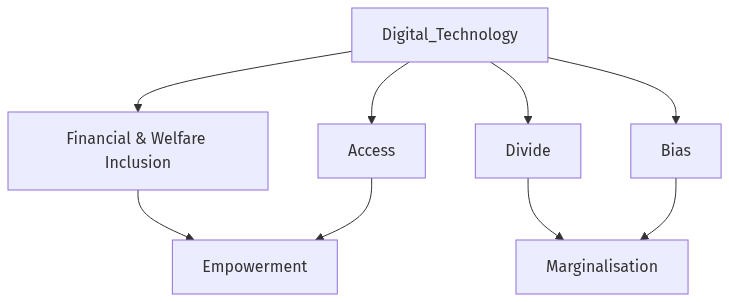
Conclusion
Digital technology inherently possesses a dual character; its capacity to empower is contingent upon equitable physical access and capability building. True social empowerment requires moving beyond mere connectivity to foster digital justice and inclusive policy design.
Quick related
Students also ask
-
Intercaste marriages between castes which have socio-economic parity have increased, to some extent, but this is less true of interreligious marriages. Discuss.
Next question on this syllabus topic (2024 · Q9). View answer →
-
How does digital technology promote social empowerment in UPSC GS1?
It promotes empowerment by enhancing financial inclusion through JAM trinity, improving access to education, and providing platforms for marginalized voices to mobilize.
-
What are the challenges of digital empowerment discussed in mains?
Key challenges include the gender digital divide, rural-urban infrastructure disparities, lack of digital literacy, and algorithmic biases that can reinforce social exclusion.
Same topic · past papers
UPSC has asked this before
These previous-year questions sit on the same topic. Open one to practise the earlier ask.
More from this topic
Q8 · UPSC Mains 2026 · GS I · 10 marks · Solution
Unity in diversity remains the defining feature of Indian society despite the challenges from communalism and regionalism. Comment.
Social Empowerment, Communalism and Secularism
India's civilizational ethos of unity in diversity persists despite structural pressures from communalism and regionalism. The answer analyses how historical syncretism and constitutional pluralism absorb societal friction. Communal polarization threatens the secular fabric through identity politics and majoritarianism. Regional aspirations, while occasionally manifesting as divisive sub-nationalism, often reflect genuine developmental imbalances. The conclusion highlights constitutionalism and inclusive governance as the anchors for reinforcing national cohesion.
Q9 · UPSC Mains 2024 · GS I · 10 marks · Solution
Intercaste marriages between castes which have socio-economic parity have increased, to some extent, but this is less true of interreligious marriages. Discuss.
Social Empowerment, Communalism and Secularism
Intercaste marriage has increased a little where education, income and urban life already match. The Hindu Marriage Act does not bar intercaste unions. The Special Marriage Act offers a civil path. The rise is selective and still a minority practice. Caste violence has not vanished. Interreligious marriage is rarer because personal law, conversion fears and honour politics raise the cost. Class can sometimes buy a caste exception. It rarely buys a religious exception in today’s climate. Constitutional choice of partner exists. Social enforcement is still family and community.
Q20 · UPSC Mains 2023 · GS I · 15 marks · Solution
Discuss the impact of post-liberal economy on ethnic identity and communalism.
Social Empowerment, Communalism and Secularism
After 1991, markets, private jobs, and mass media grew together. Ethnic claims for language, tribe, and new states continued inside that growth. Communal mobilisation used television, rumour, and later social media. Riots and polarising politics showed that GDP does not cancel religious conflict. The market can mix people at work and still sell identity at home and at the vote.