
Revision summary
Forensic anthropology applies skeletal biology and archaeological recovery to medico-legal problems. Sex, age, stature and population affinity form a probabilistic biological profile. Trauma must be separated from taphonomic damage. Dental records, implants and STR DNA can confirm identity. Clyde Snow and the Argentine team show its human-rights role. Indian cases require local standards, chain of custody, dignity and explicit error ranges.
Model answer
Copper italics in this answer — like this — are the key facts. Each one is unpacked in the Facts & figures rail.
Introduction
Forensic anthropology applies biological anthropology and archaeology to human remains in legal and humanitarian contexts. It does not merely 'identify a skeleton': it recovers context, builds a biological profile, interprets post-mortem history and assists identification.
Body
Applications
Scene recovery: Archaeological mapping, controlled excavation and chain of custody establish whether remains are human, their minimum number, position and association. William Bass's Anthropology Research Facility helped make decomposition and taphonomy experimentally testable.
Biological profile: Pelvic and cranial traits estimate sex; pubic symphysis, auricular surface, epiphyseal union and teeth estimate age; long-bone equations estimate stature. Metric and morphoscopic ancestry estimates are probabilistic reference-sample affinities, not biological race labels. T. Dale Stewart and Wilton Krogman systematised much of this osteology.
Individualisation: Dental records, healed fractures, implants and radiographs can identify. Autosomal STRs provide stronger confirmation; mtDNA assists with hair shafts or degraded bone. Alec Jeffreys's DNA profiling transformed personal identification. Facial approximation may generate leads but is not positive identification.
Trauma and cause-related evidence: Perimortem blunt, sharp and firearm trauma may be distinguished from post-mortem breakage. Taphonomy analyses burning, weathering, carnivore damage, burial and post-mortem interval. Cause and manner of death remain the medical examiner's legal conclusions.
Mass disaster and human rights: Disaster Victim Identification combines anthropology, odontology, fingerprints and DNA after crashes, floods or tsunamis. Clyde Snow and the Argentine Forensic Anthropology Team documented the disappeared, showing how skeletons can test state narratives. In India, unidentified railway deaths, disaster recovery and commingled remains are practical fields; local reference data are needed because imported equations may misclassify Indian populations.
Error ranges, observer variation, consent, family dignity, repatriation and secure genetic data are method, not afterthought.
Flow diagram
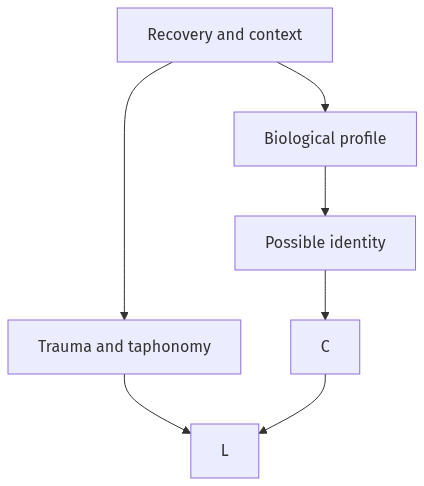
Conclusion
- Forensic anthropology is strongest as a team science: archaeology preserves context, osteology narrows identity, trauma and taphonomy reconstruct events, and DNA or dental records may confirm a name. Its conclusions should be transparent probabilities, not racial certainty.
Quick related
Students also ask
-
Discuss various methods of personal identification based on skeletal remains.
Next question on this syllabus topic (2023 · Q4(b)). View answer →
-
Can a skull determine caste or exact ethnicity?
No. Skeletal methods estimate broad affinities with reference-sample error; caste is a social identity and cannot be read from one skull.
-
Does the forensic anthropologist decide cause of death?
The anthropologist documents skeletal evidence; the authorised forensic pathologist or medical examiner reaches the formal conclusion.
Same topic · past papers
UPSC has asked this before
These previous-year questions sit on the same topic. Open one to practise the earlier ask.
-
2016 · Q5(e) · Anthropology GS 1 · 10 marks
Forensic Anthropology. -
2026 · Q3(a) · Anthropology GS 1 · 20 marks
How do the concepts of power, authority, legitimacy and social control change with changing political organization? Discuss in detail giving suitable examples -
2026 · Q3(c) · Anthropology GS 1 · 15 marks
Numerical chromosomal aberrations can be due to abnormalities in autosomes as well as sex chromosomes. Elaborate in terms of the effects these have on human body, giving suitable examples -
2026 · Q6(a) · Anthropology GS 1 · 20 marks
How would you find out that a particular disease/disorder is inherited and, if so, in which manner? Elaborate with suitable examples -
2023 · Q2(c) · Anthropology GS 1 · 15 marks
Elucidate the different forms of malnutrition. Describe protein-calorie malnutrition with suitable examples.
More from this topic
Q8(b) · UPSC Mains 2026 · Anthropology GS 1 · 15 marks · Solution
In what manner is our understanding of serogenetics and cytogenetics useful in reproductive biology? What are the major ethical issues involved in reproductive technology?
Applications of Anthropology
Serogenetics uses blood groups and serum protein markers for paternity disputes, Rh incompatibility, and fertility-related polymorphism. Cytogenetics uses karyotyping to detect numerical and structural chromosomal defects behind miscarriage and congenital disorders. IVF, ICSI and PGD extend these tools into clinical reproduction. Ethical flashpoints include commercial surrogacy, commodification of reproduction, eugenic selection through PGD, and unclear parentage when donors are involved. India's ART and Surrogacy Acts, 2021, aim to regulate practice while protecting dignity.
Q8(c) · UPSC Mains 2025 · Anthropology GS 1 · 15 marks · Solution
Examine the utility of human remains in forensic analysis. Discuss the facial reconstruction technique
Applications of Anthropology
Forensic anthropology estimates sex, age, stature and trauma from bones and teeth, and it records context. Krogman and Stewart standardised osteological identification. DNA STRs and dentistry confirm identity when references exist. Clyde Snow’s human-rights cases show remains as testimony. Facial reconstruction uses tissue-depth markers, as in Gerasimov and Gatliff, now often with CT and 3D prints. The face is an approximation to prompt recognition, not a certain portrait. Ethics include family consent and no racial or caste over-claim.
Q6(a) · UPSC Mains 2025 · Anthropology GS 1 · 20 marks · Solution
What are genetic markers? Discuss their applications in understanding population variation, disease association and forensics
Applications of Anthropology
A genetic marker is a heritable polymorphism that can be read in families or populations. Classical markers include ABO and proteins. DNA markers include SNPs, STRs, mtDNA and Y haplotypes. Population applications map variation and movement and undermine typological race. Disease applications include sickle-cell and malaria, HLA, counselling, and GWAS. Forensic applications include STR identification, mtDNA from degraded samples, and Y-lineage in mixtures. Lewontin’s within-group diversity and Jeffreys’s DNA fingerprinting are central names.