
Revision summary
Forensic anthropology estimates sex, age, stature and trauma from bones and teeth, and it records context. Krogman and Stewart standardised osteological identification. DNA STRs and dentistry confirm identity when references exist. Clyde Snow’s human-rights cases show remains as testimony. Facial reconstruction uses tissue-depth markers, as in Gerasimov and Gatliff, now often with CT and 3D prints. The face is an approximation to prompt recognition, not a certain portrait. Ethics include family consent and no racial or caste over-claim.
Model answer
Copper italics in this answer — like this — are the key facts. Each one is unpacked in the Facts & figures rail.
Introduction
Forensic anthropology applies biological anthropology to medico-legal investigations. Human remains such as bones, teeth, soft tissues and DNA act as biological archives that help establish identity, estimate the biological profile, reconstruct trauma and understand past populations.
Body
I. Utility of Human Remains in Forensic Analysis
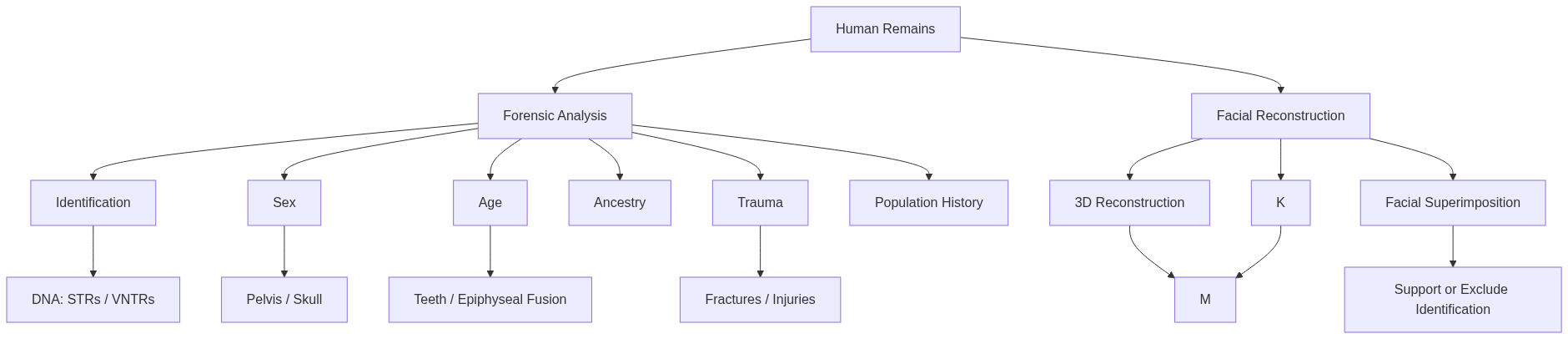
- Individual identification: STRs and VNTRs obtained from skeletal remains can be compared with relatives or reference samples to establish identity.
- Example: DNA analysis has been used in the Ahmedabad plane crash, Nithari case and Sheena Bora investigation for victim identification.
- Sex estimation: The pelvis is the most reliable skeletal indicator, while the skull provides additional clues through features such as the brow ridge, forehead and mandible.
- Age estimation: Dental eruption, epiphyseal fusion, cranial suture closure and degenerative changes help estimate age.
- Ancestry estimation: Cranial and dental morphology, along with genetic evidence, can provide clues about geographical ancestry. Modern anthropology treats such estimates probabilistically rather than as rigid racial categories.
- Trauma and cause of death: Fractures, sharp-force injuries, gunshot trauma and pathological changes can help reconstruct injury patterns and circumstances of death.
- Population reconstruction: Human remains can reveal past migration, diet, disease and population history.
- Example: Genetic analysis of the Roopkund remains identified three distinct population groups, providing evidence of past population movement.
II. Facial Reconstruction
Facial reconstruction recreates the probable facial appearance of an individual from the skull. It is mainly used when visual identification, dental records or DNA are unavailable.
- Direct 3D reconstruction: A replica of the skull is prepared and soft-tissue thickness markers are placed at anatomical landmarks. Clay or wax is then built over the replica to reconstruct the probable facial appearance.
- 2D reconstruction: Standardised frontal and profile photographs of the skull are used. A forensic artist or digital software estimates soft-tissue thickness and produces a facial approximation.
- Facial superimposition: A skull photograph is superimposed on an antemortem photograph of a suspected individual. Landmarks such as the eye sockets, nasal region, jaw and teeth are compared to support or exclude an identification.
- Limitation: Facial reconstruction is an investigative aid rather than definitive identification, because features such as the nose, lips and ears cannot be completely determined from the skull.
Flow diagram
Conclusion
Human remains function as a biological archive, providing evidence about identity, sex, age, ancestry, trauma and population history. Facial reconstruction complements these methods by converting skeletal evidence into a recognisable investigative image, thereby supporting identification, justice and closure for families.
Quick related
Students also ask
-
Discuss the applications of forensic anthropology with suitable examples.
Next question on this syllabus topic (2024 · Q6(b)). View answer →
-
Can a reconstructed face be used as unique identification?
No. It is a public or investigative lead. Positive identification needs DNA, dental records or a unique medical device, plus context.
-
How is this different from palaeoart of hominins?
The forensic case has a real individual and a legal purpose. Hominin faces are scientific illustration with even wider uncertainty.
Same topic · past papers
UPSC has asked this before
These previous-year questions sit on the same topic. Open one to practise the earlier ask.
-
2023 · Q4(b) · Anthropology GS 1 · 15 marks
Discuss various methods of personal identification based on skeletal remains. -
2025 · Q2(a) · Anthropology GS 1 · 20 marks
Discuss the Miocene hominoid remains and their significance in evolution
More from this topic
Q8(b) · UPSC Mains 2026 · Anthropology GS 1 · 15 marks · Solution
In what manner is our understanding of serogenetics and cytogenetics useful in reproductive biology? What are the major ethical issues involved in reproductive technology?
Applications of Anthropology
Serogenetics uses blood groups and serum protein markers for paternity disputes, Rh incompatibility, and fertility-related polymorphism. Cytogenetics uses karyotyping to detect numerical and structural chromosomal defects behind miscarriage and congenital disorders. IVF, ICSI and PGD extend these tools into clinical reproduction. Ethical flashpoints include commercial surrogacy, commodification of reproduction, eugenic selection through PGD, and unclear parentage when donors are involved. India's ART and Surrogacy Acts, 2021, aim to regulate practice while protecting dignity.
Q6(a) · UPSC Mains 2025 · Anthropology GS 1 · 20 marks · Solution
What are genetic markers? Discuss their applications in understanding population variation, disease association and forensics
Applications of Anthropology
A genetic marker is a heritable polymorphism that can be read in families or populations. Classical markers include ABO and proteins. DNA markers include SNPs, STRs, mtDNA and Y haplotypes. Population applications map variation and movement and undermine typological race. Disease applications include sickle-cell and malaria, HLA, counselling, and GWAS. Forensic applications include STR identification, mtDNA from degraded samples, and Y-lineage in mixtures. Lewontin’s within-group diversity and Jeffreys’s DNA fingerprinting are central names.
Q4(a) · UPSC Mains 2025 · Anthropology GS 1 · 20 marks · Solution
Anthropology provides a multidimensional understanding of human beings by bridging the gap between science and humanities. Elucidate
Applications of Anthropology
Anthropology studies one species as organism and as meaning-maker. The science side is palaeoanthropology, genetics, anthropometry and dating. The humanities side is ethnography, ritual, kinship and interpretation, as in Geertz. The bridge is biocultural questions such as nutrition, forensics, language and embodiment. The two failures are reductionism and culturalism. Fossils and symbols belong in one understanding of the human.