
Revision summary
A genetic marker is a heritable polymorphism that can be read in families or populations. Classical markers include ABO and proteins. DNA markers include SNPs, STRs, mtDNA and Y haplotypes. Population applications map variation and movement and undermine typological race. Disease applications include sickle-cell and malaria, HLA, counselling, and GWAS. Forensic applications include STR identification, mtDNA from degraded samples, and Y-lineage in mixtures. Lewontin’s within-group diversity and Jeffreys’s DNA fingerprinting are central names.
Model answer
Copper italics in this answer — like this — are the key facts. Each one is unpacked in the Facts & figures rail.
Introduction
A genetic marker is a measurable hereditary character that differs among individuals and can be followed in families or populations. It may be a classical blood-group antigen, a protein variant, or a DNA site such as a SNP or STR. Markers are tools. They are not the same thing as a ‘race gene’.
Body
Definition and characteristics
- Genetic marker: A genetic marker is a heritable genetic trait or DNA sequence that can be identified and used to distinguish individuals or populations, trace inheritance, and study evolution and genetic relationships.
- Heritability and stability: An effective marker should be heritable and genetically stable, so that it remains largely unchanged during an individual's lifetime.
- Polymorphism: A good marker should be highly polymorphic, showing sufficient variation among individuals or populations to distinguish them effectively.
- Environmental independence: Genetic markers are preferred because their identification is largely independent of environmental influences, unlike many morphological traits.
- Mendelian inheritance: Markers used for pedigree analysis should follow recognizable Mendelian inheritance patterns, allowing their transmission across generations to be traced.
Types of genetic markers
- Classical genetic markers: These are based on observable phenotypic, chromosomal, or biochemical expressions of genetic variation.
- Morphological markers: These include visible traits such as eye colour. However, their usefulness is limited because many morphological traits can be influenced by age and environmental conditions.
- Cytological markers: These involve chromosome number, structure, and banding patterns, such as G-banding and karyotyping, and are useful for identifying chromosomal variation.
- Biochemical markers: These include variations in proteins, enzymes, and blood groups, such as ABO and Rh blood groups and allozymes. Karl Landsteiner’s ABO system remains a classic example of a human genetic polymorphism.
- Molecular markers: These identify variation directly at the DNA sequence level. They are generally more stable, abundant, and less affected by environmental conditions than classical phenotypic markers.
- RFLP: Restriction Fragment Length Polymorphism detects genetic variation through differences in the lengths of DNA fragments produced after digestion with specific restriction enzymes.
- STR/SSR: Short Tandem Repeats, also called microsatellites or Simple Sequence Repeats, consist of short DNA sequences repeated a variable number of times. Their high variability makes them particularly useful for forensic identification.
- SNP: Single-Nucleotide Polymorphisms are variations involving a single nucleotide at a specific genomic position. They are the most abundant type of genetic variation in the human genome and are widely used in population and disease studies.
Population variation
- Population structure: Genetic markers help measure allele frequencies, genetic distances, genetic clines, and patterns of variation among populations. They contributed to the shift from the typological concept of race towards a population-based understanding of human diversity.
- Maternal lineage: Mitochondrial DNA (mtDNA) is transmitted predominantly through the maternal line and does not undergo the same type of recombination as nuclear DNA. It is therefore useful for tracing maternal ancestry, migration, and population history.
- Mitochondrial Eve: Comparative mtDNA studies support the existence of a most recent common maternal ancestor, popularly termed “Mitochondrial Eve”, who lived in Africa. This does not mean that she was the only woman alive at that time.
- Paternal lineage: Y-chromosome markers are transmitted through the paternal line and are useful for reconstructing male ancestry, migration, and lineage history.
- Human migration: Genetic markers provide evidence for major population movements, including the Out-of-Africa dispersal of modern humans. Studies of isolated populations such as the Jarawa of the Andaman Islands have contributed to debates on population history and migration.
- Roopkund: Ancient DNA from the Roopkund Lake skeletons in Uttarakhand revealed genetically distinct groups, including South Asian, Southeast Asian, and Mediterranean-related individuals. The finding provided evidence of complex historical movements and helped distinguish different episodes of human presence at the site.
- Indian anthropology: Classical markers such as ABO, MN and PTC, followed by molecular markers, have been used to study caste, tribal, and regional variation. These differences are better understood as overlapping frequency distributions rather than sharply separated biological types.
- Ethical caution: Genetic ancestry should not be directly equated with cultural identity. A haplogroup represents a genetic lineage, not a civilisation, culture, or race.
Disease association
- HLA markers: Human Leukocyte Antigen (HLA) markers on chromosome 6 play an important role in immune regulation. Particular HLA variants can be associated with susceptibility or resistance to specific diseases.
- Tuberculosis: In studies of the Sahariya tribe, variants such as HLA-DRB115 have been associated with greater susceptibility to pulmonary tuberculosis, while HLA-DRB116 has been reported in association with resistance.
- HIV resistance: The CCR5-Δ32 variant is a 32-base-pair deletion that can reduce susceptibility to HIV infection. It is much more common in some European populations and is relatively rare in Indian populations.
- Sickle-cell and malaria: The relationship between sickle-cell trait (HbS) and malaria is the classic anthropological example of a marker–disease–environment interaction. A. C. Allison linked the distribution of the sickle-cell trait with malaria prevalence.
- Balanced polymorphism: The persistence of the sickle-cell allele in malaria-endemic regions illustrates balanced polymorphism and heterozygote advantage, because individuals carrying one HbS allele have greater protection against severe malaria.
- Thalassemia: Variants affecting the HBB gene and other genes involved in haemoglobin production can contribute to thalassemia. Their relatively high frequency in some malaria-endemic populations is also discussed in the context of natural selection and malaria-related protection.
- GWAS: Genome-Wide Association Studies use large numbers of SNPs to identify genetic variants statistically associated with diseases and complex traits.
- Association is not causation: A marker associated with a disease may not itself cause the disease. Linkage disequilibrium can make a nearby marker appear associated with a disease-causing gene.
- Population stratification: Genetic differences between subpopulations can create false associations if disease cases and controls are not appropriately matched for population background.
Forensics
- DNA fingerprinting: Alec Jeffreys developed DNA fingerprinting using highly variable DNA regions, establishing an important foundation for modern forensic genetics.
- STR profiling: STRs (Short Tandem Repeats) are highly polymorphic and occur at multiple loci across the genome. Their combined variation provides a very high degree of discrimination and makes them the principal markers used in modern forensic DNA profiling.
- VNTRs: Variable Number Tandem Repeats vary in the number of repeated DNA sequences between individuals. They were important in the earlier development of DNA fingerprinting and forensic identification.
- Individual identification: Combining multiple STR loci can generate a highly discriminating genetic profile that can identify individuals and exclude unrelated individuals.
- Paternity testing: STR profiles can be compared between a child and alleged parents to establish or exclude a biological relationship.
- Mass disasters: DNA markers can help identify victims when conventional identification is difficult. In the Ahmedabad plane crash, DNA-based comparison with relatives was used as part of the identification process.
- Criminal investigations: DNA profiling can help identify victims, link biological evidence to individuals, and exclude innocent suspects. Its application has been important in major Indian forensic investigations, including the Nithari and Sheena Bora cases.
- mtDNA in forensics: Mitochondrial DNA is particularly useful when nuclear DNA is highly degraded, such as in hair shafts and old bones, because each cell contains many copies of mtDNA.
- Y-chromosome profiling: Y-chromosome markers can help trace paternal lineages and are particularly useful in analysing certain male–female DNA mixtures, including some sexual-assault investigations.
- Forensic anthropology: DNA evidence complements osteology, biological profiling, contextual evidence, and chain of custody. DNA is a powerful identification tool, but it does not replace the anthropological examination of skeletal remains.
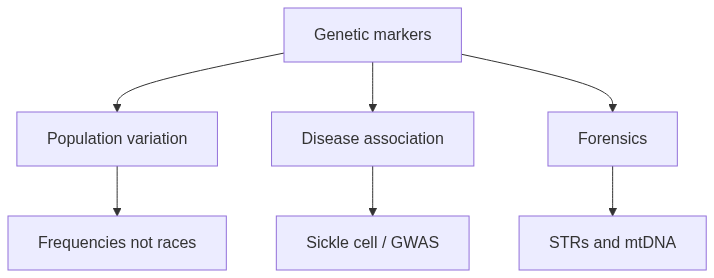
Flow diagram
Conclusion
Genetic markers are heritable polymorphisms used as instruments. In populations they map variation and history. In medicine they flag disease risk and Mendelian loci. In forensics they identify and exclude. Landsteiner, Jeffreys, Cavalli-Sforza and Lewontin mark the path from blood groups to DNA, and race typology does not follow from markers.
Quick related
Students also ask
-
Examine the utility of human remains in forensic analysis. Discuss the facial reconstruction technique
Next question on this syllabus topic (2025 · Q8(c)). View answer →
-
Are blood groups outdated as markers?
They are no longer the frontier, but they still illustrate Mendelism and early population surveys. DNA markers now lead, with classical ones as history and pedagogy.
-
Can markers prove caste origins?
They can describe average affinities and movements. They cannot certify a mythic origin story.
Same topic · past papers
UPSC has asked this before
These previous-year questions sit on the same topic. Open one to practise the earlier ask.
-
2025 · Q8(b) · Anthropology GS 1 · 15 marks
'Genome-wide Disease Association Studies (GWAS) advanced our understanding of health and disease.' Discuss
More from this topic
Q8(b) · UPSC Mains 2026 · Anthropology GS 1 · 15 marks · Solution
In what manner is our understanding of serogenetics and cytogenetics useful in reproductive biology? What are the major ethical issues involved in reproductive technology?
Applications of Anthropology
Serogenetics uses blood groups and serum protein markers for paternity disputes, Rh incompatibility, and fertility-related polymorphism. Cytogenetics uses karyotyping to detect numerical and structural chromosomal defects behind miscarriage and congenital disorders. IVF, ICSI and PGD extend these tools into clinical reproduction. Ethical flashpoints include commercial surrogacy, commodification of reproduction, eugenic selection through PGD, and unclear parentage when donors are involved. India's ART and Surrogacy Acts, 2021, aim to regulate practice while protecting dignity.
Q8(c) · UPSC Mains 2025 · Anthropology GS 1 · 15 marks · Solution
Examine the utility of human remains in forensic analysis. Discuss the facial reconstruction technique
Applications of Anthropology
Forensic anthropology estimates sex, age, stature and trauma from bones and teeth, and it records context. Krogman and Stewart standardised osteological identification. DNA STRs and dentistry confirm identity when references exist. Clyde Snow’s human-rights cases show remains as testimony. Facial reconstruction uses tissue-depth markers, as in Gerasimov and Gatliff, now often with CT and 3D prints. The face is an approximation to prompt recognition, not a certain portrait. Ethics include family consent and no racial or caste over-claim.
Q4(a) · UPSC Mains 2025 · Anthropology GS 1 · 20 marks · Solution
Anthropology provides a multidimensional understanding of human beings by bridging the gap between science and humanities. Elucidate
Applications of Anthropology
Anthropology studies one species as organism and as meaning-maker. The science side is palaeoanthropology, genetics, anthropometry and dating. The humanities side is ethnography, ritual, kinship and interpretation, as in Geertz. The bridge is biocultural questions such as nutrition, forensics, language and embodiment. The two failures are reductionism and culturalism. Fossils and symbols belong in one understanding of the human.