
Revision summary
Anthropology studies one species as organism and as meaning-maker. The science side is palaeoanthropology, genetics, anthropometry and dating. The humanities side is ethnography, ritual, kinship and interpretation, as in Geertz. The bridge is biocultural questions such as nutrition, forensics, language and embodiment. The two failures are reductionism and culturalism. Fossils and symbols belong in one understanding of the human.
Model answer
Copper italics in this answer — like this — are the key facts. Each one is unpacked in the Facts & figures rail.
Introduction
Anthropology’s wager is that Homo is one animal who also lives in worlds of symbols, law and history. Science without the humanities yields a body without a world. Humanities without science yield a world without a primate. The discipline is multidimensional when it refuses that split in the same problem.
Body
The science limb
Biological anthropology, prehistoric dating and taphonomy, linguistics as a natural history of languages, and formal demography are scientific in the ordinary sense: measurement, hypothesis, comparison and falsification. Franz Boas insisted on this empirical discipline against armchair race science. Sherwood Washburn’s new physical anthropology later joined fossils, function and behaviour.
Miocene hominoids, Mousterian assemblages, Mendelian loci and nutritional anthropometry are not metaphors. They constrain the stories we may tell about origins, health and variation. Human biology also includes culture as a selective and developmental environment: plasticity and life history. That is science of a biocultural object.
The humanities limb
Ethnography, interpretation of ritual, kinship as moral reason, embodiment, and Geertzian reading of public symbols are humanist crafts: language, context, critique and the particular. Clifford Geertz made the literary analogy explicit. Frazer’s evolutionism shows what happens when a humanist topic such as religion is forced through a thin scientific costume of unilinear stages. The remedy is not to abandon comparison. It is to interpret.
Bridging as practice
- Four-field training: Biological, socio-cultural, archaeological and linguistic wings in one syllabus. Fossils and Purum, nutrition and Turner, sit in the same discipline for that reason.
- Biocultural problems: Stunting is a z-score and a gendered plate. Forensic anthropology is osteology and a legal narrative of identity. Language is a cognitive system and a politics of tongue.
- Against C. P. Snow’s two cultures: Anthropology trains one person to hold a cladogram and a kinship term without converting one into the other.
A current Indian join is anaemia or child growth in NFHS numbers plus ethnography of who eats eggs, who gets ICDS take-home rations, and whose work is in the heat. Another is Siwalik fossils beside living diversity.
Tensions worth naming
Reductionism (genes explain the cockfight) and culturalism (bones are only stories) are the two failures of the bridge. A. L. Kroeber’s superorganic over-separated culture from biology. Some sociobiology over-joined them. The multidimensional claim is a discipline of the joint: different methods, one species.
Flow diagram
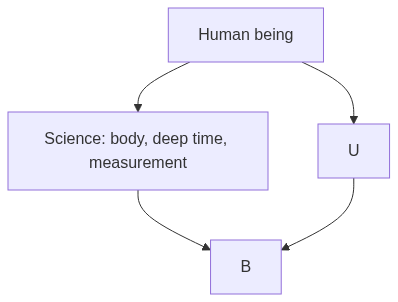
Conclusion
Anthropology is scientific where the primate, the tool and the allele require it, and humanistic where meaning, power and history require it. The gap is bridged by biocultural problems that cannot be answered from one side alone.
Quick related
Students also ask
-
What are genetic markers? Discuss their applications in understanding population variation, disease association and forensics
Next question on this syllabus topic (2025 · Q6(a)). View answer →
-
Is this only a definition of anthropology?
The task is to elucidate. Define briefly, then show the bridge with fossils, symbols and nutrition on the same human being.
-
How does India appear here?
Caste diet and anaemia, or Siwalik fossils beside living diversity, show the same join of measurement and meaning.
Same topic · past papers
UPSC has asked this before
These previous-year questions sit on the same topic. Open one to practise the earlier ask.
-
2016 · Q6(c) · Anthropology GS 1 · 15 marks
Discuss different factors affecting growth and development in human beings. -
2016 · Q8(b) · Anthropology GS 1 · 15 marks
Discuss the genetic and non-genetic factors in the bio-cultural adaptations of human beings to different environments. -
2015 · Q8(a) · Anthropology GS 1 · 20 marks
Forensic Science can help in criminal investigations. Discuss
More from this topic
Q8(b) · UPSC Mains 2026 · Anthropology GS 1 · 15 marks · Solution
In what manner is our understanding of serogenetics and cytogenetics useful in reproductive biology? What are the major ethical issues involved in reproductive technology?
Applications of Anthropology
Serogenetics uses blood groups and serum protein markers for paternity disputes, Rh incompatibility, and fertility-related polymorphism. Cytogenetics uses karyotyping to detect numerical and structural chromosomal defects behind miscarriage and congenital disorders. IVF, ICSI and PGD extend these tools into clinical reproduction. Ethical flashpoints include commercial surrogacy, commodification of reproduction, eugenic selection through PGD, and unclear parentage when donors are involved. India's ART and Surrogacy Acts, 2021, aim to regulate practice while protecting dignity.
Q8(c) · UPSC Mains 2025 · Anthropology GS 1 · 15 marks · Solution
Examine the utility of human remains in forensic analysis. Discuss the facial reconstruction technique
Applications of Anthropology
Forensic anthropology estimates sex, age, stature and trauma from bones and teeth, and it records context. Krogman and Stewart standardised osteological identification. DNA STRs and dentistry confirm identity when references exist. Clyde Snow’s human-rights cases show remains as testimony. Facial reconstruction uses tissue-depth markers, as in Gerasimov and Gatliff, now often with CT and 3D prints. The face is an approximation to prompt recognition, not a certain portrait. Ethics include family consent and no racial or caste over-claim.
Q6(a) · UPSC Mains 2025 · Anthropology GS 1 · 20 marks · Solution
What are genetic markers? Discuss their applications in understanding population variation, disease association and forensics
Applications of Anthropology
A genetic marker is a heritable polymorphism that can be read in families or populations. Classical markers include ABO and proteins. DNA markers include SNPs, STRs, mtDNA and Y haplotypes. Population applications map variation and movement and undermine typological race. Disease applications include sickle-cell and malaria, HLA, counselling, and GWAS. Forensic applications include STR identification, mtDNA from degraded samples, and Y-lineage in mixtures. Lewontin’s within-group diversity and Jeffreys’s DNA fingerprinting are central names.