
Revision summary
The biological profile estimates sex, age, stature, and ancestry from bone. Pelvis and Phenice traits lead for sex; Todd, Suchey–Brooks and Iscan lead for adult age. Trotter–Gleser and Fully estimate stature. Teeth, sinuses, and implants individualise. Krogman standardised the forensic teaching sequence. DNA and isotopes extend identification when bone and records allow.
Model answer
Copper italics in this answer — like this — are the key facts. Each one is unpacked in the Facts & figures rail.
Introduction
A skeleton can still be a person for the law if sex, age, stature, ancestry, and unique marks can be read. Forensic anthropology is that reading, from bone first and from DNA when bone is not enough.
Body
Biological profile
- Sex is best from the pelvis, using the Phenice traits of the pubis, the greater sciatic notch, and then the skull; accuracy falls in children because secondary sex traits are incomplete.
- Age uses dental eruption and epiphyseal union in the young, then pubic symphysis methods of Todd and Suchey–Brooks, sternal rib ends after Iscan, and cranial suture closure with wide error in the old.
- Stature is estimated from long-bone length with regression formulae such as Trotter and Gleser, which must match population; Fully’s anatomical method uses more of the skeleton when it is complete.
- Ancestry from craniofacial metrics is statistical and contested, and it is a forensic lead, not a race essence.
Unique identification
- Dental charting, restorations, and radiographs match a named person when antemortem records exist.
- Frontal sinus outline, surgical implants, and healed fractures are individualising when records or family memory exist.
- Occupational and pathological markers, such as squatting facets or chronic infection, narrow the field but rarely name a person alone.
- Wilton Krogman’s The Human Skeleton in Forensic Medicine made this profile-plus-unique-mark sequence standard teaching.
Molecular and imaging methods
- Nuclear STR DNA from dense bone or tooth, mitochondrial DNA from degraded remains, and Y- or X-markers for kinship are now ordinary when a reference sample exists.
- Facial approximation from the skull is an investigative aid, not a courtroom photograph of the dead.
- Isotopes of strontium, oxygen, and carbon can speak of diet and childhood geology, which helps unidentified migrants and mass graves.
Indian and practical context
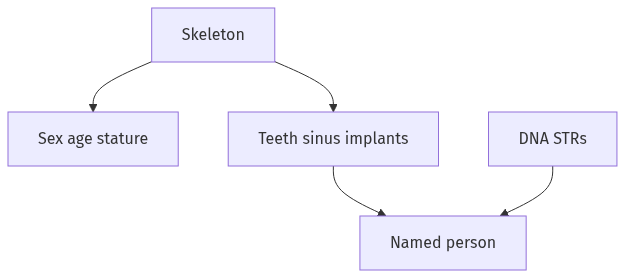
- Mass disasters, unidentified poor, and human-rights graves use the same sequence: inventory, profile, unique match, then DNA.
- The method is only as good as the reference collections and the antemortem file.
Flow diagram
Conclusion
Personal identification from bone starts with sex, age, stature, and unique dental or surgical marks, then DNA. Krogman’s forensic sequence still holds, with molecular tests as the last name-tag when records exist.
Quick related
Students also ask
-
Describe the practical applications of DNA technology in the current scenario.
Next question on this syllabus topic (2023 · Q6(c)). View answer →
-
Can ancestry from the skull prove race?
No. It is a statistical resemblance used as an investigative hint. It does not restore nineteenth-century racial types.
-
When is DNA required?
When the biological profile and dental or surgical matches cannot name the person, or when the court needs a molecular identity.
Same topic · past papers
UPSC has asked this before
These previous-year questions sit on the same topic. Open one to practise the earlier ask.
-
2016 · Q8(c) · Anthropology GS 1 · 15 marks
Explain the skeletal changes due to erect posture and their implications.
More from this topic
Q8(b) · UPSC Mains 2026 · Anthropology GS 1 · 15 marks · Solution
In what manner is our understanding of serogenetics and cytogenetics useful in reproductive biology? What are the major ethical issues involved in reproductive technology?
Applications of Anthropology
Serogenetics uses blood groups and serum protein markers for paternity disputes, Rh incompatibility, and fertility-related polymorphism. Cytogenetics uses karyotyping to detect numerical and structural chromosomal defects behind miscarriage and congenital disorders. IVF, ICSI and PGD extend these tools into clinical reproduction. Ethical flashpoints include commercial surrogacy, commodification of reproduction, eugenic selection through PGD, and unclear parentage when donors are involved. India's ART and Surrogacy Acts, 2021, aim to regulate practice while protecting dignity.
Q8(c) · UPSC Mains 2025 · Anthropology GS 1 · 15 marks · Solution
Examine the utility of human remains in forensic analysis. Discuss the facial reconstruction technique
Applications of Anthropology
Forensic anthropology estimates sex, age, stature and trauma from bones and teeth, and it records context. Krogman and Stewart standardised osteological identification. DNA STRs and dentistry confirm identity when references exist. Clyde Snow’s human-rights cases show remains as testimony. Facial reconstruction uses tissue-depth markers, as in Gerasimov and Gatliff, now often with CT and 3D prints. The face is an approximation to prompt recognition, not a certain portrait. Ethics include family consent and no racial or caste over-claim.
Q6(a) · UPSC Mains 2025 · Anthropology GS 1 · 20 marks · Solution
What are genetic markers? Discuss their applications in understanding population variation, disease association and forensics
Applications of Anthropology
A genetic marker is a heritable polymorphism that can be read in families or populations. Classical markers include ABO and proteins. DNA markers include SNPs, STRs, mtDNA and Y haplotypes. Population applications map variation and movement and undermine typological race. Disease applications include sickle-cell and malaria, HLA, counselling, and GWAS. Forensic applications include STR identification, mtDNA from degraded samples, and Y-lineage in mixtures. Lewontin’s within-group diversity and Jeffreys’s DNA fingerprinting are central names.