
Revision summary
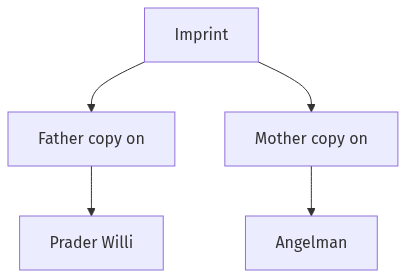
Imprinting silences one parental copy of a gene. Haig tied the logic to parental conflict over growth. Paternal versus maternal loss at 15q yields Prader–Willi or Angelman. Beckwith–Wiedemann and Silver–Russell are growth-side examples. Counselling must record which parent transmitted the region.
Model answer
Copper italics in this answer — like this — are the key facts. Each one is unpacked in the Facts & figures rail.
Introduction
Imprinting is parent-of-origin silencing of a gene. The same deletion can therefore cause two different diseases according to whether the chromosome came from the mother or the father.
Body
The mechanism
- Epigenetic marks, not a change of DNA letters, switch one parental copy off. David Haig linked this to parental conflict over foetal growth.
- Chromosome 15q is the teaching human region.
Disease pairs
- Prader–Willi syndrome follows loss of the paternal 15q contribution. Angelman syndrome follows loss of the maternal UBE3A copy.
- Beckwith–Wiedemann and Silver–Russell growth disorders involve imprinted loci on 11p.
- Hydatidiform moles and some cancers show imprinting errors. Pedigree counselling must ask which parent transmitted the chromosome.
Anthropological note
- This is non-Mendelian at the phenotype even though the deletion can be mapped. A simple dominant chart fails.
Flow diagram
Conclusion
Imprinting makes parent of origin a clinical fact. Prader–Willi and Angelman are the pair every counsellor names.
Quick related
Students also ask
-
Discuss how anthropological knowledge of the human body may be used in designing equipments and articles of human use
Next question on this syllabus topic (2022 · Q8(c)). View answer →
-
Can a pedigree look Mendelian and still be imprinted?
Transmission may look dominant, but only one parental origin produces the disease. That is the clue.
-
Is imprinting the same as sex linkage?
No. Sex linkage is on X or Y. Imprinting can sit on an autosome and still care which parent it came from.
Same topic · past papers
UPSC has asked this before
These previous-year questions sit on the same topic. Open one to practise the earlier ask.
-
2025 · Q5(e) · Anthropology GS 1 · 10 marks
Foetal origin of adult diseases and contribution of David Barker. -
2024 · Q2(c) · Anthropology GS 1 · 15 marks
Critically comment on the lifestyle diseases and their impact on human health. -
2022 · Q6(b) · Anthropology GS 1 · 15 marks
What is meant by health? Is the burden of life style diseases on the rise? Justify your answer with suitable examples -
2016 · Q7(c) · Anthropology GS 1 · 15 marks
Describe the scope of Epidemiological Anthropology in the study of infectious and non-infectious diseases.
More from this topic
Q8(b) · UPSC Mains 2026 · Anthropology GS 1 · 15 marks · Solution
In what manner is our understanding of serogenetics and cytogenetics useful in reproductive biology? What are the major ethical issues involved in reproductive technology?
Applications of Anthropology
Serogenetics uses blood groups and serum protein markers for paternity disputes, Rh incompatibility, and fertility-related polymorphism. Cytogenetics uses karyotyping to detect numerical and structural chromosomal defects behind miscarriage and congenital disorders. IVF, ICSI and PGD extend these tools into clinical reproduction. Ethical flashpoints include commercial surrogacy, commodification of reproduction, eugenic selection through PGD, and unclear parentage when donors are involved. India's ART and Surrogacy Acts, 2021, aim to regulate practice while protecting dignity.
Q8(c) · UPSC Mains 2025 · Anthropology GS 1 · 15 marks · Solution
Examine the utility of human remains in forensic analysis. Discuss the facial reconstruction technique
Applications of Anthropology
Forensic anthropology estimates sex, age, stature and trauma from bones and teeth, and it records context. Krogman and Stewart standardised osteological identification. DNA STRs and dentistry confirm identity when references exist. Clyde Snow’s human-rights cases show remains as testimony. Facial reconstruction uses tissue-depth markers, as in Gerasimov and Gatliff, now often with CT and 3D prints. The face is an approximation to prompt recognition, not a certain portrait. Ethics include family consent and no racial or caste over-claim.
Q6(a) · UPSC Mains 2025 · Anthropology GS 1 · 20 marks · Solution
What are genetic markers? Discuss their applications in understanding population variation, disease association and forensics
Applications of Anthropology
A genetic marker is a heritable polymorphism that can be read in families or populations. Classical markers include ABO and proteins. DNA markers include SNPs, STRs, mtDNA and Y haplotypes. Population applications map variation and movement and undermine typological race. Disease applications include sickle-cell and malaria, HLA, counselling, and GWAS. Forensic applications include STR identification, mtDNA from degraded samples, and Y-lineage in mixtures. Lewontin’s within-group diversity and Jeffreys’s DNA fingerprinting are central names.