
Revision summary
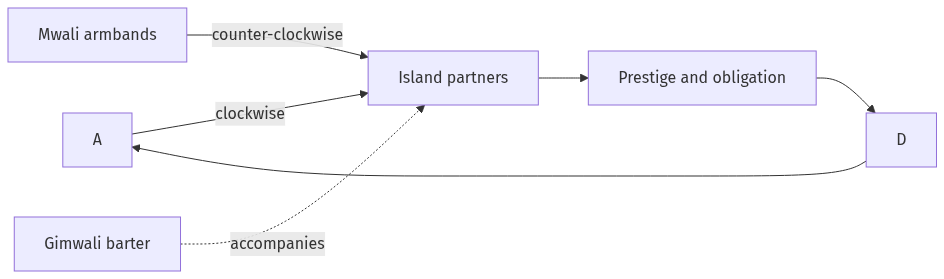
Malinowski described Kula exchange among the Massim in Argonauts of the Western Pacific. Soulava necklaces move clockwise and mwali armbands counter-clockwise. Temporary possession yields prestige; valuables must circulate. Kula creates delayed reciprocity, trust, leadership and inter-island integration. Gimwali barter accompanies but is distinguished from ceremonial exchange. Weiner corrected Malinowski's male bias by documenting women's wealth and exchange.
Model answer
Copper italics in this answer — like this — are the key facts. Each one is unpacked in the Facts & figures rail.
Introduction
The Kula is the ceremonial circulation of shell valuables among communities of the Massim region of Papua New Guinea. In Argonauts of the Western Pacific (1922), Bronislaw Malinowski used it to show that exchange is simultaneously economic, political, magical and moral.
Body
The ring and its meanings
Red shell necklaces, soulava, move clockwise; white shell armbands, mwali, move counter-clockwise. Named partners exchange them as gifts over long sea voyages. A valuable brings prestige through temporary possession, but it must continue to circulate. Ordinary barter, gimwali, accompanies expeditions but remains conceptually distinct.
The Kula's cultural relevance is wider than shells:
- Reciprocity and trust: delayed return creates durable obligations between otherwise separate islands. It anticipates Marcel Mauss's argument that gifts carry social persons and demand return.
- Rank and biography: famous valuables have names and histories; access to partners converts circulation into reputation and leadership.
- Integration: canoe building, gardening surplus, navigation, magic and feasting mobilise whole communities. Malinowski therefore explained an institution through the needs it serves.
- World-view: spells, danger and myth make the voyage a cultural drama, not market transport.
Later work by Annette Weiner on Trobriand women's banana-leaf bundles and skirts corrected Malinowski's male-centred account. Maurice Godelier likewise stressed that exchange systems also depend on things kept outside exchange. Kula is therefore neither irrational barter nor a harmonious circle free of gender and power.
Flow diagram
Conclusion
Kula valuables have little utilitarian use but great relational value. Their movement creates partners, rank, memory and inter-island peace. Malinowski revealed the institutional whole; Mauss and Weiner expose reciprocity, inalienability and the gendered limits of his view.
Quick related
Students also ask
-
William Ogburn and Cultural lag.
Next question on this syllabus topic (2023 · Q5(e)). View answer →
-
Is Kula a form of barter?
No. It is ceremonial gift circulation. Gimwali is the more direct barter that may occur on the same expedition.
-
Why do valuables keep moving?
Prestige comes from receiving, holding appropriately and passing them on; permanent retention breaks the moral relation.
Same topic · past papers
UPSC has asked this before
These previous-year questions sit on the same topic. Open one to practise the earlier ask.
-
2023 · Q1(a) · Anthropology GS 1 · 10 marks
Scope and relevance of Social and Cultural Anthropology -
2023 · Q7(c) · Anthropology GS 1 · 15 marks
Discuss political and methodological aspects of national character studies. Elucidate the contemporary relevance of such studies.
More from this topic
Q4(b) · UPSC Mains 2025 · Anthropology GS 1 · 15 marks · Solution
Write a note on Mousterian tool tradition, Mousterian culture and its makers
The Nature of Culture
The tradition is Middle Palaeolithic flakes, Levallois technique, scrapers, points and denticulates. Bordes saw facies as cultural variants. Binford saw functional tool-kits. Culture includes fire, hunting and shelters. Be cautious on burial and ornament. Makers in Europe are mainly Neanderthals. In the Levant early modern humans also used Mousterian tools. The date ballpark is the Middle Palaeolithic, to about 40,000 years ago in Europe. Mousterian is not identical with all Neanderthal behaviour everywhere.
Q1(e) · UPSC Mains 2025 · Anthropology GS 1 · 10 marks · Solution
Culture and embodiment.
The Nature of Culture
Embodiment means culture is lived as a body, not only as symbols in the head. Csordas, following Merleau-Ponty, treated the body as the ground of culture. Bourdieu’s habitus is class and gender as posture, taste and practical sense. Mauss described techniques of the body such as walking, swimming and childbirth. Medical anthropology uses the mindful body and structural violence made flesh. The body is cultural practice, not a costume.
Q1(c) · UPSC Mains 2024 · Anthropology GS 1 · 10 marks · Solution
Critical perspective on avoidance and joking relationship
The Nature of Culture
Avoidance prescribes reserve; joking licenses teasing between named kin categories. Radcliffe-Brown read both as complementary ways of regulating conjunction and separation. Mother-in-law/son-in-law avoidance and cross-cousin or junior-affine joking are common patterns. Symmetrical joking permits reciprocity; asymmetrical joking protects one-sided licence. Gluckman highlights ritualised expression of contradiction. Critical analysis asks whether joking reproduces gendered power and whether rules match actual conduct.