
Revision summary
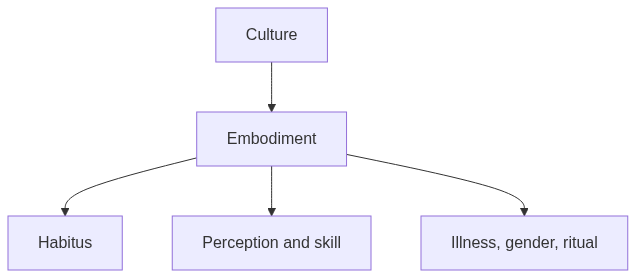
Embodiment means culture is lived as a body, not only as symbols in the head. Csordas, following Merleau-Ponty, treated the body as the ground of culture. Bourdieu’s habitus is class and gender as posture, taste and practical sense. Mauss described techniques of the body such as walking, swimming and childbirth. Medical anthropology uses the mindful body and structural violence made flesh. The body is cultural practice, not a costume.
Model answer
Copper italics in this answer — like this — are the key facts. Each one is unpacked in the Facts & figures rail.
Introduction
Embodiment means that culture is not only a set of ideas people carry in their heads. It is a way of being a body in the world. The body is not a biological object with culture painted on top. Habit, gender, illness, ritual and inequality become flesh.
Body
From body as object to body as subject
Older physical anthropology measured the body. Older cultural anthropology often treated it as a vehicle for kinship and belief. Thomas Csordas, drawing on Maurice Merleau-Ponty, made the body the ground of culture. We do not first have a body and then learn culture. We are a skilled, oriented body.
- Pierre Bourdieu’s habitus: How one sits, eats, labours and feels shame becomes class and gender. A child who is taught to eat last, to occupy less space, or to carry head-loads, learns culture as posture and taste, not only as a rule-book.
- Marcel Mauss: “Techniques of the body” showed that swimming, marching, sitting and childbirth positions are culturally transmitted. They are as social as a kinship term.
- Against mind–body dualism: If culture is only a text to be read, we never return to gait, breath, scar and skill.
Where it shows up
- Ritual: Victor Turner treated the ritual body as a site of transformation. Csordas’s work on charismatic healing treated cure as a bodily event, not only a change of doctrine. A possession séance or a pilgrimage on foot is embodiment, not a pamphlet.
- Caste, gender and work: Who may enter a kitchen, whose spine is marked by load-carrying, and whose hunger is served last are political anatomy. Nancy Scheper-Hughes and Margaret Lock called this the “mindful body”: individual body, social body and body politic.
- Medical anthropology: Stunting, stigma of leprosy or disability, and Paul Farmer’s structural violence are embodiment in a health register. Inequality is not only a metaphor when it is short stature and repeated infection.
- A contemporary example: Masking, distancing and “essential worker” bodies during COVID-19 showed how a public health rule becomes a trained bodily practice, and how some bodies were more exposed than others.
Why it matters
The idea sits between socio-cultural theory and biological anthropology. It refuses two reductions: culture as disembodied meaning, and the body as a culture-free organism.
Flow diagram
Conclusion
- Embodiment means culture is practised as a body: trained, gendered, sick and skilled. Csordas and Bourdieu give the vocabulary. Ethnography of ritual, labour and illness gives the evidence. The argument is a critique of the mind–body split, not a synonym for physical education.
Quick related
Students also ask
-
Write a note on Mousterian tool tradition, Mousterian culture and its makers
Next question on this syllabus topic (2025 · Q4(b)). View answer →
-
How is this different from culture and personality?
Culture and personality asked how culture shapes character. Embodiment asks how culture organises perception, posture and skill, including inequality.
-
Can caste or gender illustrate embodiment?
Yes. Who may enter a space, whose hunger is last, and whose labour marks the spine are bodily facts of culture and power.
Same topic · past papers
UPSC has asked this before
These previous-year questions sit on the same topic. Open one to practise the earlier ask.
-
2025 · Q4(b) · Anthropology GS 1 · 15 marks
Write a note on Mousterian tool tradition, Mousterian culture and its makers -
2024 · Q1(a) · Anthropology GS 1 · 10 marks
Attributes of culture -
2026 · Q6(b) · Anthropology GS 1 · 15 marks
Critically discuss how culture determines human behaviour in the light of Leslie White's theory -
2025 · Q1(c) · Anthropology GS 1 · 10 marks
Osteodontokeratik culture and its makers. -
2025 · Q2(b) · Anthropology GS 1 · 15 marks
Compare and contrast the symbolic approaches of Clifford Geertz and Victor Turner to understand culture
More from this topic
Q4(b) · UPSC Mains 2025 · Anthropology GS 1 · 15 marks · Solution
Write a note on Mousterian tool tradition, Mousterian culture and its makers
The Nature of Culture
The tradition is Middle Palaeolithic flakes, Levallois technique, scrapers, points and denticulates. Bordes saw facies as cultural variants. Binford saw functional tool-kits. Culture includes fire, hunting and shelters. Be cautious on burial and ornament. Makers in Europe are mainly Neanderthals. In the Levant early modern humans also used Mousterian tools. The date ballpark is the Middle Palaeolithic, to about 40,000 years ago in Europe. Mousterian is not identical with all Neanderthal behaviour everywhere.
Q5(b) · UPSC Mains 2024 · Anthropology GS 1 · 10 marks · Solution
Cultural relevance of the Kula
The Nature of Culture
Malinowski described Kula exchange among the Massim in Argonauts of the Western Pacific. Soulava necklaces move clockwise and mwali armbands counter-clockwise. Temporary possession yields prestige; valuables must circulate. Kula creates delayed reciprocity, trust, leadership and inter-island integration. Gimwali barter accompanies but is distinguished from ceremonial exchange. Weiner corrected Malinowski's male bias by documenting women's wealth and exchange.
Q1(c) · UPSC Mains 2024 · Anthropology GS 1 · 10 marks · Solution
Critical perspective on avoidance and joking relationship
The Nature of Culture
Avoidance prescribes reserve; joking licenses teasing between named kin categories. Radcliffe-Brown read both as complementary ways of regulating conjunction and separation. Mother-in-law/son-in-law avoidance and cross-cousin or junior-affine joking are common patterns. Symmetrical joking permits reciprocity; asymmetrical joking protects one-sided licence. Gluckman highlights ritualised expression of contradiction. Critical analysis asks whether joking reproduces gendered power and whether rules match actual conduct.