
Revision summary
Ogburn’s Social Change (1922) distinguished material and non-material culture. Cultural lag is the slower movement of law and morals behind invention. The concept travelled from sociology into culture-contact and applied anthropology. It fits new technology before new ethics, including in development settings. It fails if meaning is treated as a mere lagging part.
Model answer
Copper italics in this answer — like this — are the key facts. Each one is unpacked in the Facts & figures rail.
Introduction
William F. Ogburn argued that the parts of culture do not change at one speed. Cultural lag is the delay of non-material rules behind material invention.
Body
Ogburn’s claim
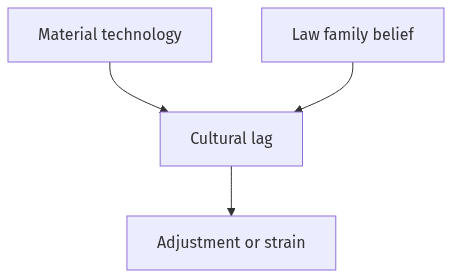
- In Social Change (1922) William F. Ogburn split culture into material objects and the non-material field of law, family, and belief.
- Material culture, especially technology, often moves first; family ethics, property law, and ritual catch up later, and that gap is cultural lag.
- His examples included industry, the automobile, and delayed legal and moral adjustment, a sociology that anthropologists borrowed for culture-contact studies.
Use and criticism
- Lag helps explain why IVF, the internet, or a dam can exist before kinship and compensation rules are ready, including in Indian tribal displacement.
- Leslie White and other evolutionists liked the material lead; Franz Boas and later interpretive writers warned that meaning is not a slow caboose on a technological engine.
- Lag can sound too mechanical if religion and law are treated as mere leftovers, so the term is a diagnostic, not a whole theory of culture.
Flow diagram
Conclusion
Ogburn named cultural lag as the delay of norms behind technology. The idea is still useful for law and kinship after new machines, if it is not turned into a one-way material destiny.
Quick related
Students also ask
-
Critically examine Arjun Appadurai's conceptualization of the global cultural economy.
Next question on this syllabus topic (2023 · Q8(a)). View answer →
-
Did Ogburn invent the material and non-material split?
The split is older in anthropology. His specific claim is the lag of the non-material behind the material.
-
Is every social problem a cultural lag?
No. Inequality and power can block adjustment. Lag is one diagnosis, not all of social change.
More from this topic
Q4(b) · UPSC Mains 2025 · Anthropology GS 1 · 15 marks · Solution
Write a note on Mousterian tool tradition, Mousterian culture and its makers
The Nature of Culture
The tradition is Middle Palaeolithic flakes, Levallois technique, scrapers, points and denticulates. Bordes saw facies as cultural variants. Binford saw functional tool-kits. Culture includes fire, hunting and shelters. Be cautious on burial and ornament. Makers in Europe are mainly Neanderthals. In the Levant early modern humans also used Mousterian tools. The date ballpark is the Middle Palaeolithic, to about 40,000 years ago in Europe. Mousterian is not identical with all Neanderthal behaviour everywhere.
Q1(e) · UPSC Mains 2025 · Anthropology GS 1 · 10 marks · Solution
Culture and embodiment.
The Nature of Culture
Embodiment means culture is lived as a body, not only as symbols in the head. Csordas, following Merleau-Ponty, treated the body as the ground of culture. Bourdieu’s habitus is class and gender as posture, taste and practical sense. Mauss described techniques of the body such as walking, swimming and childbirth. Medical anthropology uses the mindful body and structural violence made flesh. The body is cultural practice, not a costume.
Q5(b) · UPSC Mains 2024 · Anthropology GS 1 · 10 marks · Solution
Cultural relevance of the Kula
The Nature of Culture
Malinowski described Kula exchange among the Massim in Argonauts of the Western Pacific. Soulava necklaces move clockwise and mwali armbands counter-clockwise. Temporary possession yields prestige; valuables must circulate. Kula creates delayed reciprocity, trust, leadership and inter-island integration. Gimwali barter accompanies but is distinguished from ceremonial exchange. Weiner corrected Malinowski's male bias by documenting women's wealth and exchange.