
Revision summary
National character work grew from culture-and-personality, especially Benedict on Japan. It was politically funded as wartime culture-at-a-distance. Methods were life history, projective tests, film, and émigré interview. Faults are stereotyping, sample bias, and the ecological fallacy. Geertz moved the field from private character to public meaning. Today the genre survives in branding and populism; anthropology uses it as a caution.
Model answer
Copper italics in this answer — like this — are the key facts. Each one is unpacked in the Facts & figures rail.
Introduction
National character studies tried to describe a people’s typical personality as culture written into character. They were wartime political tools as much as methods, which is why their later reputation is mixed and still usable with care.
Body
What the studies were
- Culture-and-personality anthropology, from Ruth Benedict’s Patterns of Culture to The Chrysanthemum and the Sword on Japan, treated a nation as if it had a modal personality.
- Margaret Mead, Gregory Bateson, Geoffrey Gorer, and the Columbia seminar on contemporary cultures wrote wartime and Cold War portraits of America, Japan, and Russia, often at a distance.
Political aspects
- The United States government funded culture-at-a-distance work to know enemies and allies, so the genre is an applied anthropology of the state.
- Benedict’s Japan book influenced occupation policy talk about the Emperor and guilt versus shame, which is political consequence, not only interpretation.
- The same style can stereotype a people as childish, authoritarian, or peaceful, which feeds propaganda as easily as understanding.
- Post-colonial critics asked whose nation was being characterised when class, caste, and region were flattened.
Methodological aspects
- Methods included life histories, Rorschach and TAT tests, films, literature, and interviews with émigrés, which Abram Kardiner and Cora Du Bois also used for modal personality.
- Geertz later rejected the idea that culture is a private personality writ large; meaning is public.
- Sample bias, wartime hatred, and the ecological fallacy of moving from a few protocols to a hundred million people are the core methodological faults.
- John Whiting’s cross-cultural child-training work was a more systematic cousin, still not a passport to a national soul.
Contemporary relevance
- Soft power, branding, and populist talk of “the people” still use national character as common sense; anthropology’s job is to unpick that.
- Organisational culture studies and Hofstede’s dimensions are distant bureaucratic heirs and share the over-generalisation risk.
- Psychological anthropology still studies emotion, child-rearing, and personhood, but in named communities, not as one India or one Japan.
- Security, diplomacy, and area studies still want cultural literacy; the ethical lesson of Benedict and Mead is to supply it without a single national psyche.
- In India, claims about a Hindu psyche or a Muslim psyche repeat the old genre and should be refused on the same methodological grounds.
Flow diagram
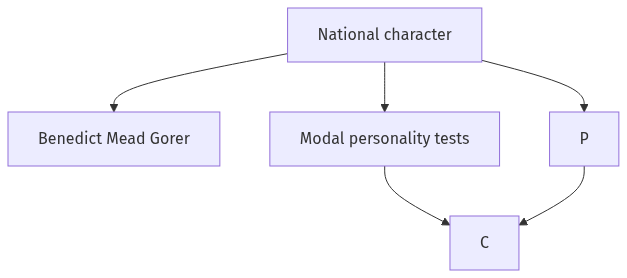
Conclusion
National character studies were a political method of knowing nations through modal personality, strongest in Benedict and the wartime seminars. They remain relevant as a warning and as a demand for cultural literacy without a single national soul.
Quick related
Students also ask
-
Debate between formalist and substantivist approaches
Next question on this syllabus topic (2022 · Q1(a)). View answer →
-
Should these studies be dropped from the syllabus?
No. They show how anthropology entered the state, and why personality is the wrong unit for a nation.
-
Is Hofstede the same thing?
It is a later managerial relative. It still risks one score for a country, which is the old problem in a spreadsheet.
Same topic · past papers
UPSC has asked this before
These previous-year questions sit on the same topic. Open one to practise the earlier ask.
-
2026 · Q8(c) · Anthropology GS 1 · 20 marks
Discuss, with appropriate examples, how basic personality types may contribute towards building up of national character
More from this topic
Q6(b) · UPSC Mains 2023 · Anthropology GS 1 · 15 marks · Solution
Discuss the impact of globalization on the economic systems of indigenous communities.
Economic Organization
Wolf already placed local peoples inside world markets. Globalization intensifies land commodification, wage labour, and branded culture. Niyamgiri and dam displacement are Indian cases of resource enclosure. Remittances and tourism can feed and hollow the same household. New brokers create internal inequality. Friction, law, and cooperatives are the counter-moves, not a return to a closed isolate.
Q1(a) · UPSC Mains 2022 · Anthropology GS 1 · 10 marks · Solution
Debate between formalist and substantivist approaches
Economic Organization
Formalists treat scarcity and choice as universal. Substantivists, after Polanyi, treat reciprocity, redistribution, and market as historical forms. Kula and Nuer cattle show goods locked in kinship and prestige. Spheres of exchange refuse one money. Use both tools: calculation inside an instituted process.
Q4(a) · UPSC Mains 2016 · Anthropology GS 1 · 20 marks · Solution
Discuss the principles governing production, distribution and exchange in simple societies.
Economic Organization
Production is household and lineage labour on common or clan land. Distribution follows reciprocity and redistribution more than wage. Exchange is gift, kula-like partnership, and spheres of goods. Polanyi and Sahlins name the principles. Price market is not the default law.