
Revision summary
The tradition is Middle Palaeolithic flakes, Levallois technique, scrapers, points and denticulates. Bordes saw facies as cultural variants. Binford saw functional tool-kits. Culture includes fire, hunting and shelters. Be cautious on burial and ornament. Makers in Europe are mainly Neanderthals. In the Levant early modern humans also used Mousterian tools. The date ballpark is the Middle Palaeolithic, to about 40,000 years ago in Europe. Mousterian is not identical with all Neanderthal behaviour everywhere.
Model answer
Copper italics in this answer — like this — are the key facts. Each one is unpacked in the Facts & figures rail.
Introduction
Mousterian names a Middle Palaeolithic stone-working tradition, a broader way of life often linked to Neanderthals, and a set of makers who were not always one species. Tradition, culture and makers are three related things, not three names for Neanderthal.
Body
Tool tradition
The Mousterian is a flake-based industry. The famous Levallois prepared-core method shapes the core so that the flake’s form is already planned. Scrapers, especially side-scrapers, points, denticulates and notched pieces dominate. Handaxes recede relative to the Acheulean. The type site is Le Moustier in France.
François Bordes typed regional facies such as typical, denticulate, Quina and Charentian. Lewis Binford later argued that many facies are functional — butchery versus woodwork — rather than tribal styles. Typology exists; it is not automatically ethnicity. The tradition is economical with stone and suited to hafting, which implies composite tools.
Mousterian culture
Beyond stone, the package includes habitual fire, hunting of medium and large mammals, and use of caves and rock shelters. Some sites have pigment and possible personal ornament. Burial is debated site by site. Shanidar in Iraq is often cited, with caution. The culture is a Middle Palaeolithic way of life in cold-to-temperate Eurasia, with related industries in the Levant and North Africa. It is not one ceremony, and it is not a single pan-Mousterian religion.
Makers
In Europe the makers are primarily Neanderthals (Homo neanderthalensis), from roughly the later Middle Pleistocene until about 40,000 years ago depending on region, overlapping incoming Homo sapiens. In the Levant, Mousterian assemblages are associated with both Neanderthals and early modern humans, as at Skhul and Qafzeh versus Tabun and Amud. North African Middle Stone Age and Mousterian-like industries have their own hominin casts.
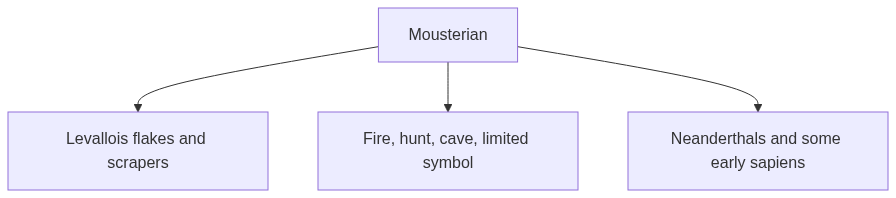
So tradition is technological. Culture is behavioural ecology plus limited symbolism. Makers are Neanderthals as the European default, with early sapiens sharing the toolkit at the gates of Europe.
Flow diagram
Conclusion
Mousterian is a flake-and-Levallois tradition, a Middle Palaeolithic adaptive culture, and, in Europe, a Neanderthal signature that sapiens could also knap. Bordes versus Binford belongs on the tradition side: facies need not mean tribes.
Quick related
Students also ask
-
Attributes of culture
Next question on this syllabus topic (2024 · Q1(a)). View answer →
-
Is Mousterian only Europe?
The type site is Le Moustier in France. Related Middle Palaeolithic flake industries extend across western Eurasia and North Africa.
-
Did Neanderthals have art?
Some sites support pigment and possible ornaments. The case is site-wise, not a blank yes for all Mousterian culture.
Same topic · past papers
UPSC has asked this before
These previous-year questions sit on the same topic. Open one to practise the earlier ask.
-
2025 · Q1(c) · Anthropology GS 1 · 10 marks
Osteodontokeratik culture and its makers.
More from this topic
Q1(e) · UPSC Mains 2025 · Anthropology GS 1 · 10 marks · Solution
Culture and embodiment.
The Nature of Culture
Embodiment means culture is lived as a body, not only as symbols in the head. Csordas, following Merleau-Ponty, treated the body as the ground of culture. Bourdieu’s habitus is class and gender as posture, taste and practical sense. Mauss described techniques of the body such as walking, swimming and childbirth. Medical anthropology uses the mindful body and structural violence made flesh. The body is cultural practice, not a costume.
Q5(b) · UPSC Mains 2024 · Anthropology GS 1 · 10 marks · Solution
Cultural relevance of the Kula
The Nature of Culture
Malinowski described Kula exchange among the Massim in Argonauts of the Western Pacific. Soulava necklaces move clockwise and mwali armbands counter-clockwise. Temporary possession yields prestige; valuables must circulate. Kula creates delayed reciprocity, trust, leadership and inter-island integration. Gimwali barter accompanies but is distinguished from ceremonial exchange. Weiner corrected Malinowski's male bias by documenting women's wealth and exchange.
Q1(c) · UPSC Mains 2024 · Anthropology GS 1 · 10 marks · Solution
Critical perspective on avoidance and joking relationship
The Nature of Culture
Avoidance prescribes reserve; joking licenses teasing between named kin categories. Radcliffe-Brown read both as complementary ways of regulating conjunction and separation. Mother-in-law/son-in-law avoidance and cross-cousin or junior-affine joking are common patterns. Symmetrical joking permits reciprocity; asymmetrical joking protects one-sided licence. Gluckman highlights ritualised expression of contradiction. Critical analysis asks whether joking reproduces gendered power and whether rules match actual conduct.