
Revision summary
Lifestyle diseases include cardiovascular disease, type-2 diabetes, obesity, chronic respiratory disease and some cancers. Omran describes epidemiological transition, but India often carries infectious and chronic burdens together. Barker links early-life nutrition to adult risk; Neel’s thrifty-genotype hypothesis is limited. Popkin’s nutrition transition and Singer’s syndemics put behaviour inside social change. Food markets, work, housing and care access constrain “choice”. Prevention requires structural policy, culturally informed care and individual risk reduction together.
Model answer
Copper italics in this answer — like this — are the key facts. Each one is unpacked in the Facts & figures rail.
Introduction
Lifestyle diseases are chronic non-communicable conditions whose risk is shaped by diet, physical activity, tobacco, alcohol, sleep and stress. The phrase is convenient but dangerous: it can convert constrained environments into individual “choices”. Anthropology relocates behaviour inside evolution, culture, class and political economy.
Body
Pattern and mechanisms
Cardiovascular disease, type-2 diabetes, obesity, chronic respiratory disease and several cancers dominate the category. Energy-dense diets, tobacco, sedentary work, air pollution, hypertension and metabolic dysregulation interact with age and genetic susceptibility. Abdel Omran’s epidemiological transition describes the population shift from infectious mortality toward chronic and degenerative disease, but many low- and middle-income populations face both simultaneously.
Evolutionary accounts propose mismatch between earlier environments and rapid urban-industrial change. James Neel’s “thrifty genotype” was influential but is neither a proven single genotype nor an adequate explanation of population differences. David Barker’s developmental-origins hypothesis is better supported: fetal and early-life undernutrition can alter later cardiometabolic risk. Biology therefore carries a life history.
Anthropological critique
- Nutrition transition: Barry Popkin describes shifts toward processed foods, fats and sugars alongside declining activity.
- Ethnographic change: Turkana moving from pastoral settings to towns experienced altered diet, activity and stress; such cases show transition, not a timeless ethnic predisposition.
- Political economy: Cheap ultra-processed food, unsafe walking space, long work hours, advertising and unequal preventive care structure behaviour. Tobacco or diabetes cannot be reduced to willpower.
- Syndemics: Merrill Singer’s concept explains mutually reinforcing disease under inequality—for example diabetes with tuberculosis, depression or food insecurity.
In India, urbanisation and changing work coexist with persistent anaemia, undernutrition and infection. A low-birth-weight child may later encounter caloric abundance: the “double burden” can occur in one household. Tribal and migrant populations may face market displacement from traditional diets without gaining reliable care.
Impact
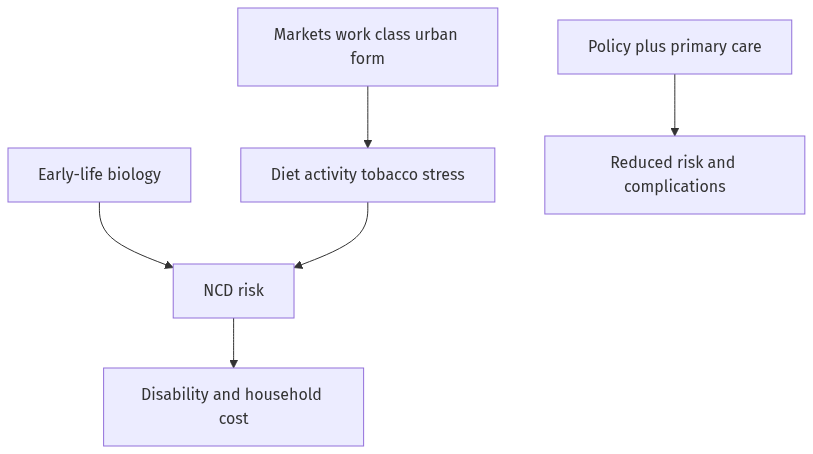
Chronic disease produces premature mortality, disability, renal and vascular complications, catastrophic household spending and long-term care burdens. Gendered caregiving and late diagnosis magnify effects. Prevention must combine tobacco control, food and urban policy, primary screening and culturally intelligible care—not only advice to exercise.
Flow diagram
Conclusion
Lifestyle matters, but lifestyles are socially produced. A critical account joins behaviour to developmental plasticity, commercial food systems, work and inequality. Effective prevention changes environments and care pathways as well as individual habits.
Quick related
Students also ask
-
What is meant by health? Is the burden of life style diseases on the rise? Justify your answer with suitable examples
Next question on this syllabus topic (2022 · Q6(b)). View answer →
-
Are lifestyle diseases entirely preventable?
Risk can be reduced, but age, developmental history, genetics, pollution and constrained resources prevent a simple choice-based account.
-
Why is the term criticised?
It can blame patients while hiding food systems, unsafe urban space, labour regimes, advertising and unequal access to prevention.
Same topic · past papers
UPSC has asked this before
These previous-year questions sit on the same topic. Open one to practise the earlier ask.
-
2022 · Q6(b) · Anthropology GS 1 · 15 marks
What is meant by health? Is the burden of life style diseases on the rise? Justify your answer with suitable examples -
2016 · Q7(c) · Anthropology GS 1 · 15 marks
Describe the scope of Epidemiological Anthropology in the study of infectious and non-infectious diseases. -
2025 · Q5(e) · Anthropology GS 1 · 10 marks
Foetal origin of adult diseases and contribution of David Barker. -
2022 · Q5(b) · Anthropology GS 1 · 10 marks
Genetic imprinting in human diseases
More from this topic
Q1(e) · UPSC Mains 2024 · Anthropology GS 1 · 10 marks · Solution
Hemoglobin in health and disease.
Epidemiological Anthropology
HbA is α2β2; HbF is α2γ2 and has higher oxygen affinity. Haemoglobin carries oxygen and participates in carbon-dioxide and acid–base physiology. HbS polymerises when deoxygenated; HbSS causes disease while HbAS may protect against severe falciparum malaria. Thalassaemia is deficient globin-chain production, not an abnormal iron molecule. HbE, HbC and thalassaemia distributions record selection, drift and migration. Anaemia also has nutritional, infectious and inflammatory causes, so genotype is not the whole diagnosis.
Q6(b) · UPSC Mains 2022 · Anthropology GS 1 · 15 marks · Solution
What is meant by health? Is the burden of life style diseases on the rise? Justify your answer with suitable examples
Epidemiological Anthropology
WHO health includes mental and social well-being, not only no germs. Kleinman split disease from lived illness. Diabetes, hypertension, and heart disease are rising with urban diets and sitting work. Tribal and Pacific transitions show how fast metabolism follows food change. Structure, not only willpower, explains the burden.
Q7(c) · UPSC Mains 2016 · Anthropology GS 1 · 15 marks · Solution
Describe the scope of Epidemiological Anthropology in the study of infectious and non-infectious diseases.
Epidemiological Anthropology
The field links disease rates to culture and environment. Infections follow water, crowding, stigma, and zoonotic edges. Non-infectious disease follows diet, work, and early-life nutrition. Kleinman’s models explain treatment uptake. Scope is biosocial explanation for prevention.