
Revision summary
WHO health includes mental and social well-being, not only no germs. Kleinman split disease from lived illness. Diabetes, hypertension, and heart disease are rising with urban diets and sitting work. Tribal and Pacific transitions show how fast metabolism follows food change. Structure, not only willpower, explains the burden.
Model answer
Copper italics in this answer — like this — are the key facts. Each one is unpacked in the Facts & figures rail.
Introduction
Health is more than the absence of a named infection. WHO called it complete physical, mental, and social well-being. Anthropology adds that well-being is locally defined and unequally distributed.
Body
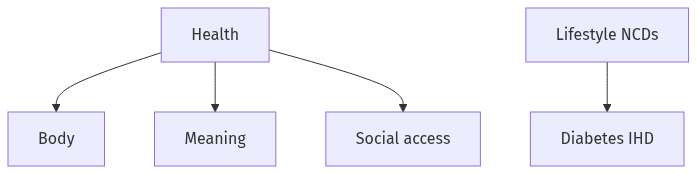
Meanings of health
- Rivers and later medical anthropologists treated sickness as both biology and meaning. Kleinman split disease, illness, and sickness.
- A pastoralist may call health the ability to walk with the herd. A factory index may call it blood pressure.
Lifestyle disease burden
- Urban diets, sitting work, tobacco, and alcohol raise type 2 diabetes, hypertension, IHD, and some cancers. ICMR and WHO India profiles show this rise beside unfinished infection.
- Thrifty hypotheses after Neel are debated, but the empirical rise in Indian metros and now in small towns is clear.
- Indigenous groups after ration rice and reduced walk, as in some Pacific and Indian tribal transitions, show rapid metabolic change.
- The burden is not only personal choice. Farmer would call it structural: oil, sugar, stress, and weak public sport.
Flow diagram
Conclusion
Health is functioning in a social world, not a lab slip alone. Lifestyle diseases are rising in India because environments of food and work have changed faster than bodies and public systems.
Quick related
Students also ask
-
Describe the scope of Epidemiological Anthropology in the study of infectious and non-infectious diseases.
Next question on this syllabus topic (2016 · Q7(c)). View answer →
-
Have infections disappeared?
No. India carries a double burden: TB and undernutrition beside diabetes.
-
Is lifestyle a blaming word?
It names diet and movement. Anthropology must still name class, caste, and food markets.
Same topic · past papers
UPSC has asked this before
These previous-year questions sit on the same topic. Open one to practise the earlier ask.
-
2024 · Q2(c) · Anthropology GS 1 · 15 marks
Critically comment on the lifestyle diseases and their impact on human health. -
2026 · Q3(a) · Anthropology GS 1 · 20 marks
How do the concepts of power, authority, legitimacy and social control change with changing political organization? Discuss in detail giving suitable examples -
2026 · Q3(c) · Anthropology GS 1 · 15 marks
Numerical chromosomal aberrations can be due to abnormalities in autosomes as well as sex chromosomes. Elaborate in terms of the effects these have on human body, giving suitable examples -
2026 · Q6(a) · Anthropology GS 1 · 20 marks
How would you find out that a particular disease/disorder is inherited and, if so, in which manner? Elaborate with suitable examples -
2024 · Q6(b) · Anthropology GS 1 · 15 marks
Discuss the applications of forensic anthropology with suitable examples.
More from this topic
Q2(c) · UPSC Mains 2024 · Anthropology GS 1 · 15 marks · Solution
Critically comment on the lifestyle diseases and their impact on human health.
Epidemiological Anthropology
Lifestyle diseases include cardiovascular disease, type-2 diabetes, obesity, chronic respiratory disease and some cancers. Omran describes epidemiological transition, but India often carries infectious and chronic burdens together. Barker links early-life nutrition to adult risk; Neel’s thrifty-genotype hypothesis is limited. Popkin’s nutrition transition and Singer’s syndemics put behaviour inside social change. Food markets, work, housing and care access constrain “choice”. Prevention requires structural policy, culturally informed care and individual risk reduction together.
Q1(e) · UPSC Mains 2024 · Anthropology GS 1 · 10 marks · Solution
Hemoglobin in health and disease.
Epidemiological Anthropology
HbA is α2β2; HbF is α2γ2 and has higher oxygen affinity. Haemoglobin carries oxygen and participates in carbon-dioxide and acid–base physiology. HbS polymerises when deoxygenated; HbSS causes disease while HbAS may protect against severe falciparum malaria. Thalassaemia is deficient globin-chain production, not an abnormal iron molecule. HbE, HbC and thalassaemia distributions record selection, drift and migration. Anaemia also has nutritional, infectious and inflammatory causes, so genotype is not the whole diagnosis.
Q7(c) · UPSC Mains 2016 · Anthropology GS 1 · 15 marks · Solution
Describe the scope of Epidemiological Anthropology in the study of infectious and non-infectious diseases.
Epidemiological Anthropology
The field links disease rates to culture and environment. Infections follow water, crowding, stigma, and zoonotic edges. Non-infectious disease follows diet, work, and early-life nutrition. Kleinman’s models explain treatment uptake. Scope is biosocial explanation for prevention.