
Revision summary
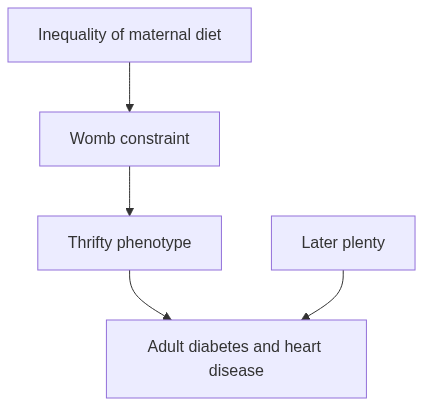
David Barker linked poor foetal growth to later adult heart disease and diabetes. Hales and Barker’s thrifty phenotype says the foetus adapts to scarcity and then mismatches plenty. This is developmental plasticity, not a single-gene disease. Indian discussion of thin–fat bodies and urban diets illustrates the mismatch. The idea joins nutrition, embodiment and political economy. The constraint is often structural, not a moral failure of mothers.
Model answer
Copper italics in this answer — like this — are the key facts. Each one is unpacked in the Facts & figures rail.
Introduction
David Barker argued that adult heart disease, stroke and type 2 diabetes can begin in the womb. Poor foetal growth, often marked by low birth weight, programmes the body for a world of scarcity. If later life is calorie-rich, the mismatch becomes disease. This is the foetal origins of adult disease, now often called DOHaD.
Body
Barker’s contribution
Using English birth and death records, Barker showed that areas with high infant mortality decades earlier also showed high adult coronary disease. The thrifty phenotype idea, developed with C. N. Hales, says the foetus adapts: smaller body, altered liver and pancreas, different blood-pressure settings. Those settings help survival if food stays short. They harm if the child later meets cheap sugar, oil and sitting work.
This is developmental plasticity, not a Mendelian defect. It sits beside nutritional anthropology: the plate of the pregnant woman is already political economy.
How anthropologists use it
- Mechanism: The uterus is an environment. Placental nutrition, infection, stress and the mother’s own childhood shape the foetus. Embodiment is literal here.
- Indian research: Physicians such as C. S. Yajnik have discussed a “thin–fat” pattern: relatively small birth size with later central fat and diabetes risk. The point is mismatch between a constrained womb and an urban food environment.
- Inequality: Low birth weight clusters with caste, class, women’s food, anaemia and indoor smoke. Barker’s biology does not replace Wolf’s political economy. It gives it a body.
- Current examples: COVID-19 pregnancy stress, heat and food-price shocks, and the gap between ICDS pregnancy care and actual intra-household allocation are living illustrations of the same hypothesis.
Significance
Foetal origins join biological and social anthropology. They warn that adult lifestyle advice that ignores the first thousand days will miss the poor. They also warn against blaming the mother as a moral failure: the constraint is often structural.
Flow diagram
Conclusion
Barker showed that adult metabolic and cardiovascular disease can be written in foetal growth. The thrifty phenotype is an adaptation to scarcity that becomes a risk in plenty. Anthropology’s job is to place that womb inside ecology, culture and inequality, not to stop at birth weight as a number.
Quick related
Students also ask
-
Is this Lamarckism?
No. It is developmental plasticity and, in some later work, epigenetic regulation. It does not claim that acquired adult gym habits rewrite the species.
-
How does this join nutritional anthropology?
Maternal diet, infection and inequality shape birth size; adult markets then mismatch that programming.
Same topic · past papers
UPSC has asked this before
These previous-year questions sit on the same topic. Open one to practise the earlier ask.
-
2023 · Q8(c) · Anthropology GS 1 · 15 marks
Critically discuss A.L. Kroeber's contribution to kinship studies.