
Revision summary
HbA is α2β2; HbF is α2γ2 and has higher oxygen affinity. Haemoglobin carries oxygen and participates in carbon-dioxide and acid–base physiology. HbS polymerises when deoxygenated; HbSS causes disease while HbAS may protect against severe falciparum malaria. Thalassaemia is deficient globin-chain production, not an abnormal iron molecule. HbE, HbC and thalassaemia distributions record selection, drift and migration. Anaemia also has nutritional, infectious and inflammatory causes, so genotype is not the whole diagnosis.
Model answer
Copper italics in this answer — like this — are the key facts. Each one is unpacked in the Facts & figures rail.
Introduction
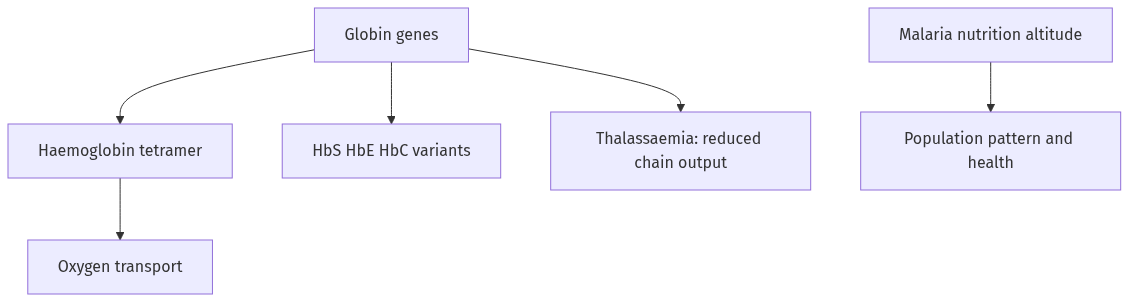
Haemoglobin is the iron-containing tetramer in red blood cells that transports oxygen and contributes to carbon-dioxide and acid–base regulation. Its molecular variants connect physiology, Mendelian inheritance, malaria ecology, migration and public health, making it a classic marker in biological anthropology.
Body
Normal function and variation
Adult HbA is mainly two alpha and two beta globin chains (α2β2), each carrying haem. HbA2 is α2δ2, while fetal HbF (α2γ2) has higher oxygen affinity and supports placental transfer. After birth, globin-chain expression switches from gamma toward beta. Iron deficiency reduces haemoglobin concentration but is not a globin-gene disorder.
Health and disease
- Sickle-cell disease: A missense variant in HBB substitutes valine for glutamic acid in beta-globin. Deoxygenated HbS polymerises, distorting cells and causing haemolysis, vaso-occlusion and organ injury. HbSS is disease; HbAS is usually a healthy trait.
- Thalassaemias: Reduced alpha- or beta-chain production causes imbalance, anaemia and ineffective erythropoiesis. Severity ranges from silent carrier states to transfusion-dependent beta-thalassaemia major.
- Other variants: HbE is frequent in parts of eastern and Southeast Asia and may interact severely with beta-thalassaemia. HbC occurs especially in West Africa. Their geographic distributions reflect mutation, drift, migration and selection.
- Acquired states: Anaemia may follow iron, folate or B12 deficiency, malaria, hookworm, inflammation or blood loss. Excess haemoglobin or erythrocytosis at altitude can aid oxygen carriage but also increase blood viscosity.
J. B. S. Haldane proposed that thalassaemia geography related to malaria; A. C. Allison supplied direct evidence for HbAS advantage against severe falciparum malaria. This does not mean “malaria causes sickle mutation”: malaria changes the fitness of pre-existing variants.
In India, sickle variants occur in several central, western and southern populations, while beta-thalassaemia and HbE have different regional concentrations. Screening must combine electrophoresis or HPLC with counselling and must avoid turning population association into caste or tribal stigma.
Flow diagram
Conclusion
Haemoglobin is simultaneously a respiratory molecule and an evolutionary record. Chain switching, structural variants and production defects explain disease; malaria, migration, nutrition and care explain their unequal distribution and consequences.
Quick related
Students also ask
-
Critically comment on the lifestyle diseases and their impact on human health.
Next question on this syllabus topic (2024 · Q2(c)). View answer →
-
Is every low haemoglobin value inherited?
No. Iron deficiency, infection, inflammation, parasites and blood loss are common acquired causes.
-
Does malaria create the HbS allele?
No. Mutation creates variation; malaria changes relative survival and can maintain the heterozygous state by selection.
Same topic · past papers
UPSC has asked this before
These previous-year questions sit on the same topic. Open one to practise the earlier ask.
-
2025 · Q8(b) · Anthropology GS 1 · 15 marks
'Genome-wide Disease Association Studies (GWAS) advanced our understanding of health and disease.' Discuss -
2026 · Q6(a) · Anthropology GS 1 · 20 marks
How would you find out that a particular disease/disorder is inherited and, if so, in which manner? Elaborate with suitable examples -
2025 · Q6(a) · Anthropology GS 1 · 20 marks
What are genetic markers? Discuss their applications in understanding population variation, disease association and forensics
More from this topic
Q2(c) · UPSC Mains 2024 · Anthropology GS 1 · 15 marks · Solution
Critically comment on the lifestyle diseases and their impact on human health.
Epidemiological Anthropology
Lifestyle diseases include cardiovascular disease, type-2 diabetes, obesity, chronic respiratory disease and some cancers. Omran describes epidemiological transition, but India often carries infectious and chronic burdens together. Barker links early-life nutrition to adult risk; Neel’s thrifty-genotype hypothesis is limited. Popkin’s nutrition transition and Singer’s syndemics put behaviour inside social change. Food markets, work, housing and care access constrain “choice”. Prevention requires structural policy, culturally informed care and individual risk reduction together.
Q6(b) · UPSC Mains 2022 · Anthropology GS 1 · 15 marks · Solution
What is meant by health? Is the burden of life style diseases on the rise? Justify your answer with suitable examples
Epidemiological Anthropology
WHO health includes mental and social well-being, not only no germs. Kleinman split disease from lived illness. Diabetes, hypertension, and heart disease are rising with urban diets and sitting work. Tribal and Pacific transitions show how fast metabolism follows food change. Structure, not only willpower, explains the burden.
Q7(c) · UPSC Mains 2016 · Anthropology GS 1 · 15 marks · Solution
Describe the scope of Epidemiological Anthropology in the study of infectious and non-infectious diseases.
Epidemiological Anthropology
The field links disease rates to culture and environment. Infections follow water, crowding, stigma, and zoonotic edges. Non-infectious disease follows diet, work, and early-life nutrition. Kleinman’s models explain treatment uptake. Scope is biosocial explanation for prevention.