
Revision summary
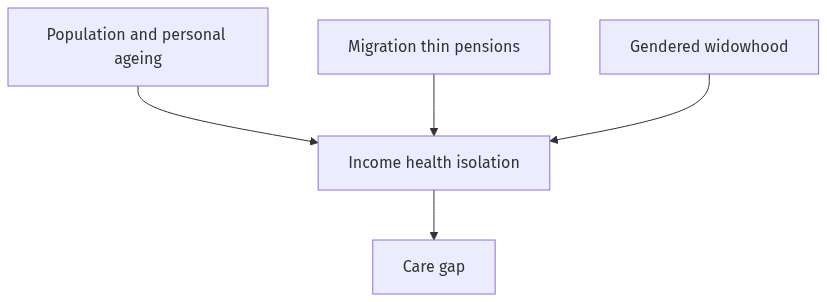
Ageing is growing older and the rising share of older persons in the population. Indian problems are income insecurity, illness, isolation and elder abuse. Older women, especially widows, are more exposed. Migration stretches family care without a full public substitute. Regional demographic ageing is uneven.
Model answer
Copper italics in this answer — like this — are the key facts. Each one is unpacked in the Facts & figures rail.
Introduction
Ageing is both a personal process of growing old and a population process in which the share of older persons rises. In India it now meets thinner joint households, uneven pensions, and a care load that still falls on women.
Body
Concept
- Chronological markers such as sixty years sit beside social ageing: widowhood, retirement, and loss of the karta role.
- Demographic ageing in India is faster in Kerala and Tamil Nadu than in high-fertility states, so problems are regional as well as national.
Major problems
- Income insecurity: informal workers lack pensions; agricultural old age depends on sons, plots, and schemes that are thin.
- Health: multiple illness, costly private care, and poor geriatrics in public hospitals.
- Isolation and neglect as adult children migrate; the continuum of rural-urban life can leave the aged in the village with a phone and little daily help.
- Widowhood, property denial, and patriarchal dependence make older women the more vulnerable face of ageing.
- Elder abuse, including property harassment, is under-reported; the Maintenance and Welfare of Parents and Senior Citizens Act, 2007, is unevenly used.
- Digital welfare and banking exclude many who cannot navigate apps, which is a new exclusion Yogendra Singh’s modernity can produce.
Sociological note
- Beteille’s family as an institution still carries care because the public system is weak.
- Caste and class decide whether old age is a pensioned leisure or a continued field labour.
Flow diagram
Conclusion
Ageing in India is a rising share of older persons facing income, health, isolation, and gendered neglect. The family remains the main welfare site; that is a problem when the family is stretched by migration and inequality.
Quick related
Students also ask
-
Elucidate the challenges of integration for tribal communities in india.
Next question on this syllabus topic (2022 · Q1(c)). View answer →
-
Is the joint family a solution to ageing?
It still provides most care. Migration and women’s unpaid burden mean it cannot be the only policy.
-
Are the aged only a dependency?
Many still work and care for grandchildren. The problem is insecurity, not the fact of living long.
Same topic · past papers
UPSC has asked this before
These previous-year questions sit on the same topic. Open one to practise the earlier ask.
-
2021 · Q6(b) · Sociology GS 2 · 20 marks
Is 'ageing an emerging issue in Indian society ? Discuss the major problems of the old age people in India -
2025 · Q5(d) · Sociology GS 2 · 10 marks
What are the major problems faced by the labour migrants while working in informal sectors of Indian States? Discuss. -
2016 · Q7(c) · Sociology GS 2 · 15 marks
How is ageing becoming an emerging issue in Indian society ?
More from this topic
Q8(c) · UPSC Mains 2026 · Sociology GS 2 · 10 marks · Solution
Where would you locate the tribal community in the Varna system of India? Discuss
Tribal communities in India
• Historically, tribal groups (Adivasis) lived outside the classical Varna system in distinct forest
Q6(a) · UPSC Mains 2025 · Sociology GS 2 · 20 marks · Solution
In what respects have the constitutional provisions changed the socio-economic and political conditions of Scheduled Castes and Scheduled Tribes in India? Critically examine
Tribal communities in India
Articles 15–17, 16(4), legislative reservation, commissions and the Schedules form the SC/ST constitutional machine. They produced political presence and an educated professional minority unprecedented in 1950. PoA, PESA and FRA extend protection into violence and livelihood, with weak delivery. Landlessness, atrocities, displacement and intra-group inequality remain. The Constitution changed conditions without completing social democracy.
Q1(d) · UPSC Mains 2025 · Sociology GS 2 · 10 marks · Solution
How did Colonial Policies for the tribes affected their socio-economic conditions in India? Discuss.
Tribal communities in India
Colonial tribal policy combined forest reservation, land revenue, labour recruitment and criminal tribes law. Economic effects were land alienation, indebtedness and incorporation as cheap labour. Missions and schools created a small elite and cultural change. Elwin’s isolation and Ghurye’s assimilation framed official thought more than they described the frontier. Independent India’s ST law and FRA still answer that colonial structure.