
Revision summary
Thorner’s malik–kisan–mazdoor map still orients agrarian class, with caste as the usual skin. Land reform thinned intermediaries unevenly; ceilings and tenancy left loopholes. Green Revolution and commercial farming produced capitalist farmers and a larger hired workforce. MGNREGA, migration and peri-urban land markets further split classes. Change is real but not a uniform national shift from feudalism to pure agrarian capitalism.
Model answer
Copper italics in this answer — like this — are the key facts. Each one is unpacked in the Facts & figures rail.
Introduction
Agrarian class structure in India was never a simple two-class war. Daniel Thorner spoke of malik, kisan and mazdoor. A. R. Desai and D. N. Dhanagare read peasant movements through class fractions. Modern forces—legislation, technology, markets and welfare—have rearranged those fractions without wiping out caste or landlord power everywhere.
Body
The older map
Zamindari, ryotwari and mahalwari produced different mixes of rent, revenue and labour. After zamindari abolition, intermediaries were legally thinned, but ceiling evasion, benami, and tenancy insecurity left a class of surplus-appropriators. In wet rice and canal regions, a rich peasant / capitalist farmer layer grew. In dry regions, smallholders and labourers remained exposed. Kathleen Gough, Béteille and village ethnography showed class sitting on caste: landowning dominant castes, tenant middle groups, and Dalit labour.
Modern forces
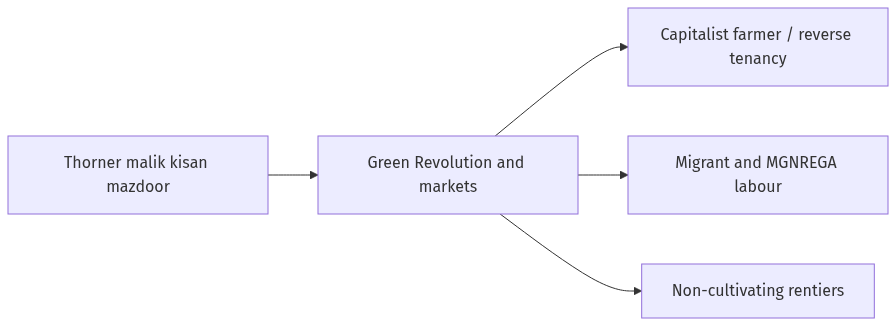
Land reform was regionally uneven (Kerala and West Bengal versus Bihar’s delayed theatre). The Green Revolution (Punjab, Haryana, west UP, parts of Tamil Nadu and Andhra) differentiated a tractor-and-tube-well class from hired labour, raised yields, and later fed a crisis of water, debt and surplus youth. Commercialisation and contract farming insert companies into cane, poultry and vegetables. Reverse tenancy appears where small owners lease to machine-owning farmers. MGNREGA and PDS shift the bargaining power of labour, especially women, without creating a full rural proletariat in Marx’s sense. Migration—circular, Gulf, factory—turns the village into a labour-exporting household. Corporate land acquisition and peri-urban real estate create a rentier layer of non-cultivating owners.
Caste still organises who owns the tubewell and who does the weeding. Jats, Reddys, Patidars, Vokkaligas illustrate agrarian class as status group. Farmer protests mix price politics with that status. At the bottom, landless Dalit and Adivasi labour remain the most proletarianised, now also in brick kilns and construction. Women do a large share of field work yet rarely hold title, so class maps are gender-blind unless we name unpaid family labour.
APMC markets, corporate retail, and the brief farm laws conflict showed that “modern forces” include the state as price-maker, not only the tractor. Dairy cooperatives and contract poultry create petty commodity producers who look independent and remain tied to companies. NITI and insurance schemes treat the farmer as an entrepreneur; village ethnography still finds debt, honour, and jati in the same ledger.
- The critical point: modern forces have pluralised agrarian classes—petty commodity producers, capitalist farmers, absentee landlords, migrant labour—rather than delivering one national kulak versus one national labourer.
Flow diagram
Conclusion
Agrarian class structure is changing under law, technology, markets and migration, but it is still a caste-inflected, regionally split formation. Thorner’s three terms remain a useful skeleton; the flesh is now Green Revolution capital, welfare wages, and non-cultivating owners.
Quick related
Students also ask
-
Do you think that law has been able to abolish child labour in India? Comment.
Next question on this syllabus topic (2025 · Q5(e)). View answer →
-
Did land reform create a nation of peasant proprietors?
Only in patches. Intermediaries were abolished more successfully than ceilings were enforced; tenancy often went underground.
-
Is the farmer a single class?
No. Price agitation often speaks for surplus producers, while labourers and tiny holders have different interests in wages and NREGA.
Same topic · past papers
UPSC has asked this before
These previous-year questions sit on the same topic. Open one to practise the earlier ask.
-
2023 · Q2(c) · Sociology GS 2 · 10 marks
Analyse the role of market and modern forces in understanding the changing trends in marriage systems in India -
2024 · Q2(c) · Sociology GS 2 · 10 marks
What, according to Andre Beteille, are the bases of agrarian class structure in India? Analyse -
2023 · Q4(b) · Sociology GS 2 · 20 marks
Explain the implications and the impact of globalization in situating the changing agrarian class structure in Indin -
2022 · Q1(b) · Sociology GS 2 · 10 marks
Do you agree that the agrarian class structure in India is changing ?Justify your answer with illustrations. -
2019 · Q3(b) · Sociology GS 2 · 20 marks
Is industrial development in India a bane or a born to agrarian class structure ? Substantiate your answer with suitable examples
More from this topic
Q7(c) · UPSC Mains 2026 · Sociology GS 2 · 10 marks · Solution
Examine the process of formalisation of informal sector to safeguard the interests of marginalised sections of the society
Industrialization and Urbanisation in India
• **Core Objective:** Formalising India's vast informal workforce integrates vulnerable groups into legal and institutional frameworks to secure their rights. • **Digital Tracking:** The e-Shram portal creates national databases and assigns Unique Account Numbers (UAN) to make unorganized workers visible for welfare delivery. • **Welfare Delivery:** Registration streamlines access to accident insurance, PM-SYM pensions, and direct benefit transfers. • **Wage Reforms:** Consolidating labour laws introduces universal statutory minimum wages and mandates formal appointment letters. • **Safety Standards:** New codes aim to improve occupational health and reduce the workplace exploitation of marginalised communities. • **Implementation Hurdles:** High compliance costs push micro-enterprises to stay informal, limiting the reach of safety nets. • **Social Realities:** Deep-rooted caste and class vulnerabilities among SC, ST, and OBC workers require more than just administrative registration to resolve.
Q6(b) · UPSC Mains 2025 · Sociology GS 2 · 20 marks · Solution
Discuss the trend of urbanization in India. Do you think that Industrialization is the only precondition of urbanization? Give you arguments
Industrialization and Urbanisation in India
India’s urbanisation is rising but remains metro-concentrated and full of census towns and slums. Kundu’s exclusionary urbanisation captures labour demand without inclusive housing. Tertiary growth, administrative history, transport and agrarian distress urbanise besides factories. Industrial belts exist and matter; they do not exhaust the trend. Policy that waits only for industry misses actually existing urban India.
Q5(e) · UPSC Mains 2025 · Sociology GS 2 · 10 marks · Solution
Do you think that law has been able to abolish child labour in India? Comment.
Industrialization and Urbanisation in India
The 1986 Act as amended in 2016 bans most child work under 14 but allows family-enterprise help. RTE adds a schooling right that is unevenly realised. Child labour persists in agriculture, kilns, domestic and home-based informal work. Poverty, caste occupations and weak inspection explain the gap between statute and practice. Law delegitimised the practice more than it abolished it.