
Revision summary
Matrimonial markets often reinforce caste filters while changing how matches are found. Dowry and wedding display follow credential and consumption markets. Law, education and migration widen conjugality and delay marriage. Endogamy and honour codes still bound the field. The pattern is recasting, not replacement.
Model answer
Copper italics in this answer — like this — are the key facts. Each one is unpacked in the Facts & figures rail.
Introduction
Marriage in India is still mostly arranged inside caste and community. Markets and modern forces have changed how matches are made, who pays, and how far a couple may live from kin, without simply replacing the marriage system with free individual choice.
Body
Market forces
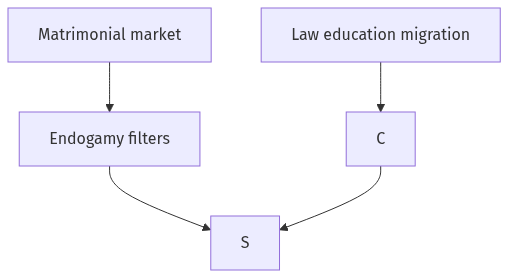
- Matrimonial newspapers, websites, and apps commodify bio-data: education, income, colour, and gotra become searchable filters that often tighten caste endogamy rather than dissolve it.
- Dowry inflation in several regions follows male credential markets; a salaried groom is priced, which is market logic inside a patriarchal gift.
- Wedding consumption and destination rituals display middle-class status, so marriage is also a consumption market.
Modern legal and social forces
- The Hindu Marriage Act, Special Marriage Act, and court support for adult choice, as in Lata Singh, sit beside family veto.
- Education, delayed age at marriage, and women’s employment increase bargaining inside the match, especially in cities.
- Migration and the urban middle class produce ‘arranged love’ and translocal households, which the Rudolphs would read as modernity of tradition.
What has not been marketised away
- Srinivas’s endogamy and Dumont’s hierarchy still organise the field of eligible spouses.
- Honour violence where choice crosses caste or faith shows the system policing its boundary when the market of dating leaks.
- Change is therefore in technology, timing, and conjugality, more than in the rule of who may marry whom.
Flow diagram
Conclusion
Markets and modern forces have recast matchmaking, cost, and residence. They have not made caste marriage a free market of individuals for most Indians.
Quick related
Students also ask
-
Define the concepts of 'Descent' and 'Alliance'. Differentiate between North Indian and South Indian Kinship systems with examples
Next question on this syllabus topic (2023 · Q3(b)). View answer →
-
Have dating apps ended arranged marriage?
They have added a search tool. Families still often convert a dating match into an arranged alliance.
-
Is dowry a traditional leftover only?
It is also a modern market in grooms’ jobs and degrees, which is why it can worsen with development.
Same topic · past papers
UPSC has asked this before
These previous-year questions sit on the same topic. Open one to practise the earlier ask.
-
2025 · Q2(b) · Sociology GS 2 · 20 marks
'Agrarian class structure has been undergoing changes due to modern forces.' Critically examine
More from this topic
Q7(a) · UPSC Mains 2026 · Sociology GS 2 · 20 marks · Solution
Urbanisation in Independent India has been characterized by over-urbanization and rural push. Explain with demographic and sociological dimensions
Systems of Kinship in India
• Indian urban growth is driven by distress migration from rural areas rather than industrial pull factors, creating over-urbanization. • The tertiary sector expands faster than secondary manufacturing, resulting in a large informal workforce, underemployment, and slum proliferation. • Urban population crossed 31% by 2011, fuelled by net migration and the reclassification of rural settlements into urban areas. • Primate city concentration in Tier-I metros causes lopsided regional development and severe strain on civic infrastructure. • Migration streams remain male-selective, leading to skewed sex ratios in cities and remittance-dependent rural households. • Caste, kinship networks, and primordial ties heavily mediate urban entry and occupational placement. • Cities exhibit deep socio-spatial dualism, separating formal enclaves from precarious informal settlements while altering family structures and gender roles.
Q1(e) · UPSC Mains 2024 · Sociology GS 2 · 10 marks · Solution
Despite the efforts of the government, bonded labour still continues in India. Discuss.
Systems of Kinship in India
The 1976 Act abolished bonded labour in law; neo-bondage continues in kilns, farms and migration streams. Advances and contractors tie Dalit, Adivasi and other poor households season after season. Breman’s neo-bondage is market unfreedom, not only old agrestic serfdom. Rescue without credit and work leads to re-bondage. Informal capitalism and caste together explain why government effort has not ended the practice.
Q1(d) · UPSC Mains 2024 · Sociology GS 2 · 10 marks · Solution
Do you think that family bondings are being affected by the changing kinship patterns in India? Comment.
Systems of Kinship in India
Kinship patterns in India are changing through migration, law, education and marriage markets. Shah and I. P. Desai separate residential nuclearisation from continuing joint family obligations. Bonds are stressed around care, authority and marriage choice. Remittances, caste weddings and digital contact keep translocal jointness alive. The family remains the main care institution for most groups.