
Revision summary
The 1986 Act as amended in 2016 bans most child work under 14 but allows family-enterprise help. RTE adds a schooling right that is unevenly realised. Child labour persists in agriculture, kilns, domestic and home-based informal work. Poverty, caste occupations and weak inspection explain the gap between statute and practice. Law delegitimised the practice more than it abolished it.
Model answer
Copper italics in this answer — like this — are the key facts. Each one is unpacked in the Facts & figures rail.
Introduction
Indian law restricts child labour; it has not abolished it. The Child Labour (Prohibition and Regulation) Act, 1986, amended in 2016, bans work for children under 14 in most occupations, allows help in family enterprises outside school hours, and treats 14–18 as adolescents barred from hazardous work. RTE 2009 promises schooling. The street, the kiln, and the farm still employ children.
Body
Why law is not enough
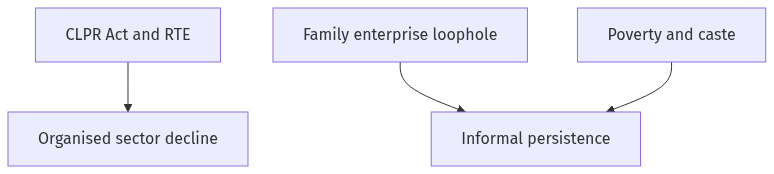
Child labour lives in the informal and agricultural majority, where labour inspectors barely go. The family enterprise clause is a sociological barn door: a loom, a dhaba, or a farm can hide a working child as “help.” Poverty and indebtedness make households treat children as earners. Caste assigns leather, sanitation, and brick-kiln work to the young of particular jatis. Girls do unpaid care and home-based piecework that statistics miss. Migration splits enrolment. COVID schooling loss pushed many back to work.
Law without a living wage, universal childcare, and inspection of contractors produces paper abolition. ILO conventions and National Policy on Child Labour set the right norm. Census and NSS/PLFS still find working children, especially as unpaid family workers. Rescue raids without scholarships and midday meals send the child back to the same kiln. NCPCR and childline matter; they cannot replace household income.
- The honest comment: law delegitimised factory child labour in the organised sector and created rescue-and-school pathways; it did not end the social demand for cheap, docile labour in the informal economy. Abolition would require treating child labour as a class and caste relation, not only as a missing FIR. NEP 2020’s schooling push helps only if attendance is cheaper than work.
Flow diagram
Conclusion
Law has reduced visible child labour in organised industry and named it a wrong. It has not abolished the practice, because family loopholes, informality, and household poverty keep children at work.
Quick related
Students also ask
-
Discuss the trend of urbanization in India. Do you think that Industrialization is the only precondition of urbanization? Give you arguments
Next question on this syllabus topic (2025 · Q6(b)). View answer →
-
Is any child work legal?
Adolescents 14–18 may do non-hazardous work. Under-14s may help in family enterprises outside school hours—a contested exception.
-
Did COVID worsen child labour?
School closure, income shock and digital divides pushed many children into paid and unpaid work; recovery is incomplete.
More from this topic
Q7(c) · UPSC Mains 2026 · Sociology GS 2 · 10 marks · Solution
Examine the process of formalisation of informal sector to safeguard the interests of marginalised sections of the society
Industrialization and Urbanisation in India
• **Core Objective:** Formalising India's vast informal workforce integrates vulnerable groups into legal and institutional frameworks to secure their rights. • **Digital Tracking:** The e-Shram portal creates national databases and assigns Unique Account Numbers (UAN) to make unorganized workers visible for welfare delivery. • **Welfare Delivery:** Registration streamlines access to accident insurance, PM-SYM pensions, and direct benefit transfers. • **Wage Reforms:** Consolidating labour laws introduces universal statutory minimum wages and mandates formal appointment letters. • **Safety Standards:** New codes aim to improve occupational health and reduce the workplace exploitation of marginalised communities. • **Implementation Hurdles:** High compliance costs push micro-enterprises to stay informal, limiting the reach of safety nets. • **Social Realities:** Deep-rooted caste and class vulnerabilities among SC, ST, and OBC workers require more than just administrative registration to resolve.
Q6(b) · UPSC Mains 2025 · Sociology GS 2 · 20 marks · Solution
Discuss the trend of urbanization in India. Do you think that Industrialization is the only precondition of urbanization? Give you arguments
Industrialization and Urbanisation in India
India’s urbanisation is rising but remains metro-concentrated and full of census towns and slums. Kundu’s exclusionary urbanisation captures labour demand without inclusive housing. Tertiary growth, administrative history, transport and agrarian distress urbanise besides factories. Industrial belts exist and matter; they do not exhaust the trend. Policy that waits only for industry misses actually existing urban India.
Q2(b) · UPSC Mains 2025 · Sociology GS 2 · 20 marks · Solution
'Agrarian class structure has been undergoing changes due to modern forces.' Critically examine
Industrialization and Urbanisation in India
Thorner’s malik–kisan–mazdoor map still orients agrarian class, with caste as the usual skin. Land reform thinned intermediaries unevenly; ceilings and tenancy left loopholes. Green Revolution and commercial farming produced capitalist farmers and a larger hired workforce. MGNREGA, migration and peri-urban land markets further split classes. Change is real but not a uniform national shift from feudalism to pure agrarian capitalism.