
Revision summary
Older maps of landlord, peasant and labourer still organise Indian villages. Post-1991 globalisation tied farms to volatile prices, corporate inputs and contracts. Rich peasants in irrigated belts commercialised; marginal households mixed wages and migration. Class conflict now includes firms and the state, not only the village landlord. Caste and gender continue to sort owners from labourers.
Model answer
Copper italics in this answer — like this — are the key facts. Each one is unpacked in the Facts & figures rail.
Introduction
Globalisation here means the post-1991 opening of trade, corporate input markets, retail, and land to new capital, together with a thinner developmental state in agriculture. Agrarian class structure did not vanish. It was recast around commercial crops, contract farming, and footloose labour.
Body
The older class map
- A. R. Desai and Daniel Thorner-type maps distinguished landlords, rich peasants, middle peasants, poor peasants, and landless labourers.
- Land reform and the Green Revolution strengthened a dominant-caste rich-peasant layer in many irrigated belts more than they created an equal family-farm India.
- Caste still sorted who was labourer and who was owner, which Beteille’s overlap of caste, class, and power already showed.
What globalisation did to that map
- Cheap imports, price volatility, and corporate seeds, chemicals, and procurement tied surplus households to global value chains.
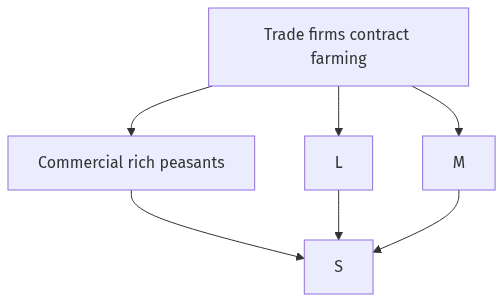
- Contract farming and supermarket standards create a layer of growers who look independent but are budgeted by firms.
- A rentier and absentee class grows where urban money leases land around cities, while actual tilling is done by migrants and women.
- Landless and marginal households mix farm wages with construction, schemes, and circular migration, so the ‘peasant’ is often a labouring household with a plot.
Implications
- Class conflict shifts from classic tenant-versus-zamindar to farmer-versus-state-and-company on prices, and labourer-versus-farmer on wages.
- Regional divergence widens: export horticulture belts versus rainfed distress belts.
- Yogendra Singh’s modernizing tradition appears as caste farmer unions using courts, media, and highways.
- Operation Barga-type tenant security matters more, not less, when land is a financial asset, because unrecorded tillers lose first.
Impact on structure, stated plainly
- Polarisation at the ends: a thinner commercial elite and a larger labouring mass, with a squeezed middle peasantry in many regions.
- Feminisation of field work where men migrate.
- New intermediaries: input dealers, cold-store owners, and labour contractors, not only village moneylenders.
Flow diagram
Conclusion
Globalisation did not abolish Indian agrarian classes. It commercialised the rich-peasant core, casualised the labouring poor, and inserted firms and urban capital into the village surplus chain.
Quick related
Students also ask
-
Do you agree that the agrarian class structure in India is changing ?Justify your answer with illustrations.
Next question on this syllabus topic (2022 · Q1(b)). View answer →
-
Did globalisation create a single farmer class?
No. Export growers, deficit smallholders and landless workers diverged further.
-
Is the village now post-agrarian?
Many households depend on non-farm wages, yet land and farm labour still structure local power.
Same topic · past papers
UPSC has asked this before
These previous-year questions sit on the same topic. Open one to practise the earlier ask.
-
2026 · Q3(b) · Sociology GS 2 · 20 marks
Explain the emergence of middle class in agrarian society in India. What have been the socio-structural implications of the emergence of this middle class? -
2026 · Q6(c) · Sociology GS 2 · 10 marks
Why was the category of 'criminal tribe' created by law during the colonial period in India? Discuss its implications -
2024 · Q3(a) · Sociology GS 2 · 20 marks
Why is the study of marriage important in Sociology? Analyse the implications of changing marriage patterns for Indian society -
2019 · Q7(b) · Sociology GS 2 · 20 marks
Discuss the implications of 'Swachha Bharat Abhiyaan'. Do you think that civil society has a role to play here ? Substantiate your answer with an example -
2025 · Q4(b) · Sociology GS 2 · 20 marks
"Industrial class structure is a function of social structure of Indian society." Do you agree with this statement? Analyze
More from this topic
Q3(b) · UPSC Mains 2026 · Sociology GS 2 · 20 marks · Solution
Explain the emergence of middle class in agrarian society in India. What have been the socio-structural implications of the emergence of this middle class?
Social Classes in India
This model answer examines the rise of the agrarian middle class in India, driven by post-independence land reforms, the Green Revolution, and market integration. It details their socio-structural implications, including shifting rural power dynamics, caste-class intersectionality, political mobilisation, and changing agrarian relations. The conclusion highlights the need for inclusive rural development and sustainable livelihoods to address emerging rural stratifications.
Q4(b) · UPSC Mains 2025 · Sociology GS 2 · 20 marks · Solution
"Industrial class structure is a function of social structure of Indian society." Do you agree with this statement? Analyze
Social Classes in India
Indian industrial classes include owners, managers, a small formal workforce and a large informal majority. Recruitment, unions and job queues follow caste, kinship, language and sending villages. Breman, Holmström and Ramaswamy show particularism inside industry, not a pure proletariat. Owners too are often community-based business groups. Capitalism reworks these ties but has not replaced them with a casteless class structure.
Q3(c) · UPSC Mains 2025 · Sociology GS 2 · 10 marks · Solution
Describe the main features of Indian new middle class. How is it different from the old middle class?
Social Classes in India
The old middle class grew from colonial education, law and bureaucracy and later staffed the Nehruvian state. The new middle class grew after 1991 around private services, IT and consumption. Béteille and Misra describe the older service stratum; Fernandes describes the consumer-citizen. Caste and English schooling shape entry into both. The new class is larger but still a minority; it has not absorbed the informal majority.