
Revision summary
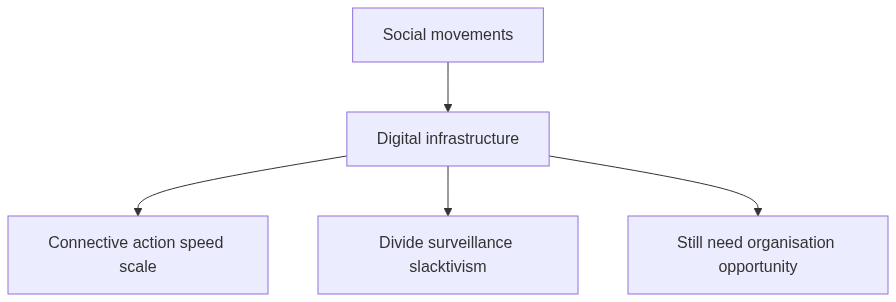
Social movements now use platforms for recruitment, framing and witnessing. Connective action personalises protest and lowers coordination costs. Significance is high for speed, scale and agenda setting. Limits include digital divide, surveillance, rumour and weak staying power. Older resource and opportunity theories still explain durable success. Indian protests and relief campaigns show amplification, not replacement, of the street.
Model answer
Copper italics in this answer — like this — are the key facts. Each one is unpacked in the Facts & figures rail.
Introduction
Social movements are organised, extra-institutional efforts to promote or resist change. In the digital era they recruit, frame and protest through platforms as well as streets. Manuel Castells wrote of networks of outrage and hope. The sociological task is to assess significance: what digital tools add, and what they cannot replace.
Body
What changes
Lance Bennett and Alexandra Segerberg distinguished connective action, based on personalised sharing, from older collective action based on dense organisations. Hashtags lower the cost of showing up, at least online. Images travel faster than pamphlets. Diasporas, students and informal workers can coordinate across cities. Zeynep Tufekci has shown how easy mobilisation can outrun the harder work of decision-making and staying power. In India, campaigns around sexual violence, farmers’ legislation, citizenship protests and disaster relief have all used phones, livestreams and WhatsApp chains. Significance is real for agenda setting, for documenting state violence, and for forming weak-tie publics that older unions never reached.
Limits of the assessment
The same infrastructure is used by rumour, hate and surveillance. A digital divide by class, gender and region means “the people online” are not the people. Slacktivism can substitute a like for a strike. Algorithms fragment publics. States and platforms can shut down the net. Resource mobilisation and political opportunity, in the older theories of McCarthy, Zald and Tilly, still decide whether a trend becomes an organisation with demands. Digital tools amplify; they do not abolish leadership, money or repression.
A balanced assessment is that the digital era has changed the ecology of movements—speed, visibility, personalised frames—without making organisation, risk and inequality obsolete. Significance is high for diffusion and narrative, mixed for durable institutional change.
Flow diagram
Conclusion
Digital media have become a normal infrastructure of contention, expanding who can speak and how fast frames spread. Their significance is greatest at the stage of mobilisation and witnessing, and weaker where long organisation and offline power are required. A movement that exists only as a feed is easy to start and easy to disperse.
Quick related
Students also ask
-
Democracy needs a vibrant culture of civil society in order to strengthen its foundation of citizenship. Comment.
Next question on this syllabus topic (2024 · Q1(d)). View answer →
-
Did social movements begin with the internet?
No. Digital tools reorganise older repertoires of strikes, petitions and crowds.
-
Is online hate a social movement?
It can be a counter-movement or a networked campaign. The same infrastructure serves progressive and reactionary projects.
Same topic · past papers
UPSC has asked this before
These previous-year questions sit on the same topic. Open one to practise the earlier ask.
-
2024 · Q6(a) · Sociology GS 1 · 20 marks
Underline the role of social media in contemporary social movements and describe its challenges -
2022 · Q7(b) · Sociology GS 1 · 15 marks
Discuss how "environmentalism" can be explained with new social movements approach. -
2020 · Q8(c) · Sociology GS 1 · 15 marks
Examine how social movements come to an end. Illustrate with examples. -
2018 · Q5(b) · Sociology GS 1 · 10 marks
Are social movements primordial in means and progressive in agenda? Explain -
2026 · Q5(e) · Sociology GS 1 · 10 marks
How do different theories explain social dimensions of social movements? Discuss.
More from this topic
Q8(a) · UPSC Mains 2026 · Sociology GS 1 · 20 marks · Solution
How are the concepts of nation, state and citizenship interrelated in a democracy? Elaborate
Politics and Society
• The state is the sovereign institutional apparatus that maintains law and order within a defined territory. • The nation is an imagined community bound by shared culture, history, language, or political values. • Citizenship acts as the legal bridge connecting individuals to the collective through rights and duties. • Modern democracies must constantly balance universal citizenship rights with particular national cultural loyalties. • State authority derives its democratic legitimacy directly from the active participation of its citizens. • Globalisation, migration, and multiculturalism increasingly challenge the traditional boundaries of nation-states. • Maintaining a healthy democracy requires inclusive citizenship that prevents majoritarian identities from marginalising minorities.
Q4(a) · UPSC Mains 2026 · Sociology GS 1 · 20 marks · Solution
Elaborate major sociological theories of power. How does power shape political process in modern societies?
Politics and Society
• Marx views power as structurally tied to economic ownership and class dominance. • Weber defines power as
Q1(e) · UPSC Mains 2026 · Sociology GS 1 · 10 marks · Solution
Explain in brief the relationship between social movement, collective action and revolution in bringing about social and political changes.
Politics and Society
This 10-marker for Sociology Paper I examines the continuum between everyday collective action, structured social movements, and radical revolutions in driving systemic social and political change. Collective action provides the foundational mobilization, social movements sustain ideological and institutional pressure, and revolution marks a structural rupture leading to regime change. The answer utilizes classical sociological frameworks from Tilly, Marx, and Smelser to explain this continuum. It includes a concise Mermaid flowchart illustrating the progressive escalation from mobilization to structural transformation. The response concludes by linking grassroots agency to democratic consolidation and policy reform.