
Revision summary
Civil society is organised life between family and the state. Citizenship is a practice of rights and claim-making, not only a legal status. Tocqueville, Habermas and Gramsci show associations as schools of democracy and as fields of hegemony. Indian movements and campaigns illustrate how publics train citizens. Civil society can exclude or become communal, so vibrancy must be judged by openness. Democracy still needs this culture to keep voting tied to everyday citizenship.
Model answer
Copper italics in this answer — like this — are the key facts. Each one is unpacked in the Facts & figures rail.
Introduction
Democracy is more than periodic voting. It needs citizens who can associate, argue, watch the state and claim rights. Civil society is the sphere of unions, associations, newspapers, social movements and voluntary groups that sit between the household and official power. A vibrant culture in this sphere trains people in citizenship. Without it, the vote can remain a lonely act and the constitution a paper promise.
Body
Civil society and the foundation of citizenship
Alexis de Tocqueville saw American democracy as a school of associations. People learned public spirit by joining groups. T. H. Marshall described citizenship as civil, political and social rights that grow over time. Those rights stay alive only when people use them. Jurgen Habermas described a public sphere where private persons debate common affairs. Antonio Gramsci treated civil society as a field of hegemony, where consent is organised, not as a purely innocent space. Neera Chandhoke and Indian debates after the 1990s placed NGOs, people’s movements and the media in this field.
Citizenship is therefore a practice. The Right to Information campaign, the Narmada Bachao Andolan, SEWA, and local resident associations show how organised publics teach claim-making. A quiet population that only consumes news does not deepen democracy in the same way.
Why vibrancy matters, and its limits
A vibrant civil society watches elections, documents police abuse, defends minority rights and supplies welfare where the state is thin. It also produces counter-publics for Dalits, women and Adivasis when the official public is captured by dominant groups. Partha Chatterjee’s argument about political society reminds us that many poor Indians meet the state through informal negotiation rather than civic association. Civil society can itself be exclusive, donor-driven or communal. Hindu and other identity associations are also civil society. Vibrancy is not automatically liberal.
The comment asked by the question is still sound. Democracy’s foundation of citizenship weakens when associations shrink, when fear replaces debate, and when the only organised voices are those of money and majorities. A culture of civil society does not replace parties and parliaments. It keeps them honest and keeps citizens in training.
Flow diagram
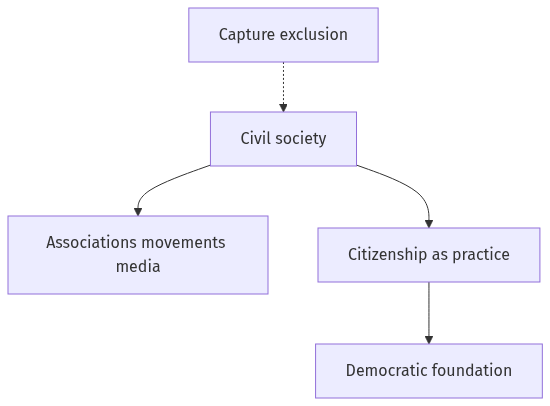
Conclusion
Democracy needs a living culture of association and public argument if citizenship is to be more than a legal label. Civil society is that training ground. It can be captured or exclusive, yet without it the democratic foundation stays weak.
Quick related
Students also ask
-
Underline the role of social media in contemporary social movements and describe its challenges
Next question on this syllabus topic (2024 · Q6(a)). View answer →
-
Are political parties part of civil society?
They sit closer to the state and electoral power. Civil society usually means associations that are not seeking office, though the border is debated.
-
Is every NGO good for democracy?
No. Donor control, lack of internal democracy and communal groups can weaken citizenship even while they occupy the civil-society slot.
Same topic · past papers
UPSC has asked this before
These previous-year questions sit on the same topic. Open one to practise the earlier ask.
-
2026 · Q8(a) · Sociology GS 1 · 20 marks
How are the concepts of nation, state and citizenship interrelated in a democracy? Elaborate -
2023 · Q5(b) · Sociology GS 1 · 10 marks
How is civil society useful in deepening the roots of democracy? -
2017 · Q5(b) · Sociology GS 1 · 10 marks
Discuss the changing interface between state and civil society in post-independent India -
2025 · Q8(b) · Sociology GS 1 · 20 marks
How do 'Civil Society Organizations' such as 'NGOs' and 'Self-Help Groups' contribute to grassroot level social changes? Discuss -
2021 · Q8(c) · Sociology GS 1 · 15 marks
Highlight the roles and functions of civil society in a democratic system.
More from this topic
Q8(a) · UPSC Mains 2026 · Sociology GS 1 · 20 marks · Solution
How are the concepts of nation, state and citizenship interrelated in a democracy? Elaborate
Politics and Society
• The state is the sovereign institutional apparatus that maintains law and order within a defined territory. • The nation is an imagined community bound by shared culture, history, language, or political values. • Citizenship acts as the legal bridge connecting individuals to the collective through rights and duties. • Modern democracies must constantly balance universal citizenship rights with particular national cultural loyalties. • State authority derives its democratic legitimacy directly from the active participation of its citizens. • Globalisation, migration, and multiculturalism increasingly challenge the traditional boundaries of nation-states. • Maintaining a healthy democracy requires inclusive citizenship that prevents majoritarian identities from marginalising minorities.
Q4(a) · UPSC Mains 2026 · Sociology GS 1 · 20 marks · Solution
Elaborate major sociological theories of power. How does power shape political process in modern societies?
Politics and Society
• Marx views power as structurally tied to economic ownership and class dominance. • Weber defines power as
Q1(e) · UPSC Mains 2026 · Sociology GS 1 · 10 marks · Solution
Explain in brief the relationship between social movement, collective action and revolution in bringing about social and political changes.
Politics and Society
This 10-marker for Sociology Paper I examines the continuum between everyday collective action, structured social movements, and radical revolutions in driving systemic social and political change. Collective action provides the foundational mobilization, social movements sustain ideological and institutional pressure, and revolution marks a structural rupture leading to regime change. The answer utilizes classical sociological frameworks from Tilly, Marx, and Smelser to explain this continuum. It includes a concise Mermaid flowchart illustrating the progressive escalation from mobilization to structural transformation. The response concludes by linking grassroots agency to democratic consolidation and policy reform.