
Revision summary
Social movements use social media to gather people, tell a story and gain visibility. Networked campaigns can be fast, visual and transnational. Indian protests of the last decade show both organising power and rumour risk. Challenges include misinformation, state and platform surveillance, and click-only support. The digital divide and outrage algorithms shape who is heard. Platforms are a resource, not a substitute for organisation and political opportunity.
Model answer
Copper italics in this answer — like this — are the key facts. Each one is unpacked in the Facts & figures rail.
Introduction
Social movements are organised efforts to promote or resist social change. They need communication, numbers, symbols and a sense of we. Social media now supply much of that infrastructure. Hashtags, videos and messaging groups can summon a crowd faster than a printed pamphlet. They also create new weaknesses. The role and the challenges must be stated together.
Body
Role in contemporary movements
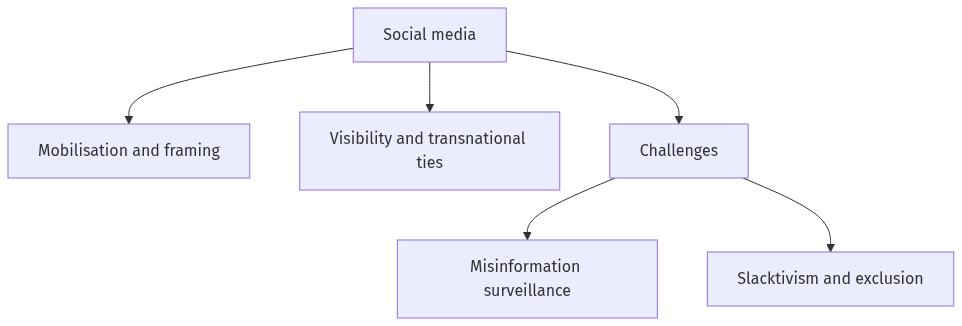
Resource mobilisation theory, associated with Mayer Zald and others, already treated media as a resource. Digital platforms cheapen that resource. They help mobilise by spreading the time and place of protest. They help frame a grievance in a short visual story, which Snow and Benford’s framing approach would recognise. They create visibility for groups that official television ignores. They link local struggles to a transnational audience, as environmental and feminist campaigns have done. Manuel Castells wrote of networked social movements in a digital age. In India, anti-corruption protests, student movements, farmers’ protests and several identity campaigns have used WhatsApp, Facebook, Twitter and later Instagram and YouTube as organising tools. Diaspora money and attention can arrive through the same channels.
Social media also allow leaderless or loosely led forms. This can protect a movement from the arrest of a single head. It can also scatter strategy.
Challenges
Misinformation and rumour travel on the same rails as solidarity. Communal riots and panics have been linked to forwarded messages. States and opponents surveil and troll activists. Platform companies can mute a page or an account without a public trial. Slacktivism, a term for low-cost clicking, can substitute a like for organisation on the ground. Charles Tilly’s older stress on WUNC, worthiness, unity, numbers and commitment, is harder to sustain if the crowd exists only as a metric. The digital divide excludes those without phones or literacy in the campaign language. Algorithms reward outrage, which can radicalise a frame and split a coalition. Donatella della Porta and others note that digital tools do not abolish the need for organisations, allies and a political opportunity structure.
The sociological lesson is that social media are a new ecology for movements, not a replacement for the street, the union, the court or the party. They amplify both voice and noise.
Role and challenge on the same platform
A farmers’ sit-in can use live video to keep a national audience when television cameras leave. The same video stream can be clipped by opponents to invent a different story. A women’s safety campaign can find allies in another state overnight. It can also attract organised abuse that silences speakers. Leadership becomes harder to locate, which protects some activists and leaves others without a mandate to negotiate. Older movements had newspapers and cadres. New movements have metrics. The role of social media is therefore infrastructural: it is how many contemporary movements think, recruit and remember. The challenge is that this infrastructure is privately owned, easily flooded, and unevenly available. A complete answer underlines both, with the street and the organisation still in the sentence.
Flow diagram
Conclusion
Social media help contemporary movements to mobilise, frame and become visible across borders. They also bring rumour, surveillance, shallow participation and corporate control of the microphone. Movements that treat platforms as tools inside a wider organisation use them well. Movements that live only online fade quickly.
Quick related
Students also ask
-
Discuss the dimensions of power in the construction and maintenance of social hierarchies in a society
Next question on this syllabus topic (2024 · Q7(c)). View answer →
-
Can a hashtag be a social movement?
It can be a moment of public. A movement still needs some continuity of organisation, claim and mobilisation.
-
Do social media only help democratic movements?
No. Vigilante and hate campaigns use the same tools. The medium is not a moral filter.
Same topic · past papers
UPSC has asked this before
These previous-year questions sit on the same topic. Open one to practise the earlier ask.
-
2023 · Q7(b) · Sociology GS 1 · 20 marks
Do you think that the social media has brought significant changes in the forms of protest? Argue your case -
2019 · Q7(b) · Sociology GS 1 · 20 marks
Feminist scholars argue that 'New media' is masculine and hence reinforces structural hierarchies rather than reconfiguring them. Comment -
2017 · Q5(e) · Sociology GS 1 · 10 marks
Assess the role of mass media as an agent of social change
More from this topic
Q8(a) · UPSC Mains 2026 · Sociology GS 1 · 20 marks · Solution
How are the concepts of nation, state and citizenship interrelated in a democracy? Elaborate
Politics and Society
• The state is the sovereign institutional apparatus that maintains law and order within a defined territory. • The nation is an imagined community bound by shared culture, history, language, or political values. • Citizenship acts as the legal bridge connecting individuals to the collective through rights and duties. • Modern democracies must constantly balance universal citizenship rights with particular national cultural loyalties. • State authority derives its democratic legitimacy directly from the active participation of its citizens. • Globalisation, migration, and multiculturalism increasingly challenge the traditional boundaries of nation-states. • Maintaining a healthy democracy requires inclusive citizenship that prevents majoritarian identities from marginalising minorities.
Q4(a) · UPSC Mains 2026 · Sociology GS 1 · 20 marks · Solution
Elaborate major sociological theories of power. How does power shape political process in modern societies?
Politics and Society
• Marx views power as structurally tied to economic ownership and class dominance. • Weber defines power as
Q1(e) · UPSC Mains 2026 · Sociology GS 1 · 10 marks · Solution
Explain in brief the relationship between social movement, collective action and revolution in bringing about social and political changes.
Politics and Society
This 10-marker for Sociology Paper I examines the continuum between everyday collective action, structured social movements, and radical revolutions in driving systemic social and political change. Collective action provides the foundational mobilization, social movements sustain ideological and institutional pressure, and revolution marks a structural rupture leading to regime change. The answer utilizes classical sociological frameworks from Tilly, Marx, and Smelser to explain this continuum. It includes a concise Mermaid flowchart illustrating the progressive escalation from mobilization to structural transformation. The response concludes by linking grassroots agency to democratic consolidation and policy reform.