
Revision summary
Mosca: an organised ruling class justified by a political formula. Michels: organisation produces oligarchy even in egalitarian parties. Pareto: elites circulate; lions and foxes name styles of rule. Similarities: minority power, scepticism toward literal popular rule and toward Marxian class monopoly of explanation. Differences: political formula versus party oligarchy versus psychological residues. Crucial issues: accountability, recruitment and whether democracy can discipline elites.
Model answer
Copper italics in this answer — like this — are the key facts. Each one is unpacked in the Facts & figures rail.
Introduction
Gaetano Mosca, Robert Michels and Vilfredo Pareto are the classical elite theorists. Writing against both simple democratic optimism and Marx’s class dichotomy, they argued that every society is run by a minority. The examiner wants the similarities of that claim, the differences in how each explained it, and the crucial issues that still matter for parties, bureaucracies and Indian democracy.
Body
Three statements
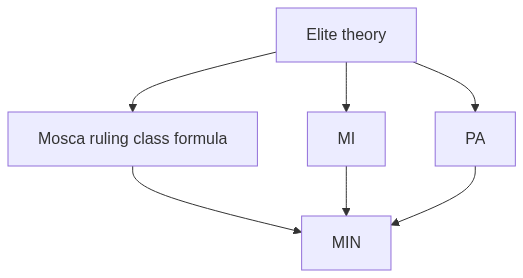
Mosca, in The Ruling Class, held that a organised minority always dominates an unorganised majority. The rulers justify themselves with a political formula—a moral or legal story such as divine right, popular sovereignty, or merit. Recruitment may be relatively open or closed, but the fact of a ruling class remains.
Michels, in Political Parties, studied socialist organisations that preached equality. He derived the iron law of oligarchy: organisation requires specialised leaders, expertise and control of communication; the base cannot govern daily. Democracy inside large associations therefore tends to oligarchy. The party secretary becomes a new elite.
Pareto distinguished governing and non-governing elites and explained history as the circulation of elites. Using his language of residues, he contrasted “lions” (force, conservation) and “foxes” (cunning, combination). When a governing elite grows rigid or over-cunning, another elite replaces it. Psychology and the distribution of talents, not only property, drive the cycle.
Similarities and differences
All three reject the idea that the people rule in any literal sense. All treat elites as a necessary minority, and all are sceptical of Marxist reduction of politics to economic classes, even when they admit wealth matters. All see organisation, not only ownership, as a source of power.
- They differ in mechanism. Mosca is the most political-sociological: organisation plus formula. Michels is the organisational ironist of mass parties and unions, empirically closer to later bureaucracy studies. Pareto is the most psychological and cyclical, closer to a theory of character types and social equilibrium. Mosca allows a degree of renewal through a relatively open ruling class; Michels is bleaker about inner-party democracy; Pareto emphasises replacement rather than representation.
Crucial issues
The live issues are whether universal suffrage changes the fact of minority rule, whether bureaucracy (Weber sits nearby) is the modern elite form, and whether circulation can occur without revolution. C. Wright Mills’s power elite and later Indian debates on the IAS, business houses and party high commands still speak this language. The democratic hope is not that elites vanish, but that they remain accountable, permeable and plural.
Flow diagram
Conclusion
Mosca, Michels and Pareto agree that a minority governs and that organisation beats the crowd. They differ on formula, oligarchy of parties, and psychological circulation. The crucial issue for democracy is not the disappearance of elites but their recruitment, division and public control.
Quick related
Students also ask
-
How can you assess the significance of social movements in the digital era? Explain
Next question on this syllabus topic (2025 · Q6(c)). View answer →
-
Are these theorists simply anti-democratic?
They are anti-utopian about direct popular rule. Later democrats use them to design checks, not to abolish elections.
-
How do they differ from Marx?
Marx locates ruling power in a property class. Elite theorists locate it in organisation, formula and political skill, which may cut across economic classes.
Same topic · past papers
UPSC has asked this before
These previous-year questions sit on the same topic. Open one to practise the earlier ask.
-
2015 · Q5(b) · Sociology GS 1 · 10 marks
"Ideology is crucial for social transformation in a democracy." Discuss.
More from this topic
Q8(a) · UPSC Mains 2026 · Sociology GS 1 · 20 marks · Solution
How are the concepts of nation, state and citizenship interrelated in a democracy? Elaborate
Politics and Society
• The state is the sovereign institutional apparatus that maintains law and order within a defined territory. • The nation is an imagined community bound by shared culture, history, language, or political values. • Citizenship acts as the legal bridge connecting individuals to the collective through rights and duties. • Modern democracies must constantly balance universal citizenship rights with particular national cultural loyalties. • State authority derives its democratic legitimacy directly from the active participation of its citizens. • Globalisation, migration, and multiculturalism increasingly challenge the traditional boundaries of nation-states. • Maintaining a healthy democracy requires inclusive citizenship that prevents majoritarian identities from marginalising minorities.
Q4(a) · UPSC Mains 2026 · Sociology GS 1 · 20 marks · Solution
Elaborate major sociological theories of power. How does power shape political process in modern societies?
Politics and Society
• Marx views power as structurally tied to economic ownership and class dominance. • Weber defines power as
Q1(e) · UPSC Mains 2026 · Sociology GS 1 · 10 marks · Solution
Explain in brief the relationship between social movement, collective action and revolution in bringing about social and political changes.
Politics and Society
This 10-marker for Sociology Paper I examines the continuum between everyday collective action, structured social movements, and radical revolutions in driving systemic social and political change. Collective action provides the foundational mobilization, social movements sustain ideological and institutional pressure, and revolution marks a structural rupture leading to regime change. The answer utilizes classical sociological frameworks from Tilly, Marx, and Smelser to explain this continuum. It includes a concise Mermaid flowchart illustrating the progressive escalation from mobilization to structural transformation. The response concludes by linking grassroots agency to democratic consolidation and policy reform.