
Revision summary
Taboos are sacred prohibitions. Superstitions are rejected causal beliefs. Science and technology weaken some of both through germ theory, vaccines, and daily tools. Weber’s disenchantment describes the public shift to calculation. Durkheim’s sacred and caste honour explain why many taboos persist. Pulse Polio and menstrual-technology debates show both gain and limit.
Model answer
Copper italics in this answer — like this — are the key facts. Each one is unpacked in the Facts & figures rail.
Introduction
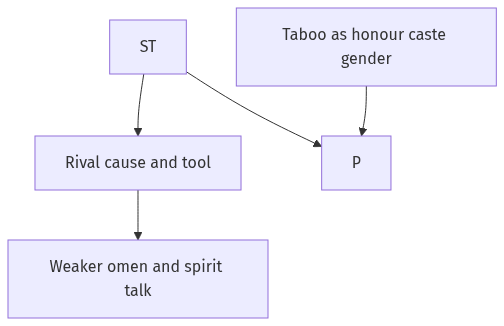
Taboos are prohibitions charged with the sacred or with pollution. Superstitions are causal beliefs that public science rejects. Science and technology can weaken both by offering rival explanations and rival techniques. They do not automatically erase them, because taboos also organise caste, gender, and honour.
Body
How science and technology address them
- Max Weber’s disenchantment named the replacement of magical means by technical calculation in public life.
- Germ theory, vaccines, and the Pulse Polio campaign reduced disease explanations that blamed spirit or fate, though rumour still attacked the same campaigns.
- Astronomy and print weakened some eclipse and omen practices in urban middle classes without ending temple ritual.
- Sanitation engineering and latrine programmes meet purity taboos around faeces and caste labour. Technology without a change in who must clean does not finish the taboo.
- Menstrual restrictions have been challenged by biology teaching and by movements around temples such as Sabarimala, with technology of pads and cups as a parallel material change.
Limits
- Durkheim’s sacred is a social fact. A laboratory result does not dissolve a group’s need for prohibition.
- New technologies create new fears, from radiation talk to vaccine rumour, which are not the old superstition but occupy the same slot of uncontrolled cause.
- Caste pollution rules can absorb scientific language and still exclude.
- Comte’s hope of a full positive age under-estimated this persistence.
Examination
- Role is real in public health, agriculture, and some gender taboos where the state and school back the technique.
- Role is limited where taboo is honour and closure rather than a mistaken cause.
Flow diagram
Conclusion
Science and technology address age-old taboos and superstitions by offering calculation, vaccines, and new tools of daily life, which is Weber’s disenchantment in practice. They do not abolish the sacred as a social fact. Health campaigns show gains. Caste and gender prohibitions show the limit unless power also changes.
Quick related
Students also ask
-
The difference between information and data in social science is subtle. Comment.
Next question on this syllabus topic (2022 · Q1(c)). View answer →
-
If vaccines work, why do rumours continue?
Trust, honour, and political talk organise belief. A working technique does not automatically command consent.
-
Is every ritual a superstition?
No. Ritual can mark belonging without claiming a false physical cause. Superstition is the causal claim science rejects.
Same topic · past papers
UPSC has asked this before
These previous-year questions sit on the same topic. Open one to practise the earlier ask.
-
2024 · Q5(e) · Sociology GS 1 · 10 marks
Critically examine the roles of science and technology in social change. What is your opinion on their increasing trend in 'online' education and teaching? -
2022 · Q8(a) · Sociology GS 1 · 20 marks
Sociologists argue for democratization of science and technology for inclusive development. Comment. -
2021 · Q8(b) · Sociology GS 1 · 15 marks
Describe the role of Science and Technology in enabling us to face the challenges triggered by the COVID-19 pandemic. -
2020 · Q4(a) · Sociology GS 1 · 20 marks
Is humanity at the mercy of Nature, Science and Technology ? Comment in the light of pandemic situation. -
2020 · Q7(a) · Sociology GS 1 · 20 marks
Technology has accelerated the process of development and dependency. Discuss.
More from this topic
Q8(b) · UPSC Mains 2026 · Sociology GS 1 · 20 marks · Solution
Critically evaluate the relevance of the cyclical theory of social change in understanding contemporary societies
Social Change in Modern Society
This model answer evaluates the cyclical theory of social change for contemporary societies. It analyses how classical cyclical models help explain recurring crises, institutional decay, and cultural revivals. It then highlights the limitations of cyclical theories, such as ignoring linear technological progress, cumulative scientific knowledge, and modern globalisation. The response integrates classical sociological thinkers and concludes with a balanced perspective on contemporary social transformation.
Q1(c) · UPSC Mains 2026 · Sociology GS 1 · 10 marks · Solution
Discuss the role of geographical factors in social change and development.
Social Change in Modern Society
This model answer for UPSC Mains Sociology evaluates the role of geographical factors in social change and development. It moves beyond strict environmental determinism to examine how topography, climate, and natural resources shape settlement patterns, economic systems, and social stratification. Classical perspectives from Montesquieu to modern ecological approaches are integrated with examples like river valley civilizations and contemporary climate migration. The answer maintains a crisp, examiner-facing style with structural headings and a flowchart.
Q5(e) · UPSC Mains 2025 · Sociology GS 1 · 10 marks · Solution
To what extent can education and skill development be an agent of social change? Critically analyze.
Social Change in Modern Society
Durkheim and Parsons treat schooling as moral and role socialisation, a force of change. Human capital and capability approaches link skill to productivity and freedom. Bourdieu and correspondence theorists show reproduction of class through the school. Indian expansion of education has created new aspirations and some mobility. Coaching, English, caste and credential inflation limit the equalising effect. The extent is partial: necessary for change, insufficient as a sole agent.