
Revision summary
Durkheim and Parsons treat schooling as moral and role socialisation, a force of change. Human capital and capability approaches link skill to productivity and freedom. Bourdieu and correspondence theorists show reproduction of class through the school. Indian expansion of education has created new aspirations and some mobility. Coaching, English, caste and credential inflation limit the equalising effect. The extent is partial: necessary for change, insufficient as a sole agent.
Model answer
Copper italics in this answer — like this — are the key facts. Each one is unpacked in the Facts & figures rail.
Introduction
Education and skill development are among the most trusted official levers of social change. They are supposed to spread knowledge, create a labour force, and open mobility. Emile Durkheim saw the school as a moral community for a differentiated society. Human-capital theory treated skill as investment. A critical analysis asks how far these processes actually transform structure, and how far they reproduce class, caste and gender under a language of merit.
Body
As agents of change
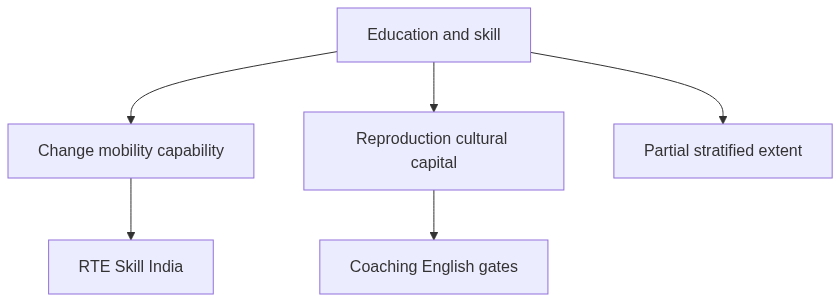
Schools socialise strangers into shared codes, which Parsons read as pattern maintenance and role allocation. Literacy and numeracy expand capability in Sen’s sense. Technical skill can shift a household from farm labour to a trade or to urban services. In India, the expansion of IITs, medical colleges, IT services and, more unevenly, industrial training has created new middle-class fractions. The Right to Education Act and campaigns for girls’ schooling have changed aspirations even where quality lags. Skill India and apprenticeship talk try to link education to employability. Social movements of oppressed groups have used degrees and English as weapons of status, not only as job tickets. In that limited but real sense, education is an agent of change.
Critical limits
- Pierre Bourdieu showed cultural capital: the school rewards the already cultured child and calls it talent. Bowles and Gintis linked schooling to workplace hierarchy. Credential inflation means more certificates chase the same scarce jobs. In India, coaching, English gates and unequal schools channel change toward those who already have resources. Caste in hiring and the steering of girls toward “safe” courses blunt mobility. Skill programmes that ignore demand produce certificates without change.
The extent is partial and stratified. Education changes some biographies. It rarely, by itself, equalises property or elite networks. Treating skill as a substitute for decent work is policy rhetoric, not a finding.
Flow diagram
Conclusion
Education and skill can be agents of social change through socialisation, capability and mobility. They also reproduce inequality through cultural capital and uneven provision. The extent in India is real for some groups and overstated when policy treats certificates as a solvent of class and caste.
Quick related
Students also ask
-
Critically examine the roles of science and technology in social change. What is your opinion on their increasing trend in 'online' education and teaching?
Next question on this syllabus topic (2024 · Q5(e)). View answer →
-
Does skill development automatically create social change?
Only if labour demand, dignity of trades and equal access exist. Otherwise it produces paper skills.
-
Is the critical view anti-schooling?
No. It is against the myth that schools alone undo structured inequality.
Same topic · past papers
UPSC has asked this before
These previous-year questions sit on the same topic. Open one to practise the earlier ask.
-
2017 · Q5(e) · Sociology GS 1 · 10 marks
Assess the role of mass media as an agent of social change -
2026 · Q1(c) · Sociology GS 1 · 10 marks
Discuss the role of geographical factors in social change and development. -
2026 · Q8(b) · Sociology GS 1 · 20 marks
Critically evaluate the relevance of the cyclical theory of social change in understanding contemporary societies -
2024 · Q5(e) · Sociology GS 1 · 10 marks
Critically examine the roles of science and technology in social change. What is your opinion on their increasing trend in 'online' education and teaching? -
2024 · Q8(b) · Sociology GS 1 · 20 marks
Discuss various theories of social change. Explain the limitations of unilinear theory of social change
More from this topic
Q8(b) · UPSC Mains 2026 · Sociology GS 1 · 20 marks · Solution
Critically evaluate the relevance of the cyclical theory of social change in understanding contemporary societies
Social Change in Modern Society
This model answer evaluates the cyclical theory of social change for contemporary societies. It analyses how classical cyclical models help explain recurring crises, institutional decay, and cultural revivals. It then highlights the limitations of cyclical theories, such as ignoring linear technological progress, cumulative scientific knowledge, and modern globalisation. The response integrates classical sociological thinkers and concludes with a balanced perspective on contemporary social transformation.
Q1(c) · UPSC Mains 2026 · Sociology GS 1 · 10 marks · Solution
Discuss the role of geographical factors in social change and development.
Social Change in Modern Society
This model answer for UPSC Mains Sociology evaluates the role of geographical factors in social change and development. It moves beyond strict environmental determinism to examine how topography, climate, and natural resources shape settlement patterns, economic systems, and social stratification. Classical perspectives from Montesquieu to modern ecological approaches are integrated with examples like river valley civilizations and contemporary climate migration. The answer maintains a crisp, examiner-facing style with structural headings and a flowchart.
Q8(c) · UPSC Mains 2024 · Sociology GS 1 · 10 marks · Solution
Critically examine the World-Systems theory of Immanuel Wallerstein in terms of development and dependency of various nations
Social Change in Modern Society
Wallerstein takes the capitalist world-economy, not the nation, as the unit of analysis. Core, semi-periphery and periphery are linked positions in one division of labour. Development of the core has been historically tied to peripheral constraint. The theory criticises Rostow-style national stages and is cousin to Frank’s underdevelopment thesis. Criticisms include thin treatment of internal class, culture and new industrial cores. It remains a strong map of dependency, provided ranks are not treated as eternal.