
Revision summary
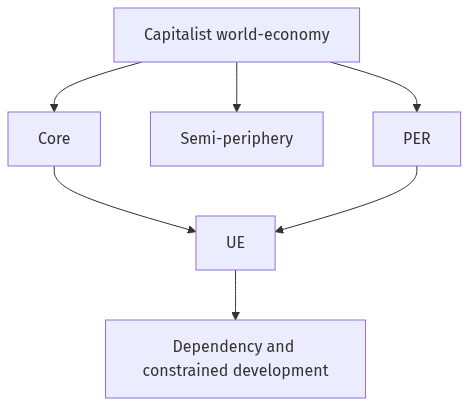
Wallerstein takes the capitalist world-economy, not the nation, as the unit of analysis. Core, semi-periphery and periphery are linked positions in one division of labour. Development of the core has been historically tied to peripheral constraint. The theory criticises Rostow-style national stages and is cousin to Frank’s underdevelopment thesis. Criticisms include thin treatment of internal class, culture and new industrial cores. It remains a strong map of dependency, provided ranks are not treated as eternal.
Model answer
Copper italics in this answer — like this — are the key facts. Each one is unpacked in the Facts & figures rail.
Introduction
Immanuel Wallerstein’s world-systems theory says that since the long sixteenth century a capitalist world-economy has been the relevant unit of analysis, not the isolated nation. Development and underdevelopment are positions in that system. Core, semi-periphery and periphery name those positions. A critical examination must state this map and then test it against how nations actually grow, stagnate and change rank.
Body
The main idea
Wallerstein, building on Fernand Braudel’s long duration and on dependency writers such as Andre Gunder Frank, argued that a world-economy is bound by a single division of labour and multiple political states. There is no single world empire that commands the whole. The core specialises in high-skill, capital-intensive production and strong states. The periphery supplies cheap labour, raw materials and weaker states. The semi-periphery stands in between and stabilises the system, as a middle layer that can be both exploited and exploiting. Unequal exchange, in the language of Arghiri Emmanuel and related debates, moves surplus toward the core. Hegemonic powers rise and fall in long cycles: the United Provinces, Britain, the United States. Development of one zone is historically linked to the constrained development of another. This is a theory of dependency inside a system, not of cultural backwardness.
Against W. W. Rostow’s stages, a peripheral nation is not simply late. Its agriculture, mines and labour markets have already been organised for the core. Frank’s development of underdevelopment is close, though Wallerstein is more historical-systemic and less a simple two-term metropolis–satellite pair.
Critical examination
The theory is strong in explaining colonial drain, plantation economies, and the limits of import-substitution when the world market still sets terms of trade. It is strong in refusing methodological nationalism: Indian or Brazilian growth cannot be read as a closed story. It helps explain why political independence did not automatically mean economic autonomy.
Limits are serious. The categories can become labels that hide class struggle inside India or Brazil. A. G. Frank and Wallerstein were criticised by Marxists who wanted more on national bourgeoisies, the state and modes of production, as in the work of Ernesto Laclau or Indian debates involving A. R. Desai and later writers. Culture, caste and gender are thin in the original world-systems volumes. The rise of East Asian industrial cores and of China challenges a frozen map of periphery. Semi-periphery can become a catch-all. Empirical measures of unequal exchange are disputed. The theory can underplay agency of labour movements and of South–South ties.
Still, as a critical tool for development and dependency, world-systems theory remains more adequate than a naive modernisation ladder. Nations develop in a hierarchy of the world-economy. They can change position, but not by pretending that the hierarchy is not there.
Development and dependency of nations, applied
A core nation can set financial rules, patent regimes and military umbrellas that shape what a peripheral nation may industrialise. A semi-peripheral nation may export cars and still import high-end chips and pay tribute in profit outflow. East Asian catch-up shows that position can change when a strong state, land reform and access to the US market combine. It does not show that every nation can repeat that path at once, because the system needs cheap zones. India’s software exports and its large informal labour force can sit in the same country, which is why a single label is crude and still why a world-economy frame is useful. Dependency is a relation, not a national character. Wallerstein’s value is to keep that relation in the answer.
Flow diagram
Conclusion
Wallerstein explains development and dependency as related positions in a capitalist world-economy of core, semi-periphery and periphery. The theory beats a closed national stages model. It is weaker on internal class, culture and recent shifts of the core. Used critically, it still names the global structure in which nations grow or stay dependent.
Quick related
Students also ask
-
Examine the role of science and technology in addressing age-old taboos and superstitions
Next question on this syllabus topic (2023 · Q8(c)). View answer →
-
Is India core, periphery or semi-periphery?
World-systems writers have usually placed it in the semi-periphery or as a complex mix of advanced pockets and large peripheral labour, which itself shows the need for internal analysis.
-
Does the theory say poor countries can never develop?
No. It says development is a change of position in a hierarchy, often limited and uneven, not an automatic climb of national stages.
Same topic · past papers
UPSC has asked this before
These previous-year questions sit on the same topic. Open one to practise the earlier ask.
-
2021 · Q7(b) · Sociology GS 1 · 15 marks
Critically examine the contribution of dependency theories in understanding the present global scenario. -
2020 · Q7(a) · Sociology GS 1 · 20 marks
Technology has accelerated the process of development and dependency. Discuss.
More from this topic
Q8(b) · UPSC Mains 2026 · Sociology GS 1 · 20 marks · Solution
Critically evaluate the relevance of the cyclical theory of social change in understanding contemporary societies
Social Change in Modern Society
This model answer evaluates the cyclical theory of social change for contemporary societies. It analyses how classical cyclical models help explain recurring crises, institutional decay, and cultural revivals. It then highlights the limitations of cyclical theories, such as ignoring linear technological progress, cumulative scientific knowledge, and modern globalisation. The response integrates classical sociological thinkers and concludes with a balanced perspective on contemporary social transformation.
Q1(c) · UPSC Mains 2026 · Sociology GS 1 · 10 marks · Solution
Discuss the role of geographical factors in social change and development.
Social Change in Modern Society
This model answer for UPSC Mains Sociology evaluates the role of geographical factors in social change and development. It moves beyond strict environmental determinism to examine how topography, climate, and natural resources shape settlement patterns, economic systems, and social stratification. Classical perspectives from Montesquieu to modern ecological approaches are integrated with examples like river valley civilizations and contemporary climate migration. The answer maintains a crisp, examiner-facing style with structural headings and a flowchart.
Q5(e) · UPSC Mains 2025 · Sociology GS 1 · 10 marks · Solution
To what extent can education and skill development be an agent of social change? Critically analyze.
Social Change in Modern Society
Durkheim and Parsons treat schooling as moral and role socialisation, a force of change. Human capital and capability approaches link skill to productivity and freedom. Bourdieu and correspondence theorists show reproduction of class through the school. Indian expansion of education has created new aspirations and some mobility. Coaching, English, caste and credential inflation limit the equalising effect. The extent is partial: necessary for change, insufficient as a sole agent.