
Revision summary
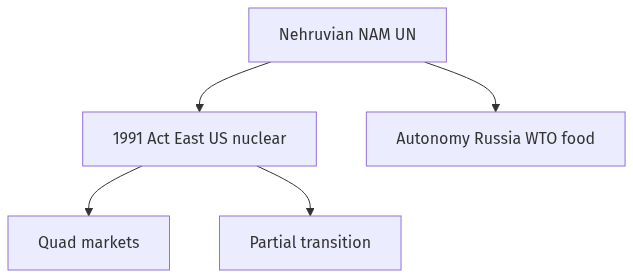
Nehruvianism meant NAM, UN moralism and refusal of blocs; neoliberalism in this debate means markets, U.S. partnership and globalisation. 1991, Act East, the U.S. nuclear bargain and the Quad are the visible transition. India still refuses formal alliance, keeps Russia, defends WTO policy space and talks Global South — Nehruvian residues. Concur partly: instruments have shifted; doctrine of autonomy has not been abolished. Multi-alignment is the mix, not a clean replacement of one school by the other.
Model answer
Copper italics in this answer — like this — are the key facts. Each one is unpacked in the Facts & figures rail.
Introduction
Nehruvianism in foreign policy meant non-alignment, Afro-Asian solidarity, UN moral language, and suspicion of military blocs, with a weak material base. Neoliberalism here does not mean only domestic market reform. In the foreign-policy debate it means engagement with global capital, closer ties to the United States, and comfort with economic globalisation. The view that India has been in transition from Nehruvianism to neoliberalism is partly right. It is wrong as a completed story.
Body
Where the transition is visible
1991 opened the economy and forced diplomacy to seek capital, oil and technology. Look East / Act East replaced a purely continental NAM map with ASEAN and later the Indo-Pacific. The civil nuclear path with the United States, the 2+2s, LEMOA, COMCASA and BECA, and revival of the Quad are not Nehru’s instruments. India signs trade talks, courts supply chains, and speaks the language of ease of capital. C. Raja Mohan and others have described this as a turn from idealism to a more interest-based, market-compatible diplomacy. Examples are concrete: India as a lower-cost manufacturing hedge in China-plus-one; ITEC plus digital public infrastructure as exports; a G20 presidency that sold investment as much as NAM memory.
Where Nehruvianism has not died
India still refuses a NATO-like alliance, which is the point of 7(c). It still buys oil and platforms with Russia. It still uses strategic autonomy and Global South voice — a Nehruvian habit in a new accent. It did not join a condemnation camp on Ukraine in the way neoliberal Atlanticism demanded. At the WTO, India defends food stocks and policy space rather than a pure open-market catechism. Neighbourhood policy still uses civilisational and security language that is not reducible to FDI.
So the transition is in the economic and U.S.-facing layers. It is not a conversion of the whole doctrine. NonAlignment 2.0 already tried to name autonomy after NAM’s bipolar script died. Multi-alignment, treated in 8(c), is the current mix: Nehruvian refusal of a camp, neoliberal use of markets and minilaterals.
Comment
Concur in part. Late Indian foreign policy has moved toward markets, the United States and issue-based coalitions. Do not concur that Nehruvianism has been replaced. The state still wants autonomy in a hierarchical world-economy that Wallerstein would recognise. Neoliberal tools serve that autonomy. They have not abolished it.
Flow diagram
Conclusion
India has used neoliberal economic diplomacy and U.S. minilaterals that Nehru would not have signed. It has not become a camp follower or a free-trade fundamentalist. The transition is real in instruments. The end remains autonomy. That is a partial, not a total, shift.
Quick related
Students also ask
-
Explain the major features of India's Foreign Policy in the 21st century.
Next question on this syllabus topic (2023 · Q5(a)). View answer →
-
Is neoliberalism the same as being pro-American?
In Indian FP debate the two overlap in the 2000s–2020s, but neoliberalism also means WTO and capital. India can be market-engaging and still fight Washington at Geneva.
-
Did Nehru ignore economics?
No. He sought aid and mixed economy. He did not organise foreign policy around global production chains and a U.S. nuclear bargain.
Same topic · past papers
UPSC has asked this before
These previous-year questions sit on the same topic. Open one to practise the earlier ask.
-
2026 · Q3(c) · PSIR GS 2 · 15 marks
Does power transition theory reflect the dynamics of US-China relations? -
2025 · Q2(c) · PSIR GS 2 · 15 marks
Transnational actors have qualitatively transformed the world by the way of their fresh insights and actions. Illustrate your answer with suitable examples -
2023 · Q3(c) · PSIR GS 2 · 15 marks
Narrate the various ways in which rapid environmental degradation is posing a serious threat to human security. Illustrate your answer with suitable examples
More from this topic
Q8(b) · UPSC Mains 2026 · PSIR GS 2 · 15 marks · Solution
India has recognised that West Asia is not a single contest, but a tangle of rivalries, bargains and anxieties. Comment
Recent developments in Indian Foreign policy
This 15-mark model answer for UPSC CSE Mains examines India's evolved diplomacy in West Asia, transitioning from a monolithic view to navigating complex regional rivalries, strategic bargains, and security anxieties. It highlights India's de-hyphenated engagement with Israel, Iran, and the Arab Gulf, robust energy diplomacy, diaspora protection, and minilateral frameworks like I2U2. The conclusion anchors this pragmatic realism within India's strategic autonomy and Act West policy.
Q5(b) · UPSC Mains 2026 · PSIR GS 2 · 10 marks · Solution
What strategic options can India exercise as a response to the tensions between Pakistan and Afghanistan?
Recent developments in Indian Foreign policy
India faces a complex security landscape due to Durand Line tensions and cross-border terrorism between Pakistan and Afghanistan. Strategic options include proactive diplomatic engagement with the Taliban regime to secure developmental investments, intelligence-sharing and capacity-building with regional partners like Iran and Central Asian Republics, and maintaining a strict posture on counter-terrorism. By leveraging multilateral platforms such as the Shanghai Cooperation Organisation and reinforcing soft-power outreach through humanitarian aid, New Delhi can safeguard its core security interests. Simultaneously, India must balance its defensive posture with strategic autonomy, ensuring regional stability without direct military entanglement in the Pashtun belt.
Q5(c) · UPSC Mains 2025 · PSIR GS 2 · 10 marks · Solution
For India, a multipolar world order would also mean a multipolar Asia. Comment.
Recent developments in Indian Foreign policy
A multipolar world is several great-power centres; it is hollow for India if Asia is Sino-centric. India’s threats, trade and waters are Asian, so Asian power-sharing is the real test of the slogan. Japan, ASEAN centrality, Korea, Australia and India beside China and the U.S. are the intended map. Quad and FOIP are instruments of pluralism, not a finished concert. The claim is right as strategy and still aspirational as fact.