
Revision summary
India kept autonomy and added many partnerships at once. The US civil nuclear path and later defence logistics marked a new Western channel. Act East, BIMSTEC, and a stalled SAARC reshaped the neighbourhood method. China’s rise and the Quad moved policy toward the Indo-Pacific. G20 and Global South summits updated older NAM claims for a growth-centred State.
Model answer
Copper italics in this answer — like this — are the key facts. Each one is unpacked in the Facts & figures rail.
Introduction
India’s 21st-century foreign policy kept strategic autonomy and added multi-alignment, economic statecraft, and a harder maritime view of China. The change is of mix and of partners, not a simple drop of NAM language.
Body
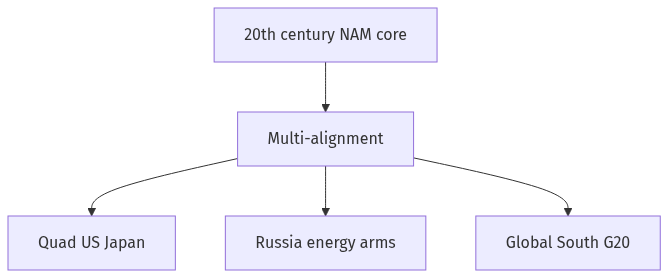
From non-alignment as centre to multi-alignment
- The Cold War NAM core remains a vocabulary. Practice added simultaneous work with the United States, Russia, the European Union, Japan, and the Global South.
- The 2008 India–United States civil nuclear path and later logistics and foundational agreements showed a strategic partnership that 20th-century non-alignment had not contained.
- Russia remained a defence and energy partner even as its share of new arms orders fell.
Neighbourhood and East
- Neighbourhood First and Act East replaced a thinner Look East slogan with connectivity, BIMSTEC, and ASEAN-centred diplomacy.
- SAARC stalled. Sub-regional and trans-regional clubs grew.
China, Quad, and the sea
- Border crises, including 2020 in eastern Ladakh, moved China from a manageable rivalry toward a central military problem.
- The Quad’s revival, Malabar exercises, and Indo-Pacific language placed India in a maritime balancing set without a NATO treaty.
- Offensive-realist readings of Chinese power and defensive-realist caution about over-alignment both appear in official practice.
Global South and domestic link
- Energy, diaspora, and trade became first-order tools. G20 presidency in 2023 and Voice of Global South diplomacy updated NAM-era claims.
- Foreign policy is now sold more openly as a support to growth, technology, and Indian-origin communities abroad.
Flow diagram
Conclusion
The major 21st-century changes are multi-alignment, a tighter economic and diaspora policy, Act East, and a maritime-plus-border response to China. Autonomy is still the stated doctrine. The partner set is wider than the 20th-century NAM map.
Quick related
Students also ask
-
"India's Nuclear policy is deeply influenced by its cultural beliefs and the pragmatic approach of its foreign policy." Discuss
Next question on this syllabus topic (2023 · Q7(a)). View answer →
-
Did India abandon non-alignment in this century?
It abandoned exclusive reliance on a NAM-centred map. It did not join a military alliance. Officials prefer multi-alignment or strategic autonomy.
-
Is the Quad the whole of the change?
No. Energy with the Middle East, Russia oil after 2022, and Africa diplomacy are also major 21st-century files.
Same topic · past papers
UPSC has asked this before
These previous-year questions sit on the same topic. Open one to practise the earlier ask.
-
2026 · Q4(c) · PSIR GS 2 · 15 marks
What is UNCLOS? Explain its salient features -
2026 · Q5(d) · PSIR GS 2 · 10 marks
Discuss the main features of the land-boundary agreement between India and Bangladesh. -
2024 · Q2(b) · PSIR GS 2 · 15 marks
What are the distinctive features of the post-modern state in the advanced capitalist economies? Analyse.
More from this topic
Q8(b) · UPSC Mains 2026 · PSIR GS 2 · 15 marks · Solution
India has recognised that West Asia is not a single contest, but a tangle of rivalries, bargains and anxieties. Comment
Recent developments in Indian Foreign policy
This 15-mark model answer for UPSC CSE Mains examines India's evolved diplomacy in West Asia, transitioning from a monolithic view to navigating complex regional rivalries, strategic bargains, and security anxieties. It highlights India's de-hyphenated engagement with Israel, Iran, and the Arab Gulf, robust energy diplomacy, diaspora protection, and minilateral frameworks like I2U2. The conclusion anchors this pragmatic realism within India's strategic autonomy and Act West policy.
Q5(b) · UPSC Mains 2026 · PSIR GS 2 · 10 marks · Solution
What strategic options can India exercise as a response to the tensions between Pakistan and Afghanistan?
Recent developments in Indian Foreign policy
India faces a complex security landscape due to Durand Line tensions and cross-border terrorism between Pakistan and Afghanistan. Strategic options include proactive diplomatic engagement with the Taliban regime to secure developmental investments, intelligence-sharing and capacity-building with regional partners like Iran and Central Asian Republics, and maintaining a strict posture on counter-terrorism. By leveraging multilateral platforms such as the Shanghai Cooperation Organisation and reinforcing soft-power outreach through humanitarian aid, New Delhi can safeguard its core security interests. Simultaneously, India must balance its defensive posture with strategic autonomy, ensuring regional stability without direct military entanglement in the Pashtun belt.
Q5(c) · UPSC Mains 2025 · PSIR GS 2 · 10 marks · Solution
For India, a multipolar world order would also mean a multipolar Asia. Comment.
Recent developments in Indian Foreign policy
A multipolar world is several great-power centres; it is hollow for India if Asia is Sino-centric. India’s threats, trade and waters are Asian, so Asian power-sharing is the real test of the slogan. Japan, ASEAN centrality, Korea, Australia and India beside China and the U.S. are the intended map. Quad and FOIP are instruments of pluralism, not a finished concert. The claim is right as strategy and still aspirational as fact.