
Revision summary
Human security after UNDP 1994 centres people, not only territorial defence. Climate, pollution, water stress, and ecosystem loss kill and displace without a foreign army. Bay of Bengal cyclones, Pakistan 2022 floods, and urban air are South Asian exhibits. COVID-19 linked ecology, health, and later vaccine rules. Realist State security remains relevant for war; it is incomplete for this class of threat.
Model answer
Copper italics in this answer — like this — are the key facts. Each one is unpacked in the Facts & figures rail.
Introduction
Human security, as used after the UNDP Human Development Report of 1994, is safety of people in daily life, not only safety of States from invasion. Environmental degradation now produces that insecurity through water, food, disease, and disaster, including in South Asia.
Body
From State security to human security
- Traditional realism, including Waltz, ranked military threats first. Environmental harm was a domestic or scientific issue.
- Human security treats drought, flood, pollution, and epidemic as security problems because they kill, displace, and break livelihoods.
- Robert Cox’s critical theory helps here: an order that protects capital and great-power stability can still leave people exposed to climate and toxic risk.
How degradation produces insecurity
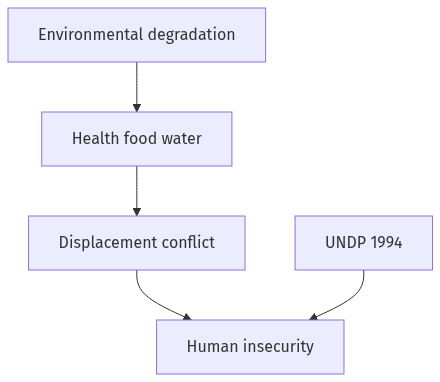
- Climate change raises heat, cyclone intensity, and glacier melt, which hit farming and coastal cities.
- Deforestation, mining, and air pollution raise respiratory disease and destroy commons that the poor use.
- Water stress between upstream and downstream users, including India–Pakistan Indus politics and India–China Brahmaputra concern, can feed diplomatic conflict.
- Loss of fisheries and soil pushes migration, which then appears as a border and urban security issue.
Examples
- Cyclones in the Bay of Bengal, including events that have struck Odisha, West Bengal, and Bangladesh, show how a “natural” disaster is worsened by degraded mangroves and dense coastal poverty.
- The 2022 Pakistan floods linked monsoon extremes, river management, and mass displacement.
- Delhi’s seasonal air quality is a public-health emergency that no army can treat as a foreign enemy.
- COVID-19 showed how ecological disturbance and global travel can create a health-security shock; vaccine nationalism then appeared at the WTO, treated in Section B.
- Sahel drought and farmer–herder conflict show the same chain in Africa, which also shapes India’s development diplomacy there.
Policy implication
- Mitigation, adaptation, disaster management, and climate finance are security policy in this frame, not extras after defence.
Flow diagram
Conclusion
Environmental degradation is a major source of human insecurity because it destroys health, food, water, and shelter at scale. Examples from South Asian floods and storms, urban air, and global disease show that State military balance does not measure this threat.
Quick related
Students also ask
-
What do you mean by offensive and defensive realism?
Next question on this syllabus topic (2023 · Q4(b)). View answer →
-
Is climate change a replacement for military security?
No. It is an added source of insecurity. States still face armies. People also face heat, flood, and toxic air.
-
Can the Security Council treat climate as a threat to peace?
Members have debated it. P5 disagreement and sovereignty claims have limited a standing Chapter VII climate practice.
Same topic · past papers
UPSC has asked this before
These previous-year questions sit on the same topic. Open one to practise the earlier ask.
-
2025 · Q2(c) · PSIR GS 2 · 15 marks
Transnational actors have qualitatively transformed the world by the way of their fresh insights and actions. Illustrate your answer with suitable examples -
2025 · Q1(c) · PSIR GS 2 · 10 marks
Explain the non-traditional security threats in the context of food and environmental crises. -
2024 · Q6(a) · PSIR GS 2 · 20 marks
Would you concur with the view that of late, India's foreign policy has been in a transition mode from Nehruvianism to Neoliberalism? Support your answer with the help of suitable examples.
More from this topic
Q7(a) · UPSC Mains 2026 · PSIR GS 2 · 20 marks · Solution
How does illegal cross border migration pose challenges to India's security? Discuss the steps taken by the government in this direction and their effectiveness
Comparative Politics
Illegal cross-border migration undermines India's national security by altering demographic balances, straining economic resources, and exacerbating internal security vulnerabilities. The government has responded through border fencing, technological integration like SMART fencing, institutional mechanisms, and bilateral agreements. However, porous terrain, regional political complexities, and local connivance limit the complete effectiveness of these measures. A holistic approach combining strict border management with socio-economic development and robust legal frameworks is essential for sustainable containment.
Q5(d) · UPSC Mains 2026 · PSIR GS 2 · 10 marks · Solution
Discuss the main features of the land-boundary agreement between India and Bangladesh.
Comparative Politics
• Operationalized via the 100th Constitutional Amendment Act of 2015 to resolve Radcliffe Line anomalies. • Rooted in the unratified 1974 bilateral agreement and the 2011 additional protocol. • Involved the peaceful exchange of 111 Indian enclaves in Bangladesh and 51 Bangladeshi enclaves in India. • Granted affected residents the sovereign right to choose their nationality and place of residence. • Demarcated roughly 6.1 km of previously un-demarcated land boundaries to end administrative confusion. • Secured human rights and welfare access for over 50,000 formerly stateless enclave residents. • Reduced bilateral trust deficits, paving the way for deeper cooperation in security and connectivity.
Q4(c) · UPSC Mains 2026 · PSIR GS 2 · 15 marks · Solution
What is UNCLOS? Explain its salient features
Comparative Politics
UNCLOS, established in 1982, serves as the constitution of the oceans, codifying customary international law regarding maritime jurisdictions. Its salient features include distinct maritime zones ranging from territorial waters to the high seas, balancing coastal state sovereignty with freedom of navigation. It establishes compulsory dispute settlement mechanisms through institutions like ITLOS. The convention also mandates environmental protection and sustainable management of marine resources. For India, UNCLOS provides a rules-based order in the Indo-Pacific while respecting navigational rights. It remains central to addressing contemporary maritime security and resource challenges.