
Revision summary
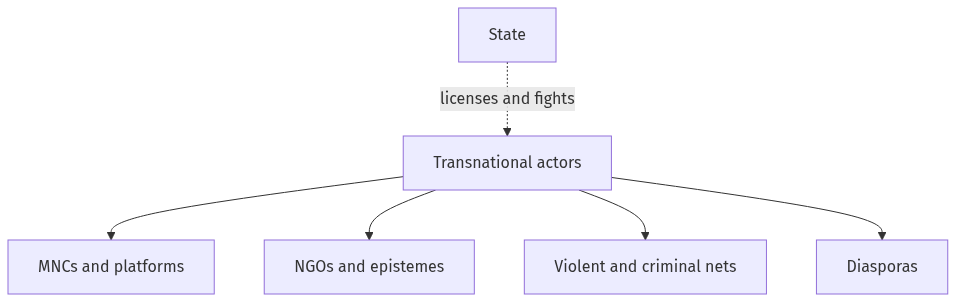
Transnational actors are organised non-state forces that operate across borders. MNCs, epistemic communities, NGOs, terrorist and criminal networks, diasporas and platforms are the main types. They changed agenda-setting, norms and sometimes the use of force — a qualitative, not only quantitative, shift. Keohane, Nye, Rosenau, Haas and Strange supply theory. The state still licenses, bans and fights; world politics is a mesh, not a replacement of Westphalia.
Model answer
Copper italics in this answer — like this — are the key facts. Each one is unpacked in the Facts & figures rail.
Introduction
Transnational actors are organised forces that work across borders without being sovereign states: firms, churches, scientific networks, terror groups, diasporas and platforms. Robert Keohane and Joseph Nye, James Rosenau, and later constructivists argued that they changed not only the quantity of international contacts but the quality of world politics — who sets agendas, who writes norms, who can hurt.
Body
Market and expert actors
Multinational corporations allocate investment, set labour and data standards, and lobby trade rounds. Apple, Aramco, and semiconductor alliances shape the Indo-Pacific as surely as destroyers. Epistemic communities — Peter Haas — wrote the ozone regime and still staff climate IPCC summaries. Philanthropic verticals (Gavi, Global Fund, large foundations) bankroll vaccines when WHO’s assessed budget cannot. These actors bring fresh insight: they see supply chains and pathogens that foreign ministries meet late.
Norm and protest actors
Amnesty, ICRC, climate NGOs, and feminist transnational networks (from CEDAW lobbying to Woman, Life, Freedom amplification) name shame and draft soft law. The International Campaign to Ban Landmines showed that a coalition of NGOs and middle powers can produce a treaty great powers dislike. Such actors do not replace the UN; they crowd it.
Dark and hybrid actors
Al-Qaeda, ISIS, and Lashkar-type groups are transnational too. They forced states into extra-territorial war and surveillance. Criminal markets in fentanyl, arms and wildlife fold into non-traditional security. Digital platforms — X, Meta, TikTok — are a new class: they socialise open and closed societies, host both democratic backlash and disinformation. Diasporas fund parties, temples, and sometimes militancy.
Qualitative transformation
The transformation is polycentric authority. Issues are no longer only inter-state. Human rights, climate, health and tech standards are made in a mesh. Yet the state is not obsolete. It licenses firms, bans apps, kills terrorists, and still monopolises legitimate nuclear arms. Susan Strange’s structural power of finance and knowledge sits beside Waltz’s military structure. A 2025 world of Trump tariffs, WHO fights and Pahalgam terrorism is unintelligible if one counts only foreign offices. It is equally unintelligible if one pretends Google can sign a peace treaty.
Flow diagram
Conclusion
- Transnational actors added new authors to world politics: capital, science, conscience, crime and code. They transformed agendas and sometimes force. They did not abolish the state; they made it share the stage.
Quick related
Students also ask
-
Collective security and responsibility to protect (R2P) are uniform neither in scope, goals and methods. Explain
Next question on this syllabus topic (2025 · Q3(b)). View answer →
-
Is the UN a transnational actor?
The UN is an intergovernmental organisation of states. Many of its agencies host transnational professionals, but legal authority still runs through members.
-
Are Big Tech firms more powerful than states?
In data and attention, sometimes. In taxation, war and borders, states can still ban, break up or draft them — as India, the EU and the U.S. have each shown.
Same topic · past papers
UPSC has asked this before
These previous-year questions sit on the same topic. Open one to practise the earlier ask.
-
2021 · Q2(c) · PSIR GS 2 · 15 marks
What is complex interdependence? Discuss the role of transnational actors in the international system -
2024 · Q6(a) · PSIR GS 2 · 20 marks
Would you concur with the view that of late, India's foreign policy has been in a transition mode from Nehruvianism to Neoliberalism? Support your answer with the help of suitable examples. -
2023 · Q3(c) · PSIR GS 2 · 15 marks
Narrate the various ways in which rapid environmental degradation is posing a serious threat to human security. Illustrate your answer with suitable examples
More from this topic
Q6(c) · UPSC Mains 2026 · PSIR GS 2 · 15 marks · Solution
"The mother of all deals" is a transformative milestone in Indo-EU trade relations. Elaborate on the new Security and Defence partnership
Key concepts in International Relations
• India-EU ties have shifted from basic dialogue to pragmatic geoeconomic and security alignment. • The revitalized trade architecture tackles market access hurdles and builds supply chain resilience. • Both sides are diversifying critical raw materials and transferring advanced technologies. • A new Security and Defence partnership institutionalizes cooperation on maritime security and cyber defense. • Defense ties are moving from a buyer-seller model to co-development and co-production. • Enhanced naval exercises and information-sharing secure sea lines of communication in the Indo-Pacific. • This partnership reinforces India's strategic autonomy and supports a multipolar global order.
Q3(a) · UPSC Mains 2026 · PSIR GS 2 · 20 marks · Solution
NATO, the oldest surviving collective security system, is facing the challenge of transactional coercion from its own biggest member. What future does NATO have amidst such developments?
Key concepts in International Relations
• Founded in 1949 as a collective defense pact, NATO now faces internal pressure from US transactional coercion alongside resurgent external threats. • Severe power asymmetry allows Washington to leverage security guarantees for narrow economic and political concessions, straining Article 5. • Chronic disputes over the 2 percent GDP defense spending target expose deep fault lines in alliance burden-sharing. • Despite internal frictions, NATO shows resilience through the accession of Finland and Sweden and expanded mandates in cyber and hybrid warfare. • Strategic outreach to Indo-Pacific AP4 nations aligns transatlantic security with broader global containment frameworks. • The alliance's future depends on balancing European demands for strategic autonomy with the irreplaceable US nuclear umbrella. • NATO will likely persist because Europe currently lacks any viable alternative security architecture to handle geopolitical revanchism.
Q1(c) · UPSC Mains 2026 · PSIR GS 2 · 10 marks · Solution
Discuss various methods of Balance of Power.
Key concepts in International Relations
Balance of Power is a core realist concept designed to prevent any single state from dominating the global system.