
Revision summary
India and Sri Lanka share people-to-people, security and neighbourhood-first ties, including the civil-war and 13th Amendment file. Chinese infrastructure credit, Colombo Port City and the Hambantota lease created economic presence with strategic meaning for Delhi. Colombo used China to hedge Indian political weight, especially on Tamil issues. The 2022 debt crisis restored India’s role as first financier and IMF-era partner. Strain is real omni-enmeshment, not a finished Chinese capture of the island.
Model answer
Copper italics in this answer — like this — are the key facts. Each one is unpacked in the Facts & figures rail.
Introduction
India and Sri Lanka share religion, language zones, a narrow strait, and a long security intimacy, including India’s role in the civil-war years and in the 13th Amendment debate. Those deep ties have been strained as China financed infrastructure and gained economic presence, most famously at Hambantota. The analysis must hold both facts: strain is real; geography and the 2022 crisis still pull Colombo toward Delhi.
Body
Deep ties
Tamil Nadu politics, fisheries, Buddhism, and Indian tourists and investment are everyday links. India is a first responder in disaster and, in 2022, in credit, fuel and currency support when Sri Lanka’s sovereign debt collapsed. Defence dialogues and the neighbourhood-first claim treat the island as vital ground in the Indian Ocean, which is why the Indo-Pacific vocabulary of 5(d) includes Sri Lanka whether Colombo likes the label or not.
China’s economic dominance as politics
Chinese loans and contractors built ports, highways and the Colombo Port City vision. Hambantota port’s long lease after debt distress became the global example of a strategic asset shifting under commercial stress. For India, a Chinese-run deep port on the southern flank, plus possible dual-use visits, is a security externalities problem like Bhutan’s border, only maritime. Colombo’s earlier governments used Chinese money to reduce dependence on India, especially when Delhi was associated with Tamil concerns and with 1987 intervention memory.
Strains show up as delayed energy projects with India, mixed messages on Chinese ‘research’ vessels, and domestic Sri Lankan politics that treat Indian proximity as interference and Chinese proximity as development.
Analyse, do not flatten
China did not buy Sri Lankan identity. It bought time and concrete when Indian and Western finance were slower or more conditional. The 2022 default damaged the Chinese model’s reputation as costless. India’s aid, IMF-linked recovery, and renewed talk of connectivity (ports, power, tourism) showed that economic dominance is reversible in influence if not in every lease. Tamil aspirations and fishermen’s livelihoods remain Indian domestic constraints that China does not carry.
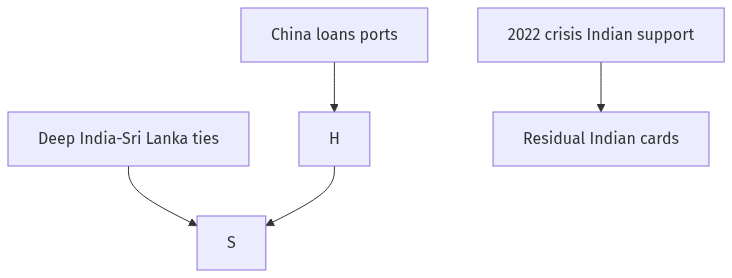
- The relationship is therefore a triangle: Colombo hedges; Beijing builds; Delhi both resents and remains indispensable. Strain is the price of a neighbour’s omni-enmeshment. It is not a completed loss of the island.
Flow diagram
Conclusion
India–Sri Lanka ties remain thick in people, security and crisis finance. Chinese investment, Hambantota and port-city politics have strained that intimacy by giving Colombo another paymaster. The 2022 crash showed the limit of that paymaster. Analysis should register strain without writing India out of the map.
Quick related
Students also ask
-
Would you concur with the view that of late, India's foreign policy has been in a transition mode from Nehruvianism to Neoliberalism? Support your answer with the help of suitable examples.
Next question on this syllabus topic (2024 · Q6(a)). View answer →
-
Is Hambantota a Chinese naval base?
It is a commercial lease with dual-use anxiety. Treating it as an announced PLAN base overstates the public record and understates the risk Delhi actually manages.
-
Did India lose Sri Lanka?
It lost exclusivity. It did not lose first-responder status or the strait. Those are different losses.
Same topic · past papers
UPSC has asked this before
These previous-year questions sit on the same topic. Open one to practise the earlier ask.
More from this topic
Q8(b) · UPSC Mains 2026 · PSIR GS 2 · 15 marks · Solution
India has recognised that West Asia is not a single contest, but a tangle of rivalries, bargains and anxieties. Comment
Recent developments in Indian Foreign policy
This 15-mark model answer for UPSC CSE Mains examines India's evolved diplomacy in West Asia, transitioning from a monolithic view to navigating complex regional rivalries, strategic bargains, and security anxieties. It highlights India's de-hyphenated engagement with Israel, Iran, and the Arab Gulf, robust energy diplomacy, diaspora protection, and minilateral frameworks like I2U2. The conclusion anchors this pragmatic realism within India's strategic autonomy and Act West policy.
Q5(b) · UPSC Mains 2026 · PSIR GS 2 · 10 marks · Solution
What strategic options can India exercise as a response to the tensions between Pakistan and Afghanistan?
Recent developments in Indian Foreign policy
India faces a complex security landscape due to Durand Line tensions and cross-border terrorism between Pakistan and Afghanistan. Strategic options include proactive diplomatic engagement with the Taliban regime to secure developmental investments, intelligence-sharing and capacity-building with regional partners like Iran and Central Asian Republics, and maintaining a strict posture on counter-terrorism. By leveraging multilateral platforms such as the Shanghai Cooperation Organisation and reinforcing soft-power outreach through humanitarian aid, New Delhi can safeguard its core security interests. Simultaneously, India must balance its defensive posture with strategic autonomy, ensuring regional stability without direct military entanglement in the Pashtun belt.
Q5(c) · UPSC Mains 2025 · PSIR GS 2 · 10 marks · Solution
For India, a multipolar world order would also mean a multipolar Asia. Comment.
Recent developments in Indian Foreign policy
A multipolar world is several great-power centres; it is hollow for India if Asia is Sino-centric. India’s threats, trade and waters are Asian, so Asian power-sharing is the real test of the slogan. Japan, ASEAN centrality, Korea, Australia and India beside China and the U.S. are the intended map. Quad and FOIP are instruments of pluralism, not a finished concert. The claim is right as strategy and still aspirational as fact.