
Revision summary
A multipolar world is several great-power centres; it is hollow for India if Asia is Sino-centric. India’s threats, trade and waters are Asian, so Asian power-sharing is the real test of the slogan. Japan, ASEAN centrality, Korea, Australia and India beside China and the U.S. are the intended map. Quad and FOIP are instruments of pluralism, not a finished concert. The claim is right as strategy and still aspirational as fact.
Model answer
Copper italics in this answer — like this — are the key facts. Each one is unpacked in the Facts & figures rail.
Introduction
- A multipolar world means more than two centres of relevant power: military, economic and institutional. For India, that slogan is empty if Asia itself is a Chinese unipolar system with everyone else as spokes. S. Jaishankar has put the point bluntly in public: a multipolar world requires a multipolar Asia. The comment is a demand, not a description already achieved.
Body
Why the link is logical
If the United States, China, the EU, Russia and India are named as world poles, but East, South and Southeast Asia take their security orders from Beijing, then India is a pole only on paper. Geography is Asian. Trade is Asian. The LAC, the Indian Ocean and the Himalayan water tower are Asian. A Sino-centric Asia would squeeze India’s strategic autonomy into a continental corner while the ‘world’ applauded multipolarity. Kissinger’s old triangular diplomacy assumed more than one Asian heavy. So did Nehru’s Asian Relations imagination, in a different moral key.
What multipolar Asia looks like
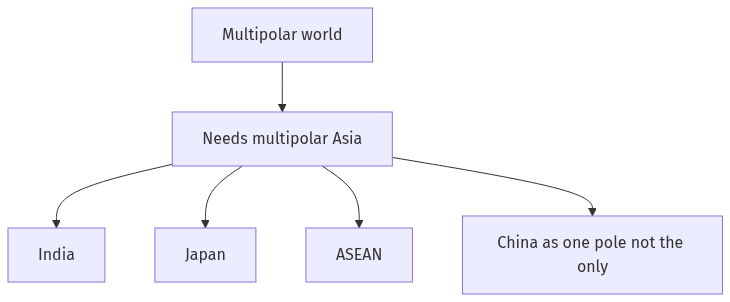
It looks like Japan as a normal security actor, ASEAN centrality that is not a Chinese waiting room, a Korea that is more than a U.S. base or a Chinese market, Australia in the Indian Ocean, and India able to refuse both tributary status and a formal U.S. alliance. The Quad, FOIP, Malabar, and supply-chain hedges on semiconductors are instruments. They are not a NATO. Multipolarity here is balanced pluralism, not anti-China theology: China remains a pole. It must not be the only Asian pole.
Obstacles
The Belt and Road, the South China Sea, and Bangladesh–Sri Lanka–Nepal courtship (Q5(a), Q8(c)) are how unipolarity is attempted by chequebook. The U.S. hub-and-spokes alliance system is another hierarchy, friendlier to Delhi than Beijing’s but still not Indian-designed. India’s own capacity — navy, manufacturing, neighbourhood delivery — is the binding constraint. A slogan without a shipyard is a toast.
- The comment is right as strategy: use world-multipolarity language to legitimise Asian power-sharing, including India’s. It is aspirational as fact. The 2020s contest which Asia the world will get.
Flow diagram
Conclusion
For India, a multipolar world that rested on a unipolar Asia would be a trap. Multipolar Asia — Japan, ASEAN, India, middle powers beside China and the U.S. — is the only version of the slogan that matches the map.
Quick related
Students also ask
-
Despite deep ties, India's relations with Sri Lanka have seen strains due to China's growing influence in Sri Lanka through investments and economic dominance. Analyse.
Next question on this syllabus topic (2024 · Q5(e)). View answer →
-
Is this just a polite way to say contain China?
It is a way to refuse Chinese primacy without accepting a unipolar U.S. Asia. Containment is a U.S. word; pluralism is India’s preferred word.
-
Does Russia fit a multipolar Asia?
Russia is a Eurasian military pole with Pacific frontage. It is not a substitute for Japan or ASEAN in India’s Asian math, especially after Ukraine.
Same topic · past papers
UPSC has asked this before
These previous-year questions sit on the same topic. Open one to practise the earlier ask.
-
2022 · Q1(d) · PSIR GS 2 · 10 marks
Bipolar structure of the world is more stable than the multipolar one. Comment.
More from this topic
Q8(b) · UPSC Mains 2026 · PSIR GS 2 · 15 marks · Solution
India has recognised that West Asia is not a single contest, but a tangle of rivalries, bargains and anxieties. Comment
Recent developments in Indian Foreign policy
This 15-mark model answer for UPSC CSE Mains examines India's evolved diplomacy in West Asia, transitioning from a monolithic view to navigating complex regional rivalries, strategic bargains, and security anxieties. It highlights India's de-hyphenated engagement with Israel, Iran, and the Arab Gulf, robust energy diplomacy, diaspora protection, and minilateral frameworks like I2U2. The conclusion anchors this pragmatic realism within India's strategic autonomy and Act West policy.
Q5(b) · UPSC Mains 2026 · PSIR GS 2 · 10 marks · Solution
What strategic options can India exercise as a response to the tensions between Pakistan and Afghanistan?
Recent developments in Indian Foreign policy
India faces a complex security landscape due to Durand Line tensions and cross-border terrorism between Pakistan and Afghanistan. Strategic options include proactive diplomatic engagement with the Taliban regime to secure developmental investments, intelligence-sharing and capacity-building with regional partners like Iran and Central Asian Republics, and maintaining a strict posture on counter-terrorism. By leveraging multilateral platforms such as the Shanghai Cooperation Organisation and reinforcing soft-power outreach through humanitarian aid, New Delhi can safeguard its core security interests. Simultaneously, India must balance its defensive posture with strategic autonomy, ensuring regional stability without direct military entanglement in the Pashtun belt.
Q5(a) · UPSC Mains 2025 · PSIR GS 2 · 10 marks · Solution
China's growing footprint and a tangible shift in power dynamics in Bangladesh has weakened India's leverage in Dhaka. Comment.
Recent developments in Indian Foreign policy
India’s Bangladesh leverage after 2009 was tied to Sheikh Hasina; her 2024 exit opened space for China. Beijing’s BRI projects, credit and defence courtship give Dhaka an omni-enmeshment option. Indian delays on Teesta, a trade surplus and political optics of patronage stored grievances. The shift weakens Delhi’s privileged access but does not erase geography, power trade or transit. A less personality-based Neighbourhood First is the repair, not a hyper-realist sulk.