
Revision summary
Elite theory claims that an organised minority always rules; democracy changes circulation, not the fact of minority rule. Mosca, Pareto, and Michels supplied the classical Italian and organisational core, including the iron law of oligarchy. Schumpeter redefined democracy as competition among elites for the vote rather than as the people willing the general will. Mills described a more closed power elite; Dahl answered with polyarchy and plural minorities. The democratic task is to keep elites plural, replaceable, and accountable rather than to pretend that nobody leads.
Model answer
Copper italics in this answer — like this — are the key facts. Each one is unpacked in the Facts & figures rail.
Introduction
Elite theory says that in every political society a minority organises and rules. Democracy does not abolish that fact. It changes how elites circulate, compete, and justify themselves. The theory is a cold reading of Rousseau’s people and of textbook majority rule.
Body
The classical Italian school
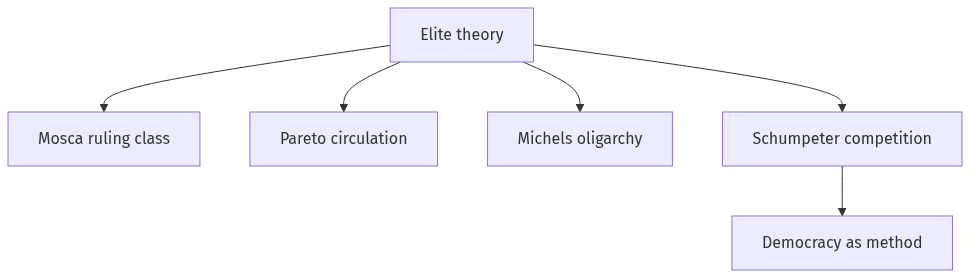
Gaetano Mosca wrote of a ruling class that monopolises organisation and political formulae — the moral stories that make rule look rightful. Vilfredo Pareto spoke of the circulation of elites, lions and foxes, residues and derivations. History is the replacement of one minority by another, not the arrival of the people as such. Robert Michels, studying socialist parties, stated the iron law of oligarchy: organisation needs leaders; leaders become a caste. Even parties of equality grow oligarchic.
- Their mood was often anti-democratic. The descriptive claim still bites: parties and bureaucracies concentrate skill, and the many cannot govern day to day.
Democratic elite theory
Joseph Schumpeter redefined democracy as a method: competing elites bid for votes. The voter chooses teams, not Rousseau’s general will. Max Weber had described party machines. C. Wright Mills pictured a more closed power elite of military, corporate, and political chiefs.
Robert Dahl answered with polyarchy: multiple minorities in contest. Giovanni Sartori took democracy as the least bad way to replace elites. The criticism is that civic education dies if voters are only consumers, and that Gramsci’s hegemony can close competition. Indian dynastic parties and anti-incumbency show oligarchy and circulation together.
Flow diagram
Conclusion
Elite theory of democracy holds that organised minorities govern, and that democracy is the competition and circulation of those minorities under rules. Mosca, Pareto, and Michels stated the hard core. Schumpeter made it a definition of democracy. The task of a democratic theory is not to deny elites, but to keep them replaceable, plural, and publicly accountable.
Quick related
Students also ask
-
Deliberative democracy seeks to promote democratic decision making about public issues among the citizens. Discuss.
Next question on this syllabus topic (2024 · Q3(b)). View answer →
-
Does elite theory say democracy is fake?
The pessimistic Italian school often did. Schumpeterian theory says democracy is real as a method of authorising and replacing elites, not as popular self-rule on every file.
-
How does Gramsci differ?
Gramsci’s hegemony explains how elites rule through culture and consent in civil society, which elite theory of office-holders can miss.
Same topic · past papers
UPSC has asked this before
These previous-year questions sit on the same topic. Open one to practise the earlier ask.
-
2025 · Q5(a) · PSIR GS 1 · 10 marks
Explain briefly the role of Peasant Movements after 1857 and before independence
More from this topic
Q4(a) · UPSC Mains 2026 · PSIR GS 1 · 20 marks · Solution
"Representative democracy is not an absolute principle, rather a question of time, place and circumstances." Analyze the statement. Mention the major challenges to representative democracy
Democracy: Classical and contemporary theories; different models of democracy
• Representative democracy is not a fixed absolute; it is a practical tool shaped by history, scale, and socioeconomic conditions. • Originally designed by thinkers like Burke and the Federalist framers as a filter for popular will rather than pure direct democracy. • Its structures have continuously evolved through struggles for rights, often reflecting underlying economic inequalities (C.B. Macpherson). • Contemporary systems face a "democratic deficit" as key decisions shift to unelected technocrats and expert bodies. • Hyper-polarization, populism, and information silos are eroding deliberative consensus and minority protections. • Corporate funding and media monopolies distort the core relationship between voters and their elected representatives. • Long-term survival requires treating democracy as an evolving system by adding participatory tools and grassroots accountability.
Q3(a) · UPSC Mains 2026 · PSIR GS 1 · 20 marks · Solution
Mill's work was crucial to the development of liberalism, because it straddled the divide between classical and modern theories. Analyze
Democracy: Classical and contemporary theories; different models of democracy
J.S. Mill served as a crucial bridge between classical and modern liberalism by modifying Bentham's quantitative utilitarianism with qualitative distinctions in pleasures. In 'On Liberty', he championed individual autonomy, freedom of expression, and the harm principle while guarding against the tyranny of the majority. Through 'Considerations on Representative Government', he introduced proportional representation, minority protection, and developmental democracy. His work transformed atomistic classical individualism into a socially conscious framework that anticipates modern democratic pluralism and participatory theory.
Q3(b) · UPSC Mains 2024 · PSIR GS 1 · 15 marks · Solution
Deliberative democracy seeks to promote democratic decision making about public issues among the citizens. Discuss.
Democracy: Classical and contemporary theories; different models of democracy
Deliberative democracy treats legitimacy as public reasoning among free and equal citizens about common issues. Habermas’s discourse ethics and public sphere, Cohen’s institutional principles, and Dryzek’s authenticity thesis are core statements. It promotes citizen decision-making through reasoned debate, citizens’ assemblies, Gram Sabhas, and public hearings, not through votes alone. Rawls’s public reason is a related liberal constraint on what counts as an acceptable political argument. Inequality, Gramscian hegemony, and the scale of the modern state are the main limits; deliberation should improve representation, not pretend to abolish it.