
Revision summary
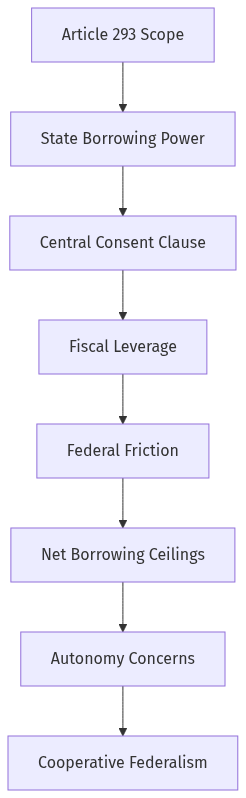
Article 293 empowers states to borrow within territory limits subject to Centre's consent if central loans are outstanding. This fiscal lever has triggered intense friction between the Union and opposition-ruled states over net borrowing ceilings and off-budget borrowings. While designed for macroeconomic stability, its centralized enforcement risks undermining the fiscal autonomy of states. The judiciary and Sarkaria-Punchhi commissions have repeatedly emphasized consultative fiscal federalism to resolve such tensions.
Model answer
Copper italics in this answer — like this — are the key facts. Each one is unpacked in the Facts & figures rail.
Introduction
Article 293 of the Constitution governs the borrowing powers of states, serving as a critical fiscal instrument in India's federal architecture. While intended to maintain macroeconomic stability and prevent state-level fiscal default, its operationalization has increasingly become a site of Centre-State friction.
Body
Constitutional Framework of Article 293
- Borrowing Scope: Article 293(1) allows states to borrow upon the security of the Consolidated Fund of India within territory limits, subject to legislative regulation.
- Central Consent: Article 293(3) mandates that a state cannot raise any loan without the Centre's consent if there is still outstanding any part of a loan made to the state by the Centre or its predecessor.
- Macroeconomic Stability: Designed to prevent reckless fiscal expansion by states that could jeopardize national credit ratings and macroeconomic stability.
Implications for Indian Federal Structure
- Fiscal Centralization: The absolute leverage provided by Article 293(3) allows the Union to control state fiscal space, often blurring lines between cooperative and coercive federalism.
- Net Borrowing Ceilings: Union regulation of Net Borrowing Ceilings (NBC) under fiscal deficit targets has restricted state development expenditures and capital outlays.
- Conditionality Disputes: Tying central consent to specific structural reforms or branding requirements has eroded state-level policy autonomy.
Limitations and Political Friction
- Off-Budget Borrowings: States have resorted to alternative financing routes through public sector undertakings to bypass central restrictions, inviting stricter Union clamping down.
- Partisan Asymmetry: Allegations of discriminatory application of borrowing limits against opposition-ruled states have intensified inter-governmental disputes.
- Institutional Recourse: Lack of a neutral adjudicatory body like the Inter-State Council leaves fiscal disputes vulnerable to executive overreach.
Flow diagram
Conclusion
Article 293 remains a vital anchor for fiscal discipline, yet its unilateral enforcement disrupts the delicate balance of Indian federalism. Restoring trust requires institutionalizing consultative mechanisms through the Inter-State Council and adhering to transparent, rule-based fiscal devolution recommendations.
Quick related
Students also ask
-
Highlight any five constitutional provisions that restrain the powers of the executive, and evaluate their effectiveness in current times
Next question on this syllabus topic (2026 · Q7(b)). View answer →
-
What is the significance of Article 293 in Centre-State relations?
Article 293 regulates state borrowings and requires central consent under certain debt conditions, making it a key instrument of fiscal control and a frequent flashpoint for federal friction.
-
How does Article 293 impact the Indian federal structure?
While intended to ensure macroeconomic stability, it often leads to fiscal centralization by allowing the Union to impose strict borrowing ceilings and conditions on states.
Same topic · past papers
UPSC has asked this before
These previous-year questions sit on the same topic. Open one to practise the earlier ask.
-
2026 · Q7(b) · PSIR GS 1 · 15 marks
Highlight any five constitutional provisions that restrain the powers of the executive, and evaluate their effectiveness in current times -
2025 · Q6(b) · PSIR GS 1 · 15 marks
Examine the constitutional provisions and nature of advisory jurisdiction of Supreme Court of India. Evaluate your answer with relevant examples
More from this topic
Q7(b) · UPSC Mains 2026 · PSIR GS 1 · 15 marks · Solution
Highlight any five constitutional provisions that restrain the powers of the executive, and evaluate their effectiveness in current times
Federalism
This model answer examines five constitutional mechanisms designed to check executive overreach in India: parliamentary accountability, judicial review under Article 13 and 32, the President's suspensive veto, the federal distribution of powers under the Seventh Schedule, and constitutional bodies like the Election Commission. It analyses their formal design alongside contemporary challenges to their operational efficacy, such as declining parliamentary scrutiny, ordinance routes, and pressure on institutional autonomy. The synthesis underscores that while the textual architecture for executive restraint is robust, its real-world effectiveness depends on political morality and judicial vigilance.
Q6(b) · UPSC Mains 2025 · PSIR GS 1 · 15 marks · Solution
Examine the constitutional provisions and nature of advisory jurisdiction of Supreme Court of India. Evaluate your answer with relevant examples
Federalism
Article 143 lets the President refer questions of public importance to the Supreme Court for an opinion. Clause (1) is discretionary for the Court; clause (2) on certain treaty disputes requires a report. The opinion is not an ordinary decree, though it is politically and legally weighty. Kerala Education Bill and Berubari show the jurisdiction at its best as advance constitutional counsel. The Ayodhya reference shows the Court may refuse a question that is better left to a pending suit; 2G shows how an invited opinion can bind the inviter politically.
Q6(c) · UPSC Mains 2025 · PSIR GS 1 · 15 marks · Solution
The recent developments in Indian Politics has not eroded the true spirit of federalism in India. Critically examine this statement with the help of appropriate illustrations
Federalism
The spirit of Indian federalism is bargaining among units, not only the three Lists. GST created a shared tax forum that the Supreme Court treated as federal dialogue, while compensation and Union weight still skew the table. The 2019 J&K reorganisation is the strongest evidence of unilateral thinning of a constituent unit, even after judicial upholding. The farm laws showed Union overreach into the agrarian political economy; their repeal showed that protest and states can restore bargaining. The Fifteenth Finance Commission remains a constitutional federal mechanism, contested over 2011 population and cesses that bypass the divisible pool.