
Revision summary
Aurobindo defined swaraj as complete self-rule, not only a change of officials. Politically it meant independence through national will, boycott, and national education after 1905. Socially and culturally it meant release from caste rigidity and from Europe as the measure of the good. The idea shaped extremist Congress politics and parallels Gandhi’s civilisational swaraj by another method. Ambedkar and later constitutionalism require that cultural swaraj still answer equal civil liberty.
Model answer
Copper italics in this answer — like this — are the key facts. Each one is unpacked in the Facts & figures rail.
Introduction
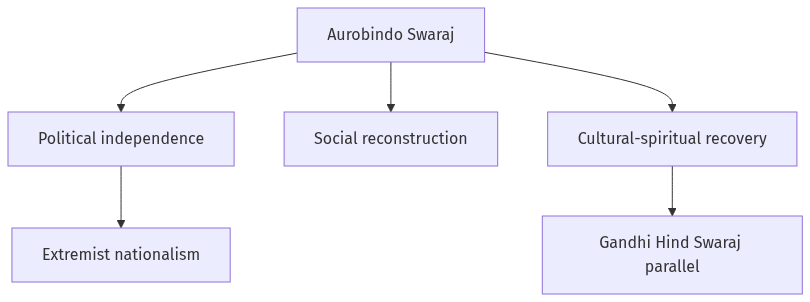
Sri Aurobindo treated swaraj as complete self-rule: political independence, social reconstruction, and a cultural-spiritual recovery of India. The idea is significant because it widened swaraj beyond a transfer of the colonial office, and because it shaped extremist politics before Gandhi’s mass satyagraha became the dominant method.
Body
Political swaraj
- In the Bande Mataram period after the 1905 Partition of Bengal, Aurobindo stated swaraj as the goal of national work, not colonial reform bit by bit.
- Passive resistance, boycott, and national education were instruments of a political will to self-rule.
- This differed from moderate constitutionalism, and it also differed from Hobbesian order under an alien sword: the nation was to be the unit of authority.
- Later, in Pondicherry, he stepped back from party office, but he did not withdraw the claim that India must be politically free.
Social and cultural swaraj
- Political freedom without social freedom would be incomplete. Caste rigidity and cultural imitation of Europe were named as inner bonds.
- Swaraj included a recovery of Indian spiritual resources, not as museum piety, but as a basis for a new public life.
- Aurobindo’s integral yoga treated the individual and the nation as fields of self-exceeding, which is a cultural theory of freedom, not only a legal one.
- Post-colonial theory’s attack on Eurocentrism finds an early Indian statement here: Europe is not the measure of the political good.
- Compared with Mill’s individuality, Aurobindo’s person is spiritual and civilisational, not only a chooser of tastes.
Historical significance and limits
- The idea fed the extremist stream of the Congress, national education, and the language of complete independence before 1929’s Lahore resolution made purna swaraj the Congress creed.
- Gandhi’s Hind Swaraj (1909) also rejected a merely English swaraj of railways and parliaments; both men tied freedom to civilisation, by different methods.
- Ambedkar judged spiritualised nation-talk against the civil liberty of the depressed classes; Aurobindo’s cultural swaraj does not by itself abolish graded inequality.
- Rawls and Dahl would still require rights and contestation inside any spiritually described nation, or swaraj becomes only a new centre of unaccountable power.
- The analysis therefore grants depth in anti-colonial political culture, and it requires constitutional limits that Aurobindo’s early nationalism did not fully specify.
Flow diagram
Conclusion
- Aurobindo’s swaraj is significant as a three-fold claim: political independence, social reconstruction, and cultural-spiritual self-rule. It marked extremist nationalism and later Indian self-understanding. Gandhi shared the civilisational widening; Ambedkar and constitutional democracy supply the civil-liberty test it still needs.
Quick related
Students also ask
-
Affirmative action.
Next question on this syllabus topic (2021 · Q1(b)). View answer →
-
Is Aurobindo’s swaraj the same as Gandhi’s?
Both reject a merely administrative transfer of power. Gandhi organised mass satyagraha and the constructive village programme; Aurobindo’s later work is yogic and civilisational more than organisational.
-
Does cultural swaraj replace the Constitution?
No. Cultural self-respect is a historical force. Public power in India is still bound by the Constitution’s rights and procedures.
Same topic · past papers
UPSC has asked this before
These previous-year questions sit on the same topic. Open one to practise the earlier ask.
-
2024 · Q3(a) · PSIR GS 1 · 20 marks
The debate on human rights is caught between the limitations of both universalism and cultural relativism. Comment. -
2022 · Q1(b) · PSIR GS 1 · 10 marks
Cultural Relativism. -
2021 · Q5(b) · PSIR GS 1 · 10 marks
"The Constitution makers faced the great task of forging a common national identity in the face of unparalleled social and cultural diversity in India." Comment.
More from this topic
Q6(a) · UPSC Mains 2026 · PSIR GS 1 · 20 marks · Solution
From passive resistors to armed revolutionaries, the Indian Freedom Struggle has a strong imprint of women freedom fighters. Elucidate
Equality
- Sarala Devi and Swarnakumari Devi led early cultural resistance and indigenous industry promotion during the Swadeshi movement. - Organizations like Bharat Stree Mahamandal successfully bridged private domestic spaces with active nationalist mobilization. - Sarojini Naidu, Kamaladevi Chattopadhyay, and thousands of women spearheaded picketing and salt manufacturing during Gandhian Satyagrahas. - Aruna Asaf Ali and Usha Mehta sustained underground networks and secret radio broadcasts during the 1942 Quit India Movement. - Kalpana Datta and Pritilata Waddedar shattered stereotypes by orchestrating armed raids alongside Surya Sen in Bengal. - Bina Das demonstrated supreme sacrifice by firing at the Governor of Bengal during her university convocation ceremony. - This comprehensive spectrum of resistance permanently redefined citizenship and secured constitutional gender equality in independent India.
Q4(b) · UPSC Mains 2026 · PSIR GS 1 · 15 marks · Solution
What is capability approach? Elaborate the distinctive features of the capability theory of equality
Equality
The capability approach, pioneered by Amartya Sen and expanded by Martha Nussbaum, shifts the metric of justice from mere resource distribution or utility maximisation to what individuals are actually able to do and be. Its distinctive features include a focus on substantive freedom, distinguishing between functionings and capabilities, and accommodating human diversity through conversion factors. Unlike resource-based egalitarianism, it recognises that individuals vary greatly in turning resources into valuable lives. In practice, this theory underpins modern human development paradigms, including the UNDP Human Development Index, shifting policy focus toward universal capabilities like health, education, and political agency.
Q7(a) · UPSC Mains 2024 · PSIR GS 1 · 20 marks · Solution
Discuss the contribution of the Dalit struggle to establish egalitarianism in Indian society during the freedom movement.
Equality
Egalitarianism in India had to mean equal personhood against caste as graded inequality, not only against colonial rule. Dalit movements, from Phule’s legacy to Mahad, temple entry, and the Scheduled Castes Federation, made water, roads, worship, schools, and representation into national issues. Ambedkar and Gandhi clashed over separate electorates and the Poona Pact, which is itself part of the contribution: two models of equality entered public argument. The Constituent Assembly’s abolition of untouchability and equality articles are institutional fruits of that struggle. The contribution is the establishment of equal citizenship as a founding principle; social egalitarianism remained an unfinished task at Independence.