
Revision summary
Democratic citizenship is equal civil and political standing; liberty is freedom from arbitrary interference and the chance to use that standing. Marshall’s social rights and Rawls’s fair opportunity and difference principle treat economic conditions as part of justice, not as a private afterthought. Marx and Ambedkar warn that political equality on a base of class and caste inequality is unstable and often empty. Indian Directive Principles, reservations, and Minerva Mills show the constitutional attempt to keep rights and socio-economic justice together. Economic equality in this argument is a floor against domination, not a demand to trade away equal basic liberties.
Model answer
Copper italics in this answer — like this — are the key facts. Each one is unpacked in the Facts & figures rail.
Introduction
- Democratic citizenship promises equal standing: the same vote, the same basic rights, the same claim to be heard. Liberty promises that this standing is not an empty title, but a space in which citizens can act without arbitrary interference. Economic inequality changes both. It can turn equal citizenship into a form and liberty into a privilege of those who can afford to use it.
Body
Equality of citizenship and liberty
T. H. Marshall distinguished civil, political, and social rights. Equal citizenship in a democracy is first civil and political: Locke’s person under law, the franchise, association. Liberty here is both negative — not being arbitrarily jailed or censored — and the positive capacity to take part. Isaiah Berlin warned against crushing negative liberty in the name of a single real self. John Rawls answered by giving equal basic liberties lexical priority, then adding fair equality of opportunity and the difference principle so that liberty is not formal only.
How economic equality enters
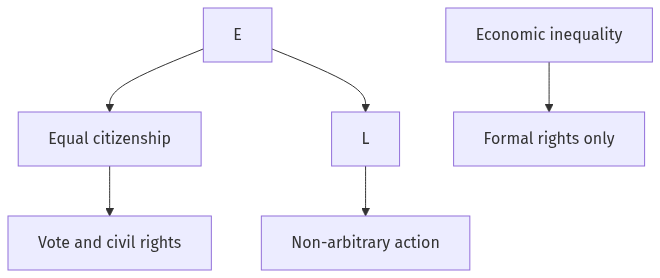
If income, land, and education are concentrated, the poor citizen has the vote and little time, counsel, or media to use it. Campaign finance, unpaid care, and bonded labour show the point. Marx called bourgeois liberty the liberty of the property owner. Ambedkar insisted that political democracy cannot last on a base of social and economic inequality. India’s Directive Principles, reservations, and land-reform attempts are constitutional admissions of that fact.
Economic equality need not mean identical incomes. It means a floor and a check on domination: the least advantaged can still be citizens in Rawls’s sense. Without that, equality of citizenship and liberty pull apart. The rich enjoy both; the poor are equal on paper and unfree in the market and the village.
Minerva Mills treated the harmony of Fundamental Rights and Directive Principles as part of the basic structure. That judicial line is a comment on this question: liberty of citizens and socio-economic justice are not two unrelated lists.
Flow diagram
Conclusion
Equality of democratic citizenship and liberty of citizens support each other when economic inequality is limited enough that rights can be used. Extreme economic inequality makes citizenship formal and liberty unequal. Rawls, Marshall, Ambedkar, and the Indian pairing of rights with directive principles all state that relation. The comment is therefore an agreement with the given statement, with the caveat that economic equality is a condition of effective liberty, not a licence to abolish basic rights.
Quick related
Students also ask
-
Discuss the contribution of the Dalit struggle to establish egalitarianism in Indian society during the freedom movement.
Next question on this syllabus topic (2024 · Q7(a)). View answer →
-
Does this mean liberty must wait until incomes are equal?
No. Rawls forbids sacrificing basic liberties for growth. It means economic arrangements must not make those liberties unusable for the worst-off.
-
How does caste fit?
Ambedkar treated caste as a structure of graded inequality that economic class analysis alone does not capture. Equal citizenship requires social as well as economic reform.
Same topic · past papers
UPSC has asked this before
These previous-year questions sit on the same topic. Open one to practise the earlier ask.
-
2024 · Q3(b) · PSIR GS 1 · 15 marks
Deliberative democracy seeks to promote democratic decision making about public issues among the citizens. Discuss. -
2023 · Q7(b) · PSIR GS 1 · 15 marks
The main goal of the Fundamental Duties in the Indian Constitution is to generate civic responsibility among the citizens. Explain
More from this topic
Q6(a) · UPSC Mains 2026 · PSIR GS 1 · 20 marks · Solution
From passive resistors to armed revolutionaries, the Indian Freedom Struggle has a strong imprint of women freedom fighters. Elucidate
Equality
- Sarala Devi and Swarnakumari Devi led early cultural resistance and indigenous industry promotion during the Swadeshi movement. - Organizations like Bharat Stree Mahamandal successfully bridged private domestic spaces with active nationalist mobilization. - Sarojini Naidu, Kamaladevi Chattopadhyay, and thousands of women spearheaded picketing and salt manufacturing during Gandhian Satyagrahas. - Aruna Asaf Ali and Usha Mehta sustained underground networks and secret radio broadcasts during the 1942 Quit India Movement. - Kalpana Datta and Pritilata Waddedar shattered stereotypes by orchestrating armed raids alongside Surya Sen in Bengal. - Bina Das demonstrated supreme sacrifice by firing at the Governor of Bengal during her university convocation ceremony. - This comprehensive spectrum of resistance permanently redefined citizenship and secured constitutional gender equality in independent India.
Q4(b) · UPSC Mains 2026 · PSIR GS 1 · 15 marks · Solution
What is capability approach? Elaborate the distinctive features of the capability theory of equality
Equality
The capability approach, pioneered by Amartya Sen and expanded by Martha Nussbaum, shifts the metric of justice from mere resource distribution or utility maximisation to what individuals are actually able to do and be. Its distinctive features include a focus on substantive freedom, distinguishing between functionings and capabilities, and accommodating human diversity through conversion factors. Unlike resource-based egalitarianism, it recognises that individuals vary greatly in turning resources into valuable lives. In practice, this theory underpins modern human development paradigms, including the UNDP Human Development Index, shifting policy focus toward universal capabilities like health, education, and political agency.
Q7(a) · UPSC Mains 2024 · PSIR GS 1 · 20 marks · Solution
Discuss the contribution of the Dalit struggle to establish egalitarianism in Indian society during the freedom movement.
Equality
Egalitarianism in India had to mean equal personhood against caste as graded inequality, not only against colonial rule. Dalit movements, from Phule’s legacy to Mahad, temple entry, and the Scheduled Castes Federation, made water, roads, worship, schools, and representation into national issues. Ambedkar and Gandhi clashed over separate electorates and the Poona Pact, which is itself part of the contribution: two models of equality entered public argument. The Constituent Assembly’s abolition of untouchability and equality articles are institutional fruits of that struggle. The contribution is the establishment of equal citizenship as a founding principle; social egalitarianism remained an unfinished task at Independence.