
Revision summary
Marx’s eleventh thesis makes Marxism a theory that must issue in action, not only in interpretation. Core principles include historical materialism, class struggle, and the critique of bourgeois property and state. Lenin added organised seizure of power; that is the strictest political form of compliance. Popper, Stalinism’s record, and later critics show the danger when strictness silences fallible inquiry. Gramsci and M. N. Roy keep Marxism as action while restoring hegemony, ethics, and the human person to the centre.
Model answer
Copper italics in this answer — like this — are the key facts. Each one is unpacked in the Facts & figures rail.
Introduction
Marxism is not only a description of class society. The eleventh thesis on Feuerbach says that philosophers have interpreted the world, and that the point is to change it. That is a political theory of action. The further claim that action must comply strictly with core principles is both a strength of discipline and a source of dogma. A comment must hold both sides.
Body
Theory of action
Karl Marx and Engels analysed capitalism as a historical mode of production: commodity, surplus value, class antagonism between bourgeoisie and proletariat. The analysis is meant to issue in praxis. The proletariat is not only an economic category. It is the agent that can abolish class by abolishing the conditions of its own existence. Lenin added organisation: a party, a seizure of the state, a dictatorship of the proletariat that is to wither. Action is therefore not optional commentary. It is the test of the theory.
Core principles, in this register, include historical materialism, class struggle, the critique of bourgeois right, and internationalism. Strict compliance means that reform which leaves exploitation intact is not the goal, and that theory is not a menu of private opinions.
The problem of strictness
If compliance becomes a closed catechism, criticism dies. Popper attacked historicism on this ground. Stalinism showed how a science of history can silence action that was supposed to emancipate. Gramsci already complicated the picture: in the West, war of position in civil society matters as much as a single insurrection. M. N. Roy later insisted on the humanistic and ethical content of Marxism against mechanical materialism and against Comintern tutelage. The New Left recovered Marx’s early writings on alienation and species-being.
So Marxism demands action guided by principles. It does not, in its best readings, demand that every later fact be forced into a 1848 sentence. Indian Marxists who entered peasant and worker struggles, and those who faced the Emergency, lived this tension between programme and circumstance.
Comment
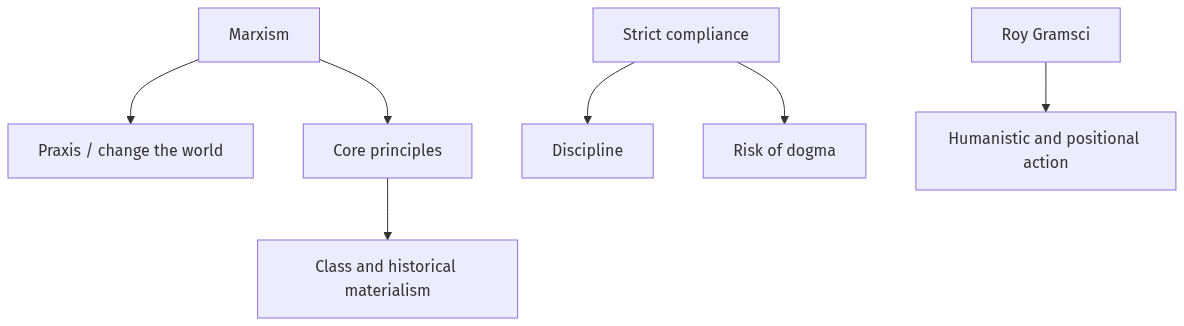
- The statement is largely true of classical Marxism: it is a theory of action, and it names principles that are not merely advisory. The comment must add that those principles include critique, including critique of the party that claims to incarnate them. Humanistic Marxism, Roy, and Gramsci keep action without treating strictness as the end of thought.
Flow diagram
Conclusion
Marxism is a political theory of action because it binds explanation to praxis and names class emancipation as the end. Core principles give that action its direction. Strict compliance becomes a vice when it forbids criticism. Roy and Gramsci show how the same tradition can keep humanistic and strategic openness without dropping the demand to act.
Quick related
Students also ask
-
The nature of relationship between equality of democratic citizenship and liberty of citizens is influenced by economic equality. Comment.
Next question on this syllabus topic (2024 · Q2(c)). View answer →
-
Is every Marxist committed to a vanguard party?
Classical Leninism is. Other Marxisms emphasise councils, hegemony in civil society, or democratic socialism. The core is still praxis toward ending class domination.
-
How does this differ from liberal reform?
Liberal reform adjusts rights and welfare inside a property order. Marxism treats that order as historical and transformable, which is why action is not only legislation.
Same topic · past papers
UPSC has asked this before
These previous-year questions sit on the same topic. Open one to practise the earlier ask.
-
2026 · Q1(a) · PSIR GS 1 · 10 marks
Resurgence of political theory. -
2025 · Q1(a) · PSIR GS 1 · 10 marks
Explain the Philosophical approach to the study of Political theory -
2025 · Q3(a) · PSIR GS 1 · 20 marks
Provide a comparative analysis of behavioural and institutional approach to the study of Political theory -
2024 · Q4(c) · PSIR GS 1 · 15 marks
Manabendra Nath Roy's political thought highlighted the humanistic aspects of Marxism. Discuss. -
2023 · Q1(e) · PSIR GS 1 · 10 marks
Decline of political theory.
More from this topic
Q6(a) · UPSC Mains 2026 · PSIR GS 1 · 20 marks · Solution
From passive resistors to armed revolutionaries, the Indian Freedom Struggle has a strong imprint of women freedom fighters. Elucidate
Equality
- Sarala Devi and Swarnakumari Devi led early cultural resistance and indigenous industry promotion during the Swadeshi movement. - Organizations like Bharat Stree Mahamandal successfully bridged private domestic spaces with active nationalist mobilization. - Sarojini Naidu, Kamaladevi Chattopadhyay, and thousands of women spearheaded picketing and salt manufacturing during Gandhian Satyagrahas. - Aruna Asaf Ali and Usha Mehta sustained underground networks and secret radio broadcasts during the 1942 Quit India Movement. - Kalpana Datta and Pritilata Waddedar shattered stereotypes by orchestrating armed raids alongside Surya Sen in Bengal. - Bina Das demonstrated supreme sacrifice by firing at the Governor of Bengal during her university convocation ceremony. - This comprehensive spectrum of resistance permanently redefined citizenship and secured constitutional gender equality in independent India.
Q4(b) · UPSC Mains 2026 · PSIR GS 1 · 15 marks · Solution
What is capability approach? Elaborate the distinctive features of the capability theory of equality
Equality
The capability approach, pioneered by Amartya Sen and expanded by Martha Nussbaum, shifts the metric of justice from mere resource distribution or utility maximisation to what individuals are actually able to do and be. Its distinctive features include a focus on substantive freedom, distinguishing between functionings and capabilities, and accommodating human diversity through conversion factors. Unlike resource-based egalitarianism, it recognises that individuals vary greatly in turning resources into valuable lives. In practice, this theory underpins modern human development paradigms, including the UNDP Human Development Index, shifting policy focus toward universal capabilities like health, education, and political agency.
Q7(a) · UPSC Mains 2024 · PSIR GS 1 · 20 marks · Solution
Discuss the contribution of the Dalit struggle to establish egalitarianism in Indian society during the freedom movement.
Equality
Egalitarianism in India had to mean equal personhood against caste as graded inequality, not only against colonial rule. Dalit movements, from Phule’s legacy to Mahad, temple entry, and the Scheduled Castes Federation, made water, roads, worship, schools, and representation into national issues. Ambedkar and Gandhi clashed over separate electorates and the Poona Pact, which is itself part of the contribution: two models of equality entered public argument. The Constituent Assembly’s abolition of untouchability and equality articles are institutional fruits of that struggle. The contribution is the establishment of equal citizenship as a founding principle; social egalitarianism remained an unfinished task at Independence.