
Revision summary
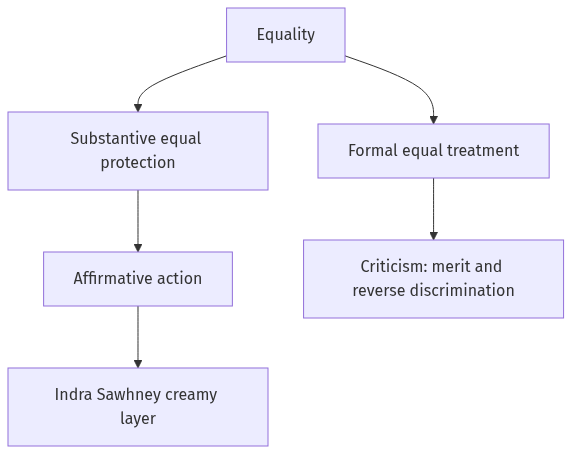
Affirmative action is a classification for historic disadvantage, authorised in India by Articles 15(4), 15(5), and 16(4). Support reads equality as equal protection and as Ambedkar’s social democracy. Criticism reads equality as identical individual treatment and points to merit, capture, and frozen identities. Indra Sawhney, Nagaraj, and the EWS amendment show the courts and Parliament working inside that split. A complete analysis of equality must hold both the case for correction and the case for review.
Model answer
Copper italics in this answer — like this — are the key facts. Each one is unpacked in the Facts & figures rail.
Introduction
Affirmative action is a set of public measures that allocate seats, jobs, or resources to groups defined by historic disadvantage. In the context of equality, support treats those measures as a means to equal citizenship. Criticism treats them as a departure from equal treatment of individuals.
Body
Equality that supports the policy
- Formal equality under Article 14 is equality before the law and equal protection. Equal protection has been read to allow reasonable classification.
- Articles 15(4), 15(5), and 16(4) expressly authorise special provisions for backward classes in education and public employment.
- Ambedkar argued that political democracy fails if social and economic inequality is left untouched; reservation was a time-bound instrument of that argument.
- John Rawls’s fair equality of opportunity and difference principle support correcting unearned disadvantage, though Rawls’s unit is the individual in a well-ordered society, not a caste as such.
- Indra Sawhney v. Union of India (1992) upheld OBC reservation, imposed a 50 per cent ceiling as a general rule, and excluded the creamy layer from OBC lists, which is equality as both group repair and individual fairness inside the group.
Equality that criticises the policy
- Critics say equality means colour-blind or caste-blind treatment of persons, in the spirit of a strict reading of Mill’s individuality and of equal protection without group ranks.
- Reverse discrimination, stagnation of merit, and capture by the better-off inside a listed class are the main charges.
- M. Nagaraj v. Union of India (2006) required the state to show backwardness, inadequacy of representation, and administrative efficiency before Scheduled Caste and Scheduled Tribe promotion quotas, a judicial attempt to keep equality of opportunity in service.
- The Constitution (One Hundred and Third Amendment) Act, 2019, and Janhit Abhiyan v. Union of India (2022) added an economically weaker section quota, which supporters call another equality tool and critics call a further departure from a single open competition.
- Communitarian writers such as Walzer can support group shares in some spheres and still worry that a caste census of every office freezes identities that justice should loosen.
Analysis
- The clash is between equality as identical treatment and equality as equal results or equal starting points.
- Support is strongest where exclusion was legal and social, as with Article 17 and untouchability, and where data show under-representation.
- Criticism is strongest where the policy has no review, no creamy-layer principle, and no companion work on schooling quality.
- A consistent equality argument keeps affirmative action, reviews lists, and protects open competition as a remaining sphere, rather than treating any one reading of equality as the whole.
Flow diagram
Conclusion
Affirmative action is criticised and supported because equality itself is split between identical treatment and corrective equal protection. Ambedkar, Rawls, and Articles 15 and 16 support correction. Individual-merit criticism and creamy-layer doctrine name the costs. The analysis is of that split, not of a single slogan of equality.
Quick related
Students also ask
-
Sri Aurobindo's idea of Swaraj has deep significance in the Indian social, political and cultural history. Analyze
Next question on this syllabus topic (2023 · Q4(c)). View answer →
-
Is reservation a violation of Article 14?
The Court has treated reasonable classification and the special-provision clauses as part of equal protection, not as a simple violation.
-
Does Rawls require caste quotas?
Rawls requires fair opportunity and concern for the least advantaged. Caste lists are one historical instrument, not the only possible one.
Same topic · past papers
UPSC has asked this before
These previous-year questions sit on the same topic. Open one to practise the earlier ask.
-
2021 · Q1(b) · PSIR GS 1 · 10 marks
Affirmative action.
More from this topic
Q6(a) · UPSC Mains 2026 · PSIR GS 1 · 20 marks · Solution
From passive resistors to armed revolutionaries, the Indian Freedom Struggle has a strong imprint of women freedom fighters. Elucidate
Equality
- Sarala Devi and Swarnakumari Devi led early cultural resistance and indigenous industry promotion during the Swadeshi movement. - Organizations like Bharat Stree Mahamandal successfully bridged private domestic spaces with active nationalist mobilization. - Sarojini Naidu, Kamaladevi Chattopadhyay, and thousands of women spearheaded picketing and salt manufacturing during Gandhian Satyagrahas. - Aruna Asaf Ali and Usha Mehta sustained underground networks and secret radio broadcasts during the 1942 Quit India Movement. - Kalpana Datta and Pritilata Waddedar shattered stereotypes by orchestrating armed raids alongside Surya Sen in Bengal. - Bina Das demonstrated supreme sacrifice by firing at the Governor of Bengal during her university convocation ceremony. - This comprehensive spectrum of resistance permanently redefined citizenship and secured constitutional gender equality in independent India.
Q4(b) · UPSC Mains 2026 · PSIR GS 1 · 15 marks · Solution
What is capability approach? Elaborate the distinctive features of the capability theory of equality
Equality
The capability approach, pioneered by Amartya Sen and expanded by Martha Nussbaum, shifts the metric of justice from mere resource distribution or utility maximisation to what individuals are actually able to do and be. Its distinctive features include a focus on substantive freedom, distinguishing between functionings and capabilities, and accommodating human diversity through conversion factors. Unlike resource-based egalitarianism, it recognises that individuals vary greatly in turning resources into valuable lives. In practice, this theory underpins modern human development paradigms, including the UNDP Human Development Index, shifting policy focus toward universal capabilities like health, education, and political agency.
Q7(a) · UPSC Mains 2024 · PSIR GS 1 · 20 marks · Solution
Discuss the contribution of the Dalit struggle to establish egalitarianism in Indian society during the freedom movement.
Equality
Egalitarianism in India had to mean equal personhood against caste as graded inequality, not only against colonial rule. Dalit movements, from Phule’s legacy to Mahad, temple entry, and the Scheduled Castes Federation, made water, roads, worship, schools, and representation into national issues. Ambedkar and Gandhi clashed over separate electorates and the Poona Pact, which is itself part of the contribution: two models of equality entered public argument. The Constituent Assembly’s abolition of untouchability and equality articles are institutional fruits of that struggle. The contribution is the establishment of equal citizenship as a founding principle; social egalitarianism remained an unfinished task at Independence.