
Revision summary
EIA is a public process: hearing, appraisal, clearance and compliance. Activists influence it through hearings, RTI, NGT or Supreme Court cases, and Forest Rights gram sabhas. Silent Valley: KSSP-led campaign stopped a Kerala hydel dam; the valley became a national park. Narmada Bachao Andolan put displacement at the centre of Sardar Sarovar; the World Bank left; the Court allowed height with rehabilitation conditions. Vedanta’s Niyamgiri mine was refused by Dongria Kondh gram sabhas after the 2013 Supreme Court order. Sterlite Tuticorin was shut by Tamil Nadu after the 2018 protests and firing over expansion and pollution.
Model answer
Copper italics in this answer — like this — are the key facts. Each one is unpacked in the Facts & figures rail.
Introduction
- An Environmental Impact Assessment is supposed to be a public argument: what a dam, a mine, a smelter or a steel plant will do to forest, river and people, and whether that cost is acceptable. NGOs and activists enter that argument with hearings, petitions, science notes and street pressure. They cannot stamp a clearance. They can delay, condition, reroute or kill a project when the record is weak or the community is unwilling.
Body
How the influence works
Under the EIA notification, a major project needs scoping, a public hearing, an appraisal and a clearance, with later compliance. Activists use the hearing to put local knowledge on the minutes. They use the Right to Information and leaked draft EIAs to show copy-paste biology. They move the National Green Tribunal and the Supreme Court when a hearing was a farce or a sacred grove was listed as wasteland. They organise gram sabhas where the Forest Rights Act requires consent. The influence is therefore procedural and political: a better EIA, a set of conditions, a refusal, or a project that dies because finance will not wait. Capture is the other side: a weak NGO can also be sued into silence, and a loud campaign can over-claim. The four cases below are ones where the public record is clear.
- Peg: Public hearing minutes and FRA gram sabhas are the lawful hooks; courts are the backstop when those hooks are skipped.
- Peg: Media and science collectives (as in Silent Valley) can change a Union Cabinet’s mind before a modern EIA code even existed.
Four cases
Silent Valley, Kerala. A State hydel project in a rainforest valley was opposed from the 1970s by the Kerala Sastra Sahitya Parishad, poets and the Save Silent Valley campaign. They argued extinction risk for a unique evergreen tract, including the lion-tailed macaque habitat. Indira Gandhi’s government stopped the dam. The area became Silent Valley National Park in the 1980s. It is the template: science plus a popular movement, before the 1994 EIA notification, still deciding a “development” outcome.
Narmada / Sardar Sarovar. The Narmada Bachao Andolan, with Medha Patkar and allied groups, used satyagraha, the Morse independent review for the World Bank, and long Supreme Court litigation to contest displacement and the height of Sardar Sarovar. The Bank stepped back. The Supreme Court eventually allowed raising the dam with rehabilitation conditions, so the activists did not “win a no-dam world”, but they forced rehabilitation onto the clearance bargain and made EIA-style social impact a national argument.
Vedanta bauxite, Niyamgiri, Odisha. Dongria Kondh Adivasis, with activists and later Amnesty and local groups, opposed Vedanta’s bauxite mine on a hill they hold sacred. The Supreme Court in 2013 required gram sabhas to decide. The sabhas refused. The mine did not go ahead. That is FRA plus EIA logic in one holding: a forest community can say no, and an appraisal that skips that no is not a real clearance.
Sterlite copper, Thoothukudi (Tuticorin), Tamil Nadu. Neighbourhood groups and environmental activists long alleged SO2 and effluent harm from Vedanta’s Sterlite smelter. After a proposed expansion, May 2018 protests met police firing and deaths. The State government ordered permanent closure. Courts have since wrestled with that order, but the EIA-expansion path was broken by mass local refusal, not by a quiet expert committee. (A parallel Odisha story is POSCO’s Jagatsinghpur steel-port plan, opposed over betel-vine land and forest clearance; the company exited. Niyamgiri remains the cleaner Supreme Court peg.)
- Peg: Silent Valley and Niyamgiri show a project stopped. Narmada shows conditions and a national debate. Sterlite shows a working plant shut after a public rupture.
- Peg: Influence is not a veto in every statute; it is the conversion of a hearing into a political fact the appraiser cannot honestly ignore.
Flow diagram
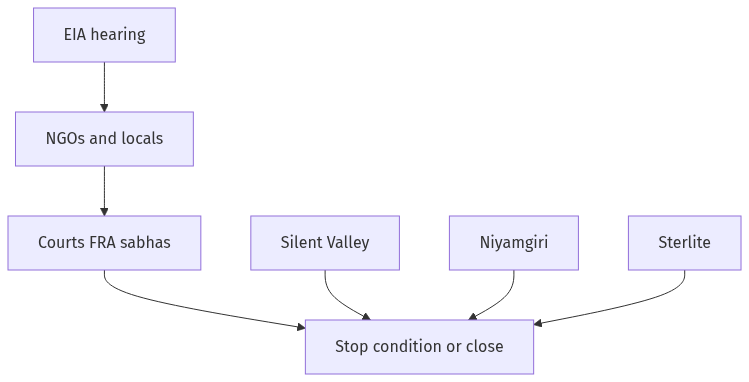
Conclusion
NGOs and activists shape EIA outcomes through hearings, FRA sabhas, courts and public cost. Silent Valley, Narmada, Niyamgiri and Sterlite Tuticorin show stoppage, conditions, community refusal and closure. A major project that treats them as noise produces a clearance that does not survive contact with the ground.
Quick related
Students also ask
-
What is oil pollution? What are its impacts on the marine ecosystem? In what way is oil pollution particularly harmful for a country like India?
Next question on this syllabus topic (2023 · Q8). View answer →
-
Can an NGO legally veto an EIA clearance?
Not as a private veto. It can make the hearing honest, sue on procedure, and, under FRA, a gram sabha can refuse forest diversion in the Niyamgiri sense.
-
Did NBA stop Sardar Sarovar?
No. It changed the terms: rehabilitation, height fights, and the exit of World Bank lending. The dam was built higher under court-set conditions.
Same topic · past papers
UPSC has asked this before
These previous-year questions sit on the same topic. Open one to practise the earlier ask.
-
2016 · Q14 · GS III · 12 marks
Rehabilitation of human settlements is one of the important environmental impacts which always attracts controversy while planning major projects. Discuss the measures suggested for mitigation of this impact while proposing major developmental projects. -
2020 · Q7 · GS III · 10 marks
How does the draft Environment Impact Assessment (EIA) Notification, 2020 differ from the existing EIA Notification, 2006?
More from this topic
Q8 · UPSC Mains 2026 · GS III · 10 marks · Solution
Discuss the aim and goals of Kunming-Montreal global biodiversity framework. Mention India's commitments and initiatives to achieve the goals and targets of this framework giving suitable examples.
Environment and Conservation
• Adopted at CBD COP15, the Kunming-Montreal Global Biodiversity Framework aims to halt and reverse biodiversity loss by 2030. • It outlines a 2050 vision of living in harmony with nature, supported by four long-term goals and 23 actionable targets. • Key global targets include the "30x30" initiative (conserving 30% of land and oceans), restoring 30% of degraded ecosystems, and cutting harmful subsidies. • India aligns its national policies by updating its National Biodiversity Action Plan (NBAP) to match the framework's 23 targets. • India supports the 30x30 goal through an extensive network of over 990 protected areas covering roughly 5.3% of its landmass. • Flagship species conservation efforts like Project Tiger, Project Elephant, and cheetah introductions drive direct ecosystem restoration. • The Biological Diversity Act, 2002 empowers grassroots conservation via local Biodiversity Management Committees and People's Biodiversity Registers.
Q18 · UPSC Mains 2025 · GS III · 15 marks · Solution
Write a review on India's climate commitments under the Paris Agreement (2015) and mention how these have been further strengthened in COP26 (2021). In this direction, how has the first Nationally Determined Contribution intended by India been updated in 2022?
Environment and Conservation
The 2015 NDC promised a 33–35 per cent cut in emissions intensity by 2030, 40 per cent non-fossil power capacity, and a large forest sink. COP26’s Panchamrit raised the political bar, including 500 GW non-fossil, a billion-tonne cut and net zero by 2070. In August 2022 India updated the NDC to 45 per cent intensity reduction and 50 per cent non-fossil installed capacity by 2030. Per-capita equity remains India’s diplomatic line. Pledges now need coal-path honesty and real forest carbon.
Q17 · UPSC Mains 2025 · GS III · 15 marks · Solution
Mineral resources are fundamental to the country's economy and these are exploited by mining. Why is mining considered an environmental hazard? Explain the remedial measures required to reduce the environmental hazard due to mining.
Environment and Conservation
Mining underpins industry but strips forest, dirties air and water, and displaces people. Open-cast coal, metal tailings, sand mining and illegal pits are the main Indian hazard types. EIA, District Mineral Foundations, scientific closure and forest rights are the legal remedies. Illegal mining needs satellite watch and police, not only a new rule. Some deposits should remain unmined where ecology and consent fail.