
Revision summary
Oil pollution is crude or fuel oil released into the sea from tankers, wells, ships and ports. It blocks light, kills plankton and larvae, smothers mangroves and coral, and poisons birds and mammals. India’s risk is a long inhabited coast, Gulf-to-Asia tanker traffic, and offshore fields next to ports. Small-scale fishers have little buffer when a landing centre closes. The Indian Coast Guard runs the National Oil Spill Disaster Contingency Plan; prevention is cheaper than cleanup.
Model answer
Copper italics in this answer — like this — are the key facts. Each one is unpacked in the Facts & figures rail.
Introduction
Oil pollution is the release of crude or refined petroleum into the sea, estuary, or coast in amounts that harm life and livelihood. It comes from tanker accidents, offshore wells, ship operations, ports, and pipeline leaks. For India it sits on a long coastline, a busy tanker lane, and millions of fishers.
Body
What oil pollution is
- A slick of crude or fuel oil on the surface; dissolved fractions in the water column; tar balls on beaches; and chronic low-level discharge from shipping and ports.
- Large events are tanker wrecks and blowouts; the daily load is often bilge, bunkering and port runoff.
Impacts on the marine ecosystem
- Surface oil blocks light and gas exchange; it coats plankton, which are the base of the food web.
- Fish eggs and larvae in the upper water die or deform; adult stocks fall after a lag.
- Mangroves, salt marsh and coral smother; recovery takes years because oil sticks to sediment.
- Birds and marine mammals lose insulation and ingest oil while preening.
- Microbial breakdown raises biochemical oxygen demand and can create local hypoxia.
- Persistent polycyclic aromatic hydrocarbons cause long-term toxicity and taint seafood.
Why particularly harmful for India
- India has about 7,500 km of mainland and island coastline and a large Exclusive Economic Zone in a crowded Indian Ocean tanker route from the Gulf to East Asia.
- Mumbai High and other offshore fields, plus major ports (Mumbai, Kandla, Chennai, Visakhapatnam, Kochi), concentrate spill risk next to dense coasts.
- Sundarbans, Gulf of Mannar, Palk Bay, Gulf of Kachchh and Kerala backwaters combine high biodiversity with fishing and salt-making.
- A very large small-scale fishery has almost no buffer if a slick closes a landing centre for weeks.
- Monsoon winds and currents can beach oil on densely inhabited strands quickly.
- The National Oil Spill Disaster Contingency Plan, with the Indian Coast Guard as central coordinating authority, is the response frame; prevention at ports and tankers remains the cheaper defence.
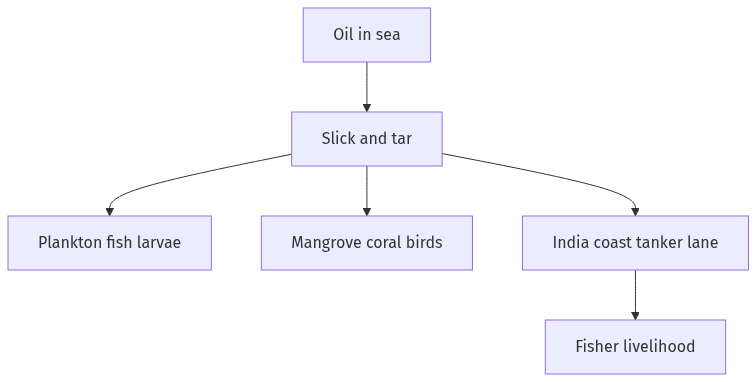
Flow diagram
Conclusion
Oil pollution is petroleum in the sea at harmful levels. It smothers plankton, fish nursery grounds, mangroves, coral and birds. India is exposed because of its tanker lane, offshore oil, long inhabited coast and fisher dependence. Coast Guard contingency plans must sit with port and shipping discipline.
Quick related
Students also ask
-
The adoption of electric vehicles is rapidly growing worldwide. How do electric vehicles contribute to reducing carbon emissions and what are the key benefits they offer compared to traditional combustion engine vehicles?
Next question on this syllabus topic (2023 · Q15). View answer →
-
Is a tanker wreck the only oil pollution?
No. Chronic bilge, bunkering and port leaks often add more oil over a year than one famous wreck.
-
Why are mangroves slow to recover?
Oil sticks to roots and mud. Trees die, and the nursery function for fish is lost for years.
Same topic · past papers
UPSC has asked this before
These previous-year questions sit on the same topic. Open one to practise the earlier ask.
More from this topic
Q8 · UPSC Mains 2026 · GS III · 10 marks · Solution
Discuss the aim and goals of Kunming-Montreal global biodiversity framework. Mention India's commitments and initiatives to achieve the goals and targets of this framework giving suitable examples.
Environment and Conservation
• Adopted at CBD COP15, the Kunming-Montreal Global Biodiversity Framework aims to halt and reverse biodiversity loss by 2030. • It outlines a 2050 vision of living in harmony with nature, supported by four long-term goals and 23 actionable targets. • Key global targets include the "30x30" initiative (conserving 30% of land and oceans), restoring 30% of degraded ecosystems, and cutting harmful subsidies. • India aligns its national policies by updating its National Biodiversity Action Plan (NBAP) to match the framework's 23 targets. • India supports the 30x30 goal through an extensive network of over 990 protected areas covering roughly 5.3% of its landmass. • Flagship species conservation efforts like Project Tiger, Project Elephant, and cheetah introductions drive direct ecosystem restoration. • The Biological Diversity Act, 2002 empowers grassroots conservation via local Biodiversity Management Committees and People's Biodiversity Registers.
Q18 · UPSC Mains 2025 · GS III · 15 marks · Solution
Write a review on India's climate commitments under the Paris Agreement (2015) and mention how these have been further strengthened in COP26 (2021). In this direction, how has the first Nationally Determined Contribution intended by India been updated in 2022?
Environment and Conservation
The 2015 NDC promised a 33–35 per cent cut in emissions intensity by 2030, 40 per cent non-fossil power capacity, and a large forest sink. COP26’s Panchamrit raised the political bar, including 500 GW non-fossil, a billion-tonne cut and net zero by 2070. In August 2022 India updated the NDC to 45 per cent intensity reduction and 50 per cent non-fossil installed capacity by 2030. Per-capita equity remains India’s diplomatic line. Pledges now need coal-path honesty and real forest carbon.
Q17 · UPSC Mains 2025 · GS III · 15 marks · Solution
Mineral resources are fundamental to the country's economy and these are exploited by mining. Why is mining considered an environmental hazard? Explain the remedial measures required to reduce the environmental hazard due to mining.
Environment and Conservation
Mining underpins industry but strips forest, dirties air and water, and displaces people. Open-cast coal, metal tailings, sand mining and illegal pits are the main Indian hazard types. EIA, District Mineral Foundations, scientific closure and forest rights are the legal remedies. Illegal mining needs satellite watch and police, not only a new rule. Some deposits should remain unmined where ecology and consent fail.