
Revision summary
The 2015 NDC promised a 33–35 per cent cut in emissions intensity by 2030, 40 per cent non-fossil power capacity, and a large forest sink. COP26’s Panchamrit raised the political bar, including 500 GW non-fossil, a billion-tonne cut and net zero by 2070. In August 2022 India updated the NDC to 45 per cent intensity reduction and 50 per cent non-fossil installed capacity by 2030. Per-capita equity remains India’s diplomatic line. Pledges now need coal-path honesty and real forest carbon.
Model answer
Copper italics in this answer — like this — are the key facts. Each one is unpacked in the Facts & figures rail.
Introduction
India’s Nationally Determined Contribution (NDC) under the Paris Agreement (2015) established a low-carbon development pathway while emphasising equity, CBDR and development space. These commitments were strengthened through the Panchamrit announced at COP26 and formally incorporated into the updated NDC in 2022.
Body
Paris Agreement, 2015 — India’s first NDC
- Emissions intensity: Reduce emissions intensity of GDP by 33–35% by 2030 from 2005 levels.
- Example: Greater energy efficiency and expansion of renewable energy help reduce emissions generated per unit of economic output.
- Non-fossil electricity capacity: Achieve about 40% of cumulative installed electric power capacity from non-fossil sources by 2030.
- Example: Expansion of solar and wind power forms the major pathway towards this target.
- Carbon sink: Create an additional 2.5–3 billion tonnes of CO₂-equivalent carbon sink through additional forest and tree cover by 2030.
- Example: Afforestation and restoration of degraded forests can enhance India’s land-based carbon sink.
- Equity and development: India linked climate action with CBDR, climate justice and per-capita equity, arguing that developing countries require adequate development space.
- Example: India’s relatively low per-capita emissions remained an important consideration in its climate diplomacy.
COP26, 2021 — Panchamrit
- 500 GW non-fossil capacity: India announced a target of achieving 500 GW of non-fossil electricity capacity by 2030.
- Example: Large-scale expansion of solar, wind, hydro and other non-fossil capacity is required to reach the target.
- 50% energy requirements from renewables: India announced that 50% of its energy requirements would come from renewable sources by 2030.
- Example: Rapid growth of renewable-energy generation and associated transmission infrastructure supports this ambition.
- One billion tonnes of emissions reduction: Reduce projected carbon emissions by 1 billion tonnes by 2030.
- Example: Greater renewable deployment, energy efficiency and cleaner mobility can contribute to the reduction.
- 45% carbon-intensity reduction: Reduce the carbon intensity of the economy by 45% by 2030.
- Example: Decarbonisation of industry and power generation can lower emissions intensity while economic output continues to grow.
- Net Zero 2070: India announced its long-term goal of achieving net-zero emissions by 2070.
- Example: The target provides a long-term direction for India’s transition towards a low-carbon economy.
Updated NDC, 2022
- Higher emissions-intensity target: In August 2022, India formally updated its NDC, raising the 2030 emissions-intensity reduction target from 33–35% to 45% below 2005 levels.
- Example: This formally incorporated the enhanced ambition announced at COP26 into India’s Paris commitments.
- Higher non-fossil capacity target: The target for non-fossil sources was raised from 40% to 50% of cumulative electric power installed capacity by 2030.
- Example: Continued expansion of renewable and other non-fossil electricity capacity supports this target.
- Carbon sink retained: The commitment to create an additional 2.5–3 billion tonnes of CO₂-equivalent carbon sink through forest and tree cover remained part of India’s climate architecture.
- Example: Forest restoration and additional tree cover remain important for strengthening the land-based carbon sink.
- Mission LiFE: The updated NDC incorporated Mission LiFE (Lifestyle for Environment), emphasising sustainable consumption and citizen participation in climate action.
- Example: Promoting resource-efficient lifestyles can complement technology- and policy-led emission reductions.
Flow diagram
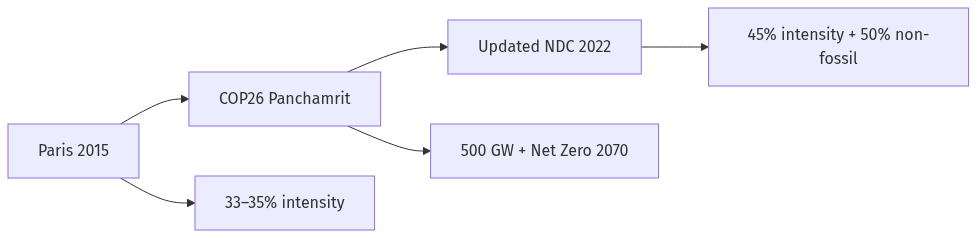
Conclusion
India’s climate trajectory shows a progressive strengthening of ambition—from the 2015 NDC to the Panchamrit at COP26 and its formal incorporation into the 2022 NDC. The challenge now is to translate these commitments into credible implementation while balancing energy security, development needs and climate justice.
Quick related
Students also ask
-
Industrial pollution of river water is a significant environmental issue in India. Discuss the various mitigation measures to deal with this problem and also the government's initiative in this regard.
Next question on this syllabus topic (2024 · Q7). View answer →
-
Is 50 per cent capacity the same as 50 per cent generation?
No. Capacity is megawatts installed. Generation is units produced; coal plants still run more hours.
-
Did Paris bind India to a carbon budget?
Paris is pledge-and-review. India’s NDC is nationally determined, then internationally recorded.
Same topic · past papers
UPSC has asked this before
These previous-year questions sit on the same topic. Open one to practise the earlier ask.
More from this topic
Q8 · UPSC Mains 2026 · GS III · 10 marks · Solution
Discuss the aim and goals of Kunming-Montreal global biodiversity framework. Mention India's commitments and initiatives to achieve the goals and targets of this framework giving suitable examples.
Environment and Conservation
• Adopted at CBD COP15, the Kunming-Montreal Global Biodiversity Framework aims to halt and reverse biodiversity loss by 2030. • It outlines a 2050 vision of living in harmony with nature, supported by four long-term goals and 23 actionable targets. • Key global targets include the "30x30" initiative (conserving 30% of land and oceans), restoring 30% of degraded ecosystems, and cutting harmful subsidies. • India aligns its national policies by updating its National Biodiversity Action Plan (NBAP) to match the framework's 23 targets. • India supports the 30x30 goal through an extensive network of over 990 protected areas covering roughly 5.3% of its landmass. • Flagship species conservation efforts like Project Tiger, Project Elephant, and cheetah introductions drive direct ecosystem restoration. • The Biological Diversity Act, 2002 empowers grassroots conservation via local Biodiversity Management Committees and People's Biodiversity Registers.
Q17 · UPSC Mains 2025 · GS III · 15 marks · Solution
Mineral resources are fundamental to the country's economy and these are exploited by mining. Why is mining considered an environmental hazard? Explain the remedial measures required to reduce the environmental hazard due to mining.
Environment and Conservation
Mining underpins industry but strips forest, dirties air and water, and displaces people. Open-cast coal, metal tailings, sand mining and illegal pits are the main Indian hazard types. EIA, District Mineral Foundations, scientific closure and forest rights are the legal remedies. Illegal mining needs satellite watch and police, not only a new rule. Some deposits should remain unmined where ecology and consent fail.
Q13 · UPSC Mains 2025 · GS III · 15 marks · Solution
Examine the factors responsible for depleting groundwater in India. What are the steps taken by the government to mitigate such depletion of groundwater?
Environment and Conservation
Most Indian irrigation still leans on groundwater, so a falling table is a farm and drinking-water crisis. Free farm power and paddy-wheat in the northwest are the classic drivers, with urban wells and weak licensing close behind. CGWB maps show over-exploited blocks across several States. Atal Bhujal, Jal Shakti Abhiyan, micro-irrigation and aquifer mapping are the main public replies. Without metering and crop change, recharge structures only delay the fall.