
Revision summary
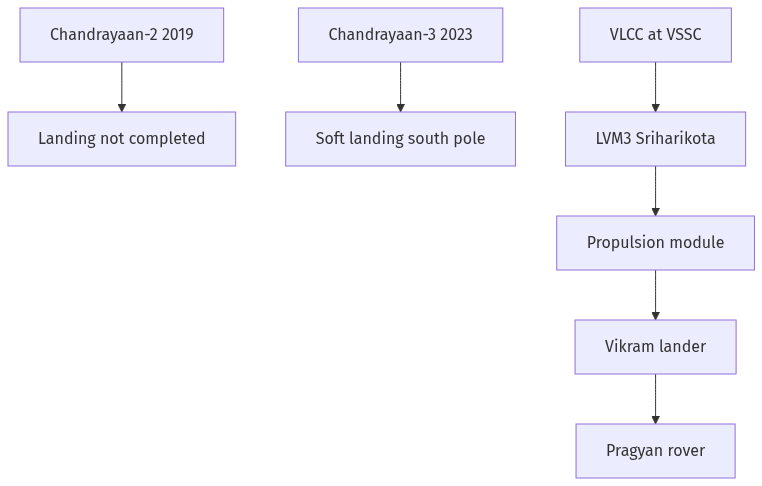
Chandrayaan-3’s main unfinished task from Chandrayaan-2 was a soft landing and rover work on the Moon. The United States, the USSR/Russia, and China had already soft-landed; India became the fourth, and the first near the south pole, on 23 August 2023. The stack was LVM3, a propulsion module, lander Vikram, and rover Pragyan. Lander and rover carried thermophysical, seismic, ionosphere, and chemistry instruments. The Virtual Launch Control Centre at VSSC let Thiruvananthapuram teams monitor the Sriharikota countdown remotely.
Model answer
Copper italics in this answer — like this — are the key facts. Each one is unpacked in the Facts & figures rail.
Introduction
Chandrayaan-3 in 2023 was India’s third Moon mission. Its main task was a soft landing and rover operations on the lunar surface — the step that Chandrayaan-2’s Vikram lander did not complete in 2019. On 23 August 2023 the new Vikram landed near the south pole. Only a few countries had done a soft landing before India.
Body
The task not achieved earlier
- Chandrayaan-1 (2008) orbited and impacted; it did not soft-land.
- Chandrayaan-2 (2019) placed an orbiter successfully; the Vikram lander crashed in the terminal descent.
- Chandrayaan-3 therefore flew a propulsion module, lander, and rover without a new orbiter (the Chandrayaan-2 orbiter still supported communication). The unachieved task was soft landing and surface science.
Countries that had already achieved it
- United States: Surveyor and Apollo landers.
- Soviet Union / Russia: Luna landers.
- China: Chang’e landers.
- India became the fourth country to soft-land, and the first to do so in the south polar region (a first among all, not only among those three).
Subsystems of the launched spacecraft
- Launch vehicle: Launch Vehicle Mark-3 (LVM3) from Satish Dhawan Space Centre, Sriharikota (14 July 2023).
- Propulsion module: carries the lander-rover stack from Earth orbit toward the Moon, then stays in lunar orbit; it also carried the SHAPE spectro-polarimeter for Earth observation.
- Lander (Vikram): legs, throttleable engines, navigation cameras, altimeters and velocity sensors, hazard-detection cameras, and payloads such as Chandra's Surface Thermophysical Experiment (ChaSTE), Instrument for Lunar Seismic Activity (ILSA), and Radio Anatomy of Moon Bound Hypersensitive Ionosphere and Atmosphere (RAMBHA); a NASA laser retroreflector was also on the lander.
- Rover (Pragyan): six wheels; Laser-Induced Breakdown Spectroscope and Alpha Particle X-ray Spectrometer to read surface chemistry.
- Guidance, propulsion, thermal control, and deep-space communication complete the stack.
Virtual Launch Control Centre at VSSC
- The Virtual Launch Control Centre (VLCC) at Vikram Sarabhai Space Centre (VSSC), Thiruvananthapuram, lets launch teams monitor and participate in countdown remotely while the vehicle lifts from Sriharikota.
- For Chandrayaan-3 it cut the need for every specialist to travel to the range, kept a second set of eyes on telemetry, and linked design teams at VSSC to the live launch. It contributed to a clean LVM3 launch, which is the first link in a landing that happens weeks later.
Flow diagram
Conclusion
Chandrayaan-3’s core task was the soft landing Chandrayaan-2 missed. The United States, the Soviet Union/Russia, and China had already landed. Vikram, Pragyan, and the propulsion module did the 2023 job near the south pole. The Virtual Launch Control Centre at VSSC backed the Sriharikota launch from Thiruvananthapuram.
Quick related
Students also ask
-
The increase in life expectancy in the country has led to newer health challenges in the community. What are those challenges and what steps need to be taken to meet them ?
Next question on this syllabus topic (2022 · Q5). View answer →
-
Did Chandrayaan-3 fly a new orbiter?
No. It used a propulsion module plus lander and rover. The Chandrayaan-2 orbiter still helped with communication.
-
Was India the first country to land on the Moon?
No. It was the fourth to soft-land, and the first to soft-land in the south polar region.
Same topic · past papers
UPSC has asked this before
These previous-year questions sit on the same topic. Open one to practise the earlier ask.
More from this topic
Q17 · UPSC Mains 2026 · GS III · 15 marks · Solution
What are the challenges to solid waste management in India? Discuss the governmental policy framework on solid waste management. Discuss the success/failure cases of Delhi and Indore cities highlighting the salient features of their solid waste management initiatives.
Indian Economy
• Rapid urbanization has made solid waste management a critical environmental and public health crisis in India. • Key challenges include lack of source segregation, inadequate processing infrastructure, reliance on unprotected informal workers, and financially weak urban local bodies. • The policy framework relies on the SWM Rules 2016, Swachh Bharat Mission (Urban), and Plastic Waste Management Rules 2016. • Indore succeeded through 100% source segregation, zero dump-site remediation, and strict enforcement with digital monitoring. • Delhi failed due to overloaded legacy landfills (Ghazipur, Bhalswa), lack of decentralization, and fragmented municipal governance. • A successful transition requires moving to a circular economy focused on source segregation, decentralized processing, and polluter accountability.
Q16 · UPSC Mains 2026 · GS III · 15 marks · Solution
What is Agentic Artificial Intelligence (AI)? Explain its working. Describe its applications with suitable examples. Discuss the advantages, risks and challenges associated with agentic AI systems.
Indian Economy
Agentic Artificial Intelligence represents an advanced paradigm where AI systems operate with autonomy, setting goals and executing complex workflows without constant human prompts. Unlike traditional generative AI that merely responds to queries, agentic AI uses perception, planning, memory, and tool-use to achieve multi-step objectives. Its applications span across autonomous software engineering, supply chain optimization, and automated financial trading. While offering massive productivity gains and dynamic problem-solving, these systems pose significant risks including lack of transparency, alignment failures, security vulnerabilities, and ethical dilemmas. Governance frameworks and robust guardrails are essential to harness their potential safely.
Q15 · UPSC Mains 2026 · GS III · 15 marks · Solution
Mention salient features of 'Mission Drishti'. Discuss the imaging techniques used in the satellite launched on 3rd May 2026. Why is it being considered world's first satellite of its kind?
Indian Economy
Mission Drishti represents a major leap in India's space-based Earth observation capabilities, launched on 3rd May 2026. The mission employs advanced multi-spectral and hyperspectral imaging techniques to capture high-resolution data across various atmospheric and terrestrial layers. It is hailed as a global first due to its unique integration of real-time onboard edge computing with quantum encryption for secure data transmission. The satellite significantly enhances resource management, disaster response, and strategic surveillance. It aligns with India's policy of leveraging space technology for sustainable development and national security.