
Revision summary
Successful land reform needed political will, peasant organisation and records that named the tiller. West Bengal’s Operation Barga and Kerala’s occupancy reforms are the standard successful cases; early J&K also went far on ceilings. Zamindari abolition was wide; ceiling and tenancy security were not. Benami, litigation and informal tenancy explain failure in much of the heartland. A gazette cannot substitute for a union and a mutation register.
Model answer
Copper italics in this answer — like this — are the key facts. Each one is unpacked in the Facts & figures rail.
Introduction
Land reform after Independence had a national statute book and a very uneven map. Zamindari abolition was wide. Ceiling, tenancy security and redistribution succeeded only where a government wanted them and a peasantry could push. West Bengal, Kerala and, in an earlier generation, Jammu and Kashmir are the usual successful parts. Large belts of the Hindi heartland show what happens when the same laws meet a weak field staff and a strong landlord.
Body
What “success” actually required
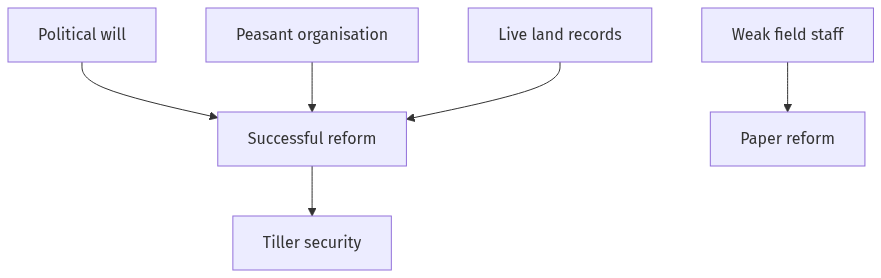
Land reform is not a gazette notification. It is a change of who owns and who can stay on the field. Where it worked, political will came first: a party whose cadre lived among tenants, not among absentee owners. Peasant organisation — bargadars in Bengal, agrarian unions in Kerala — supplied the names that the revenue office would otherwise never record. Land records that named the tiller were the next tool; without a record of rights, a ceiling law is paper. A reasonably honest revenue administration, and courts that did not stay every mutation forever, completed the kit. Literacy and a left public culture helped tenants know the law. Redistribution was easier where holdings were already mapped and where plantation or zamindari titles were legally clear enough to extinguish.
- Peg: West Bengal’s Operation Barga recorded sharecroppers so they could not be thrown off at will.
- Peg: Kerala’s land reforms under the first E.M.S. Namboodiripad government and later statutes transferred occupancy and limited remaining landlord rent.
Why only some parts
Jammu and Kashmir’s early post-1947 reforms, including a sharp ceiling, went further than most princely areas because the new State leadership treated landlordism as a political enemy. Elsewhere, benami transfers, gift to relatives, and litigation ate ceiling surplus. In much of Bihar, eastern UP and parts of Andhra, tenancy hid as “labour” and records stayed with the powerful. Green Revolution Punjab achieved peasant prosperity more through owner-cultivation and irrigation than through classic ceiling redistribution. Success was therefore a bundle: organisation plus records plus a government that would take on its own landed class. Copying a Bengal circular in a district without a peasant union does not copy Bengal.
- Peg: National zamindari abolition removed intermediaries; it did not, by itself, give the tiller a title.
- Peg: Where land reform stalled, tenancy went informal, which still blocks credit and investment on that plot.
Flow diagram
Conclusion
Land reforms worked where political will, peasant unions and live records met. West Bengal, Kerala and early Jammu and Kashmir show the bundle. The rest of the map shows that a law without that bundle remains a file.
Quick related
Students also ask
-
State the objectives and measures of land reforms in India. Discuss how land ceiling policy on landholding can be considered as an effective reform under economic criteria.
Next question on this syllabus topic (2023 · Q4). View answer →
-
Did land reform succeed all over India?
No. Intermediary abolition was wide. Redistribution and tenancy security were regional.
-
Is computerising records enough now?
It helps. It cannot, by itself, undo an informal tenancy that was never entered on the old page.
Same topic · past papers
UPSC has asked this before
These previous-year questions sit on the same topic. Open one to practise the earlier ask.
-
2015 · Q20 · GS III · 12 marks
Considering the threats cyberspace poses for the country, India needs a "Digital Armed Forces" to prevent crimes. Critically evaluate the National Cyber Security Policy, 2013 outlining the challenges perceived in its effective implementation. -
2026 · Q4 · GS III · 10 marks
Explain the factors responsible for inefficiency of agri-produce marketing. How does e-commerce help to reduce inefficiency of agri-produce marketing? Explain. -
2025 · Q13 · GS III · 15 marks
Examine the factors responsible for depleting groundwater in India. What are the steps taken by the government to mitigate such depletion of groundwater? -
2020 · Q13 · GS III · 15 marks
What are the major factors responsible for making rice-wheat system a success? In spite of this success how has this system become bane in India? -
2017 · Q18 · GS III · 15 marks
On December 2004, tsumani brought havoc on 14 countries including India. Discuss the factors responsible for occurrence of Tsunami and its effects on life and economy. In the light of guidelines of NDMA (2010) describe the mechanisms for preparedness to reduce the risk during such events.
More from this topic
Q4 · UPSC Mains 2023 · GS III · 10 marks · Solution
State the objectives and measures of land reforms in India. Discuss how land ceiling policy on landholding can be considered as an effective reform under economic criteria.
Land Reforms
Objectives were to end intermediaries, secure tenants, redistribute surplus, consolidate plots, and fix records. Measures included zamindari abolition, tenancy laws, ceiling statutes, Bhoodan, consolidation, and digital land records. A ceiling helps the economy if land moves to tillers and output and credit rise. It fails if plots become uneconomic or surplus stays benami. Legal leasing, records and a credit-water package make ceiling an economic reform, not only a slogan.
Q9 · UPSC Mains 2016 · GS III · 12 marks · Solution
Discuss the role of land reforms in agricultural development. Identify the factors that were responsible for the success of land reforms in India.
Land Reforms
Land reforms assign secure rights to the tiller, which raises investment, credit and the social base of farming. Abolition of intermediaries worked more widely than ceiling redistribution. Tenancy security and consolidation support irrigation and technology use. Success factors were political will, peasant organisation, usable records and complementary irrigation. Failure came from benami evasion, concealed tenancy and slow courts.